
ByteDance's PICO Space Pro to Launch Dec.12 With World Model
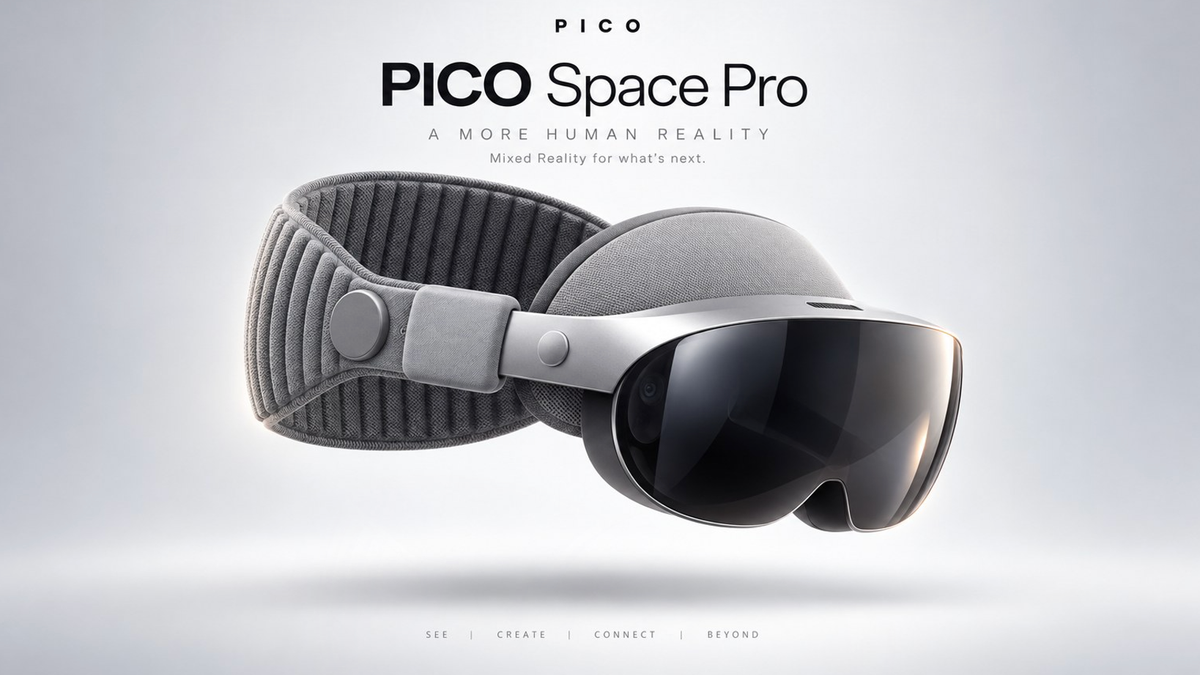
ByteDance's PICO unit is targeting December 12, 2026—China's "Double 12" shopping festival—to launch the Space Pro mixed-reality headset alongside a proprietary AI world model, according to supply-chain intelligence and recruitment filings reviewed by AR Circle, positioning the company for its most consequential hardware bet since entering the XR market.
The timing crystallizes a strategic pivot that has been building for months: hardware is ready, supply chains are loaded, and the delay since a scrubbed September 2 launch date has been spent racing to close the gap with Google LLC's world-model ambitions. ByteDance's window, however, is narrowing—Google released Genie 4 on October 27, 2026, just 11 days after a Titanium Media report first surfaced ByteDance's plan to build a competing real-time spatial-video generation model targeting Genie 3, which is now already one generation old.
Initial market read: industry contacts confirm that assembler Goertek Inc. and MicroOLED supplier Seeya Technology Co. have completed inventory build for the device. The supply chain has effectively been on standby since September.
Recruitment Patterns Confirm Dec. 12 Countdown
Consumer electronics launches leave paper trails. On October 29, 2026, PICO's official forum account "PICO News Station" posted a hiring notice for "PICO NPC" experience advisors across eight Chinese cities—Beijing, Shanghai, Shenzhen, Guangzhou, Nanjing, Chengdu, Hangzhou, and Ningbo—with recruitment running through November 23.
The playbook mirrors PICO's September cadence. In August 2026, a promotional-staff job posting specified a September 1 onboarding date and six days of training; PICO announced its launch event two weeks later for September 2, with same-day sales. Ground teams were in store before the first slide went live. Applying the same backward calculation to the current cycle: a November 23 recruitment close, followed by screening, onboarding, and training, puts floor staff ready no earlier than November 30. A separate Shanghai-based recruiter told applicants that pop-up stores open "around December 10," running for roughly two weeks. December 12—a Saturday—sits squarely in that window, catching both the Double 12 promotional peak and pre-Christmas traffic.
Shift economics also tell a story. The new posting deliberately strips out specific numbers—no onboarding dates, no per-unit sales targets, no published hourly rate. But recruiters privately quoted floor staff at RMB 330–340 per day plus commission, for 10 a.m.-to-10 p.m. shifts, implying an effective rate of roughly RMB 28 per hour. That is 27% higher than the RMB 22 rate disclosed in August's posting—consistent with selling a higher-ticket product that requires more hands-on demonstration time.
The geographic footprint also expanded from five cities in September to eight cities now, with an additional wildcard "national" slot. That configuration is not typically deployed for a mid-range refresh.
Hardware Has Been Locked Since April; the Hold-Up Was Always AI
The device itself—internally codenamed Project Swan—has been technically finalized for months. FCC and Japan MIC certification filings, reviewed by this publication, show that the headset, compute box, and companion keyboard all cleared regulatory approval in early September 2026. The headset mainboard's silk-screen reads "SWAN HMD MB VER4P0 20260408," placing hardware version 4 sign-off in April 2026. The compute box, designated "Mixed Reality Main Unit" in FCC documents, supports Wi-Fi 7 and houses a 54.32 Wh battery; processing power migrates from the headset to the box entirely, a design choice aimed at shifting weight off the user's head. The headset itself runs dual MicroOLED panels with Pancake optics, a 6DoF tracking camera array, and a ToF depth module. PICO has publicly confirmed a dual-chip architecture combining a proprietary ByteDance chip with a flagship third-party SoC.
The compute box powering the device offloads the hardware complexity. What it cannot resolve is the content problem—and that is precisely why the September launch was pulled.
On August 24, 2026, a post on PICO's official Bilibili account announcing "PICO Space Pro release date adjustment" appeared briefly before being deleted. The statement cited "an exciting new opportunity discovered during final-stage experience validation" requiring a "major software upgrade." Industry sources at the time pointed to ByteDance's internal AI roadmap as the real constraint.
The shape of that constraint became visible on October 12, 2026, during Douyin's "2026 Beauty and Wonder Night" broadcast, when Tim, founder of video production studio Shadow Film Hurricane, demonstrated a ByteDance world model in development: voice commands generating explorable, interactive 3D environments—rooms, tools, and interstellar spaces navigable in real time. The demo implied direct integration with an MR headset.
A world model—AI that generates traversable, interactive three-dimensional environments from a text prompt—addresses the single largest structural weakness of standalone MR headsets: the absence of a deep, dynamically generated content library. The Space Pro's companion keyboard already signals a productivity and office use-case orientation; adding a world model layer reframes the device as a spatial computing platform rather than a gaming peripheral.
Google's Genie 4 Compresses ByteDance's First-Mover Window
The competitive math is uncomfortable. Titanium Media reported on October 16, 2026, citing people familiar with the matter, that ByteDance is developing a real-time spatial video generation model based on its Seedance architecture, designed for PICO headset integration, targeting a year-end release to rival Google's Genie 3. Eleven days later, Google released Genie 4—capable of generating photorealistic interactive environments with real-time audio and mid-session scene modification, with rollout planned for Google AI Ultra subscribers within weeks.
AI video platform Runway has also shipped GWM Worlds 2, an interactive world-model product, compressing the differentiation window further.
ByteDance's model has already had its public preview. Continued delay risks ceding the narrative advantage that a headset bundled with a first-party, hardware-native world model could command. PICO's hiring poster copy—"New product, new world, new story"—is unlikely to be accidental: "new world" maps directly onto the world model positioning.
Three Metrics to Watch on Dec. 12
The hundred-day delay between September 2 and December 12 will be evaluated against three deliverables at launch.
World model integration depth. The critical question is not whether ByteDance can generate compelling environments—its October demo addressed that—but in what form the model arrives on the headset. A standalone application, a rendered video stream, or a native interaction layer each carry materially different implications for the platform's long-term developer and consumer ecosystem.
Latency and streaming architecture. World model inference at the scale required for dual-eye, high-resolution MR display cannot currently run on-device. Delivering low-latency stereo imagery to the headset over a tethered compute box, likely via cloud inference, represents the most significant unresolved technical question. Data volume for binocular high-resolution output scales non-linearly; the Wi-Fi 7 compute box specification suggests ByteDance has at least engineered for the bandwidth requirement.
Pricing confirmation and Day 1 availability. This publication's August 2026 analysis of JD.com pre-order reward structures estimated Space Pro configurations at approximately RMB 16,999 and RMB 18,499 ($2,361 and $2,569 respectively). Whether the addition of a world model service changes that pricing tier—through a subscription component or a hardware price adjustment—will determine the addressable consumer base at launch. Pop-up stores opening December 10 suggest ByteDance is targeting simultaneous online and offline availability on Double 12.
At RMB 16,999–18,499, the Space Pro enters territory occupied by Apple Inc.'s Vision Pro internationally and sits well above the enterprise-focused segment that has historically defined China's MR market. That price point demands exactly the kind of in-store persuasion PICO is hiring eight cities' worth of staff to provide.
Related Coverage:
ByteDance Bets Its Seed Unit on Humanoid Robots, Chasing China's 100,000-Unit Production Target