
Tencent's WorkBuddy Emerges as the Missing Spine of Its AI-to-Business Strategy
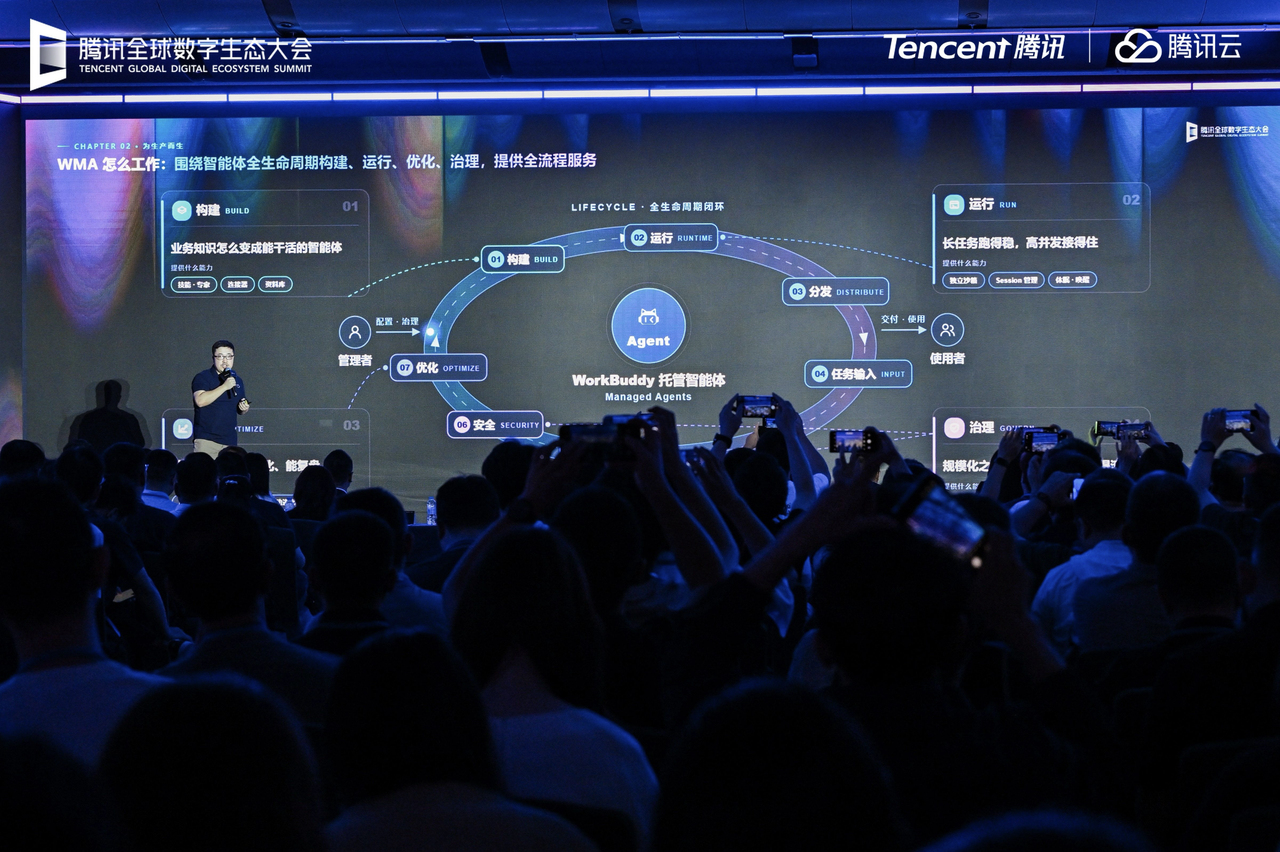
Tencent Holdings has crystallized the long-missing commercial architecture for its enterprise AI push, repositioning WorkBuddy from a productivity tool into a unified orchestration layer designed to convert AI token consumption into recurring, measurable revenue across China's corporate sector.
The strategic inflection point arrived at the 2026 Tencent Global Digital Ecosystem Conference, where the Shenzhen-based tech giant unveiled Buddy One — a cross-application AI coordination framework — alongside a hardened suite of enterprise-grade security, cost observability, and managed agent capabilities. The announcements represent the clearest signal yet that Tencent has moved beyond selling disaggregated cloud credits and software licenses toward packaging those assets into a single organizational productivity platform.
Market context matters here: with Alibaba Cloud, Huawei Cloud, and ByteDance all competing aggressively in China's AI-to-B segment in 2026, Tencent's ability to monetize its existing ecosystem — WeChat Work, Tencent Meeting, Tencent Docs, and its proprietary Hunyuan model — hinges on whether WorkBuddy can function as a credible enterprise operating environment rather than a feature layer.
Buddy One Knits Tencent's Fragmented SaaS Stack Into a Task-Centric Engine
The core structural problem WorkBuddy previously faced was context fragmentation. Agents can generate content and invoke tools, but enterprise workflows begin in meeting rooms and group chats, pass through internal knowledge bases and external databases, undergo multi-party revision, and must ultimately produce auditable, retrievable outputs. Without shared context, even AI-assisted workers were forced to manually re-upload files and re-explain background — negating efficiency gains.
Buddy One directly addresses this by assigning each product a discrete role within a single task pipeline: Tencent Meeting supplies organizational context and communication history; Yuanbao search provides external information retrieval; Tencent Docs handles collaborative editing and output delivery; ima organizes dispersed materials into a searchable knowledge base; and the newly launched Tencent NetDisk serves as a unified file storage substrate for both human-generated and agent-generated assets.
The practical workflow implication is significant. A meeting transcript can now serve as structured context for an agent to query documents, generate strategy memos, route updates through WeChat Work, and archive outputs to NetDisk — all within a single WorkBuddy orchestration session. Buddy One's unified account system and shared credit pool further reduce the operational friction of cross-product task execution. Tencent says memory-sharing across products is on the near-term roadmap.
The architecture shift is clear: these are no longer standalone SaaS applications that users open individually. They are capability modules that WorkBuddy schedules on demand.
Open Platform and Enterprise Controls Unlock Tencent's B2B Penetration Path
Internal integration alone cannot move the needle on enterprise adoption. Tencent's government and enterprise business president Li Qiang stated plainly at the conference that agent value is only realized deep inside industrial workflows — production, finance, operations, and procurement — not at the individual user level.
WorkBuddy's commercial viability therefore depends on its ability to enter existing enterprise technology stacks without requiring system replacement. Yang Chen, Vice President at Tencent Cloud and head of industrial ecosystem business, confirmed that WorkBuddy operates as an agent orchestration layer above legacy ERP, CRM, and OA systems, with bidirectional integration enabled via API — a design choice that substantially lowers enterprise switching costs.
Three enterprise-grade capability additions reinforce this positioning:
Enterprise Security and Governance: WorkBuddy's enterprise edition allows administrators to configure access rules governing files, commands, and network resources, apply data masking to sensitive outputs, and maintain a comprehensive audit log of agent data access and tool invocations. Tencent disclosed that one enterprise with over 1,000 employees using WorkBuddy informally — previously oscillating between full prohibition and uncontrolled adoption — deployed the enterprise edition, unified all users under organizational accounts, and saw 2,000+ pilot slots filled immediately.
Cost Observability Center: Enterprises can now decompose AI spending by department and task, identifying which workflow steps generate the highest token consumption or produce errors. New H3C (新华三) has used the dashboard to reallocate tokens and recalibrate internal incentive structures. Suning.com (苏宁易购) audited task execution traces and adjusted prompt configurations, model selections, and tool assignments, reducing token consumption by 10%. This transforms AI from an opaque budget line into an optimizable operational variable — a critical requirement for CFO-level buy-in.
Managed Agent Infrastructure (WMA): WorkBuddy Managed Agent moves task execution to the cloud, allowing enterprises to embed validated agents into business systems via API or deploy them into collaboration channels for continuous, unattended task processing. Near term, this enables organizations to encode proven workflows as reusable Skills and proprietary agents. Structurally, WMA is the foundation layer for what Tencent characterizes as "digital employees" — persistent, role-defined agents with explicit permissions, delivery obligations, and performance metrics that operate without continuous human supervision.
Digital Labor and Consumer Hardware Signal WorkBuddy's Longer-Term Revenue Surface
The monetization logic embedded in WorkBuddy's architecture extends well beyond traditional enterprise software economics. When agents run continuously — processing approvals, generating content, executing queries — the purchasing model shifts from per-seat licensing toward consumption-based infrastructure fees. Tencent is positioned to bundle cloud compute, Hunyuan model inference, and software access into an integrated "digital employee operating environment," converting previously siloed revenue streams into a durable subscription floor.
The scope is further expandable into consumer-facing hardware. Qiyuan Robotics (启元), manufacturer of the Q1 and T1 humanoid robot lines, has integrated WorkBuddy as the task execution backend for its devices. Under this arrangement, Qiyuan's hardware provides environmental sensing and locomotion; WorkBuddy handles intent interpretation, task decomposition, and service orchestration — connecting to Tencent Meeting, QQ Music (QQ音乐), WeChat Reading (微信读书), and payment services via Skills. Hardware manufacturers gain access to a mature digital service layer without building a proprietary backend; Tencent gains a pathway into physical endpoint devices.
Tencent has separately signaled plans to upgrade WorkBuddy's mobile personal assistant capabilities, enabling proactive monitoring of emails, group messages, and calendars — a move consistent with positioning WorkBuddy as the task execution substrate for next-generation consumer terminals.
Traction Data Validates the Framework, but Scale Remains the Test
WorkBuddy's commercial metrics since its March 2026 launch provide early validation. The platform has processed 9 billion task requests, the enterprise edition has entered more than 50 industries, and active deployment now covers 50% of China's top 500 enterprises and 60% of China's top 100 enterprises by revenue. The open platform hosts more than 200,000 Skills, with a newly introduced monetization framework allowing developers to offer both one-time purchase and subscription billing for paid Skills and expert agents.
These numbers establish WorkBuddy as a credible enterprise AI platform rather than a demo-stage product. However, the more consequential question for investors and analysts tracking Tencent's Business Services segment is whether the platform can sustain usage depth — moving from peripheral productivity tasks into mission-critical workflows where switching costs are high and token volumes are structurally large.
Tencent has spent the past two years assembling the components: the model, the cloud, the communication layer, the software suite, and the identity infrastructure. WorkBuddy's 2026 configuration represents the first architecture in which those components are genuinely interconnected. Whether that architecture translates into accelerating to-B revenue growth in the second half of 2026 is the metric that will determine whether the strategy has succeeded.
Related Coverage:
Tencent's WorkBuddy: Can an AI Productivity Tool Become the Operating System for the Agent Era?
Tencent Unveils Full Agent Suite at Shenzhen Summit, Betting on Ecosystem Over Model Wars