
Manus 2.0 Rewrites the AI Agent Playbook With Cloud Infrastructure and a Standalone Digital-Identity App
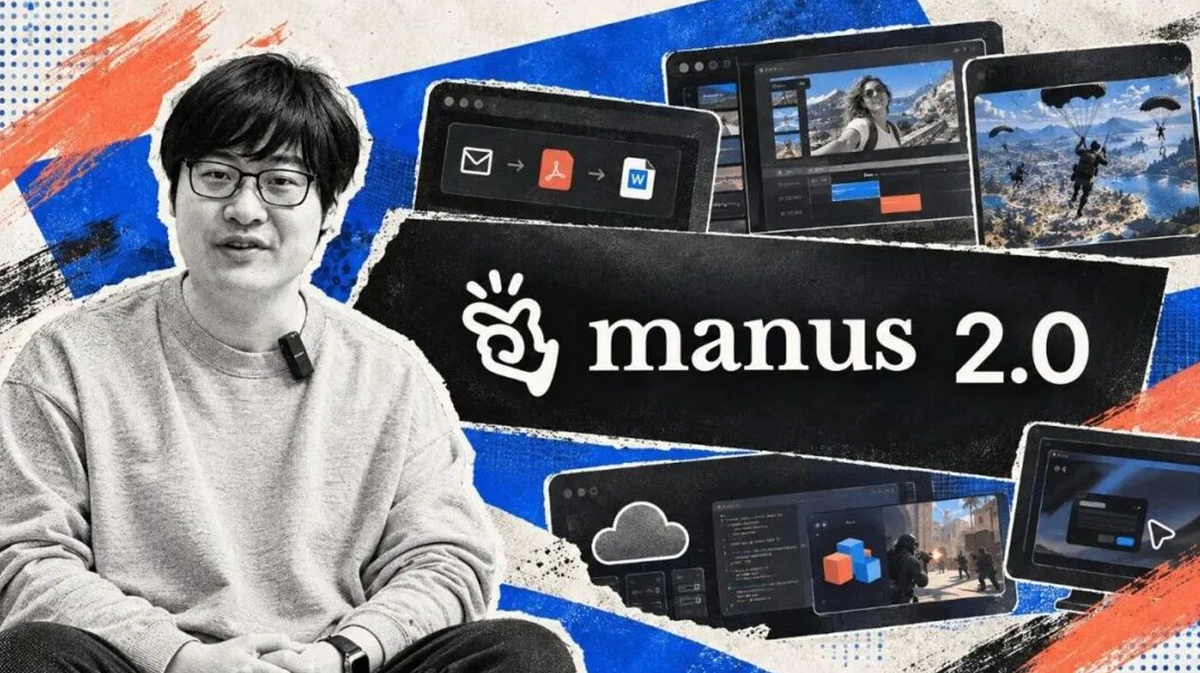
Cascade architecture cuts token consumption by 23.2% and operating costs by 32%, as founder Xiao Hong bets the next frontier lies not in generation but in post-generation control.
Manus, the Chinese AI agent startup that briefly dominated developer circles in early 2025, returned from a period of strategic silence this week with Manus 2.0 — a ground-up architectural overhaul that reframes what an AI agent fundamentally is: not a conversational interface, but a persistent, cloud-resident digital worker with its own identity, compute environment, and execution budget.
The launch marks a decisive pivot in the competitive AI agent landscape. Where the first generation of agents competed on task-completion breadth, Manus 2.0 competes on infrastructure depth — introducing proprietary orchestration hardware, event-driven automation, a professional creative studio, and an entirely separate consumer application called Cue that assigns each AI agent its own email address, phone number, wallet, and cloud computer. The strategic implication is clear: Manus is no longer positioning itself as a productivity plugin. It is positioning itself as an operating system layer for human-AI collaboration.
Initial developer feedback, circulating across Chinese tech forums and international AI communities as of this writing in 2026, centers on the efficiency gains rather than the feature list — a signal that enterprise buyers, not just hobbyists, are the intended audience.
Cascade Architecture Delivers Measurable Cost Compression
The engineering centerpiece of Manus 2.0 is Cascade, the company's latest in-house Agent Harness. Unlike prior orchestration frameworks that pre-load all agent capabilities regardless of task requirements, Cascade adopts a lean-initialization model: the system starts lightweight and pulls in specialized modules only when the active task demands them.
Internal benchmark data released alongside the launch quantifies the delta against the prior generation:
- Token consumption: -23.2%
- Task completion time: -28.2%
- Operational cost: -32%
For enterprise customers running high-frequency, multi-step agent workflows, a 32% cost reduction is not a marginal gain — it is a procurement argument. At scale, it also signals that Manus has addressed one of the most persistent criticisms leveled at agentic AI systems: that their token burn rates make them economically unviable for production deployment.
Cascade also introduces the concept of a persistent "workspace" for each project. Agents no longer reset between sessions; context, files, and intermediate outputs persist across interactions. This shifts the agent paradigm from transactional to longitudinal — a distinction that matters enormously for complex, multi-day business workflows.
Cloud Computer Dissolves the On-Device Dependency Ceiling
Parallel to Cascade, Manus 2.0 introduces Cloud Computer — dedicated cloud-hosted execution environments provisioned per project. The practical significance extends well beyond convenience.
Previously, any agent task that required continuous uptime — a multiplayer game server, an automated monitoring pipeline, a long-running data scraper — forced users to maintain their own infrastructure: server provisioning, environment configuration, uptime management. Cloud Computer absorbs that entire operational surface. The agent's work persists whether or not the user's local device is active.
This is architecturally analogous to the shift from local software to SaaS, applied one layer deeper to the agent execution layer itself. The agent's lifecycle is now decoupled from the user's session lifecycle — a structural change that enables genuinely autonomous, asynchronous operation.
Automations Shift Trigger Logic From Time-Based to Event-Driven
Manus 2.0's Automations feature extends the platform's prior Scheduled Tasks capability into event-driven territory. Agents can now be triggered not only by a clock, but by external signals: incoming emails, changes in advertising performance metrics, calendar updates, Slack messages, or Notion content edits.
The user interface for configuring these workflows is deliberately minimal. According to Manus, users specify two parameters in plain language — what to monitor, and what action to take — and the system constructs and deploys the workflow autonomously.
For marketing operations, customer success, and financial monitoring teams, this positions Manus as a direct competitor to no-code automation platforms such as Zapier and Make (formerly Integromat), with the added dimension of an AI reasoning layer sitting between trigger and action.
Manus Studio Targets Professional Creative Output, Not Just Task Completion
The desktop application has been rebranded and restructured as Manus Studio, a shared human-AI workspace that consolidates document editing, spreadsheet management, PDF processing, presentation design, website building, code execution, video production, and game development under a single adaptive interface.
The adaptive capability loading model — consistent with Cascade's lean-initialization philosophy — ensures that only the modules relevant to the active project are loaded into context, preserving both speed and cost efficiency.
Two new specialist environments within Studio merit particular attention from a market-positioning standpoint:
Video Editor introduces timeline-based editing for AI-generated video content. Rather than requiring users to regenerate entire videos when revisions are needed, individual elements — clips, images, text overlays, animations, audio tracks — are surfaced as independently editable objects on a timeline. An "Alchemy" mode further elevates output quality by combining video generation with code generation under a single creative direction pass. Target use cases include 30-to-60-second product advertisements, AI-generated UGC content, data visualization animations, and tutorial videos.
Game Dev enables end-to-end game creation with coordinated deployment of visual, image, and programming models. A "Max Ultra" mode prioritizes simultaneous optimization of graphics, gameplay mechanics, and control responsiveness. Finished games can be published directly as web-accessible URLs. Critically, multiplayer configuration — historically the highest technical barrier for independent game developers — is reduced to a four-step click sequence that routes through Cloud Computer for server provisioning and network management.
Cue Introduces the Concept of a Digitally Sovereign AI Agent
The most strategically ambitious element of the Manus 2.0 launch is not a feature — it is an entirely separate product. Cue is a standalone application, available across web, desktop, and mobile (iOS pending App Store approval as of launch), that operationalizes the concept of a personal AI agent with a complete digital identity.
Each Cue agent receives:
- A dedicated email address
- A phone number
- A digital wallet (capable of transacting within user-defined spending limits)
- A Cloud Computer instance
The wallet capability alone represents a significant escalation in agent autonomy. An agent that can receive instructions, reason about them, execute multi-step workflows, communicate via email and phone, and complete payments within a pre-authorized budget is qualitatively different from any agent product currently in wide deployment.
Cue also supports multi-agent team configurations. Users can assemble groups of agents within a shared thread, assign a collective objective, and allow agents to divide and hand off subtasks autonomously. A product launch preparation workflow cited in the official documentation illustrates the model: one agent researches venues, a second screens attendee candidates, a third produces the presentation deck.
Perhaps most provocatively, Cue is designed to interface with physical-world services. The launch documentation references restaurant ordering via QR code scan and queue-holding as early integration examples — positioning Cue as a bridge between digital agent infrastructure and offline service consumption, a space that Chinese super-apps have long sought to dominate through human-operated interfaces.
Cue is currently in Early Access. The invitation code MEETCUE is available to first-wave applicants on a first-come, first-served basis.
Market Positioning: Infrastructure Depth as the New Competitive Moat
Manus 2.0's aggregate design philosophy represents a calculated response to the commoditization pressure now visible across the AI agent market. As foundation model capabilities converge and prompt-based agent frameworks proliferate, differentiation through model quality alone is diminishing. Manus is instead building differentiation at the infrastructure layer — proprietary orchestration (Cascade), dedicated compute (Cloud Computer), event-driven execution (Automations), and identity-complete autonomous agents (Cue).
This mirrors a pattern familiar from cloud computing's maturation cycle: early competition on raw capability, followed by consolidation around infrastructure control. If Manus can establish Cloud Computer and Cascade as the default execution substrate for enterprise agent workflows in the Chinese market — and, through Cue, in consumer daily-life scenarios — the switching costs it accumulates will be structural rather than superficial.
The 32% cost reduction benchmark, if it holds under real-world production conditions, will be the number that enterprise procurement teams remember. Everything else in the Manus 2.0 launch is the story built around that number.
Related Coverage:
Tencent Reclaim Manus at Flat $2B Valuation, Mirroring Meta's Own AI Anxiety Playbook
Inside Meta’s Multi-Billion-Dollar Acquisition of Manus: Founder Xiao Hong on the Darkest Hour