
Manus Parent Butterfly Effect Raises $500M+, in China’s Largest AI App Deal
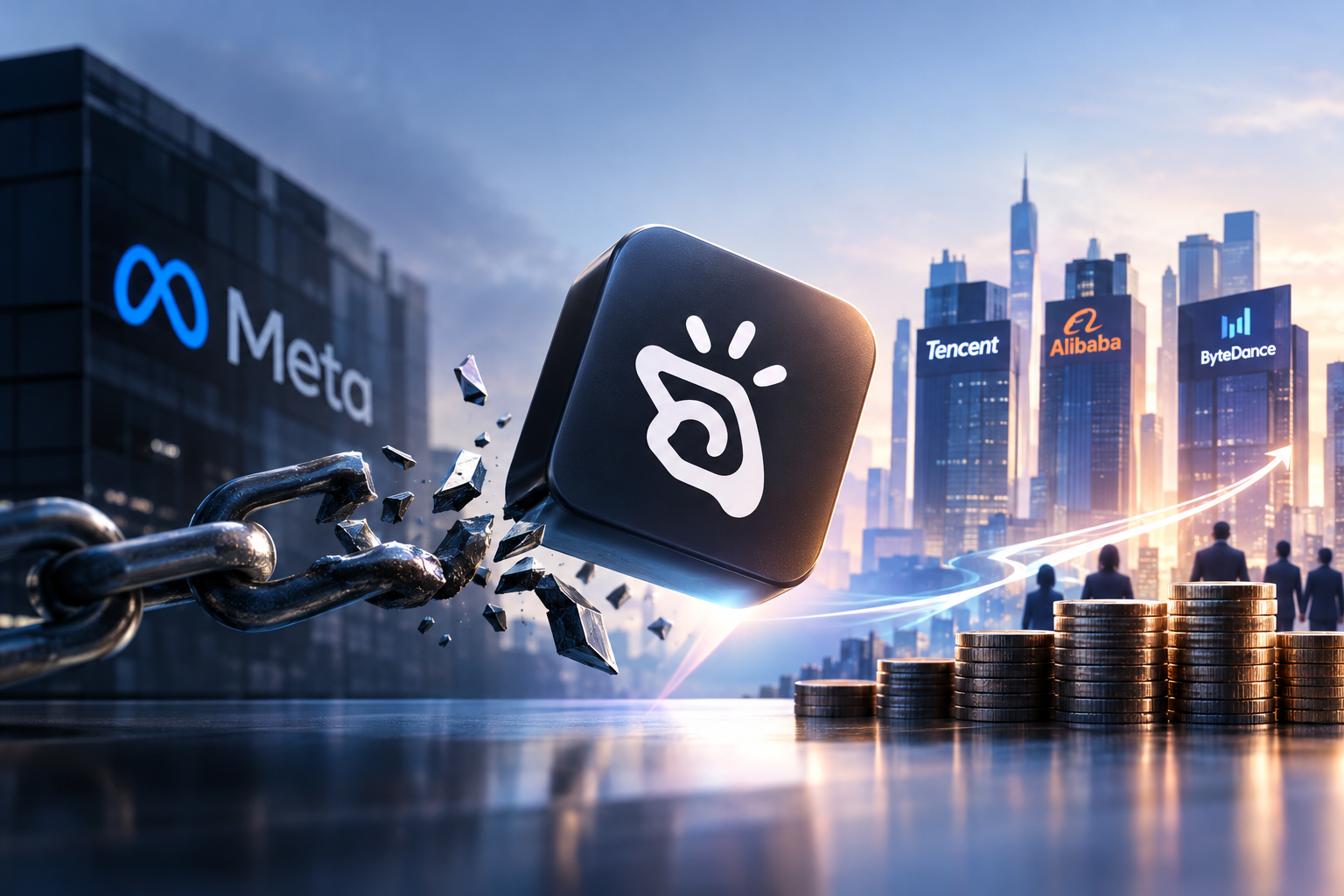
Backed by Boyu Capital and IDG, the autonomous agent startup reclaims independence from Meta and bets on a domestic product launch to challenge Tencent, Alibaba, and ByteDance on their home turf.
Butterfly Effect, the parent company of AI agent platform Manus, has closed a funding round exceeding $500 million, the company announced on October 8, 2026 — marking the single largest investment ever recorded in China's AI application layer and drawing a sharp line under a turbulent twelve months that saw the startup absorbed by, and then extricated from, Meta Platforms.
The round was co-led by Boyu Capital and IDG Capita, with existing shareholders Tencent, Sequoia China, and Zhen Fund all participating. Butterfly Effect did not disclose a formal post-money valuation. Bloomberg had previously reported on September 17 that the deal was nearing completion at an implied valuation of approximately $4 billion — roughly double the figure at which the founding team and legacy investors repurchased their equity from Meta.
A Corporate Resurrection Unlocks Record Capital
The financing caps a whiplash sequence of events compressed into less than one year. In late December 2025, Meta announced the acquisition of Manus, an agreement that generated immediate industry attention given the startup's viral debut in March 2025, when its general-purpose agent capability effectively defined a nascent product category. The deal subsequently unraveled, and on September 1, 2026, Manus formally declared the resumption of independent operations.
Twenty-seven days later, on September 28, the company shipped Manus 2.0 alongside Cue, a new personal agent application — its first major product release since regaining autonomy. The October 8 funding announcement followed within ten days, signaling that investor conviction had not eroded during the corporate turbulence.
The $500 million-plus figure is not merely a headline number. In a domestic AI application market where venture appetite has visibly cooled through the first three quarters of 2026, a single check of this magnitude into an application-layer startup carries disproportionate signaling weight: the path for independent AI application companies has not been foreclosed.
Big-Tech Consolidation Forces Startups to Differentiate or Die
The competitive backdrop against which Manus is deploying this capital has shifted materially since its March 2025 launch. What began as a startup-defined category has since been colonized by the three dominant Chinese internet platforms.
Since the summer of 2026, Tencent, Alibaba, and ByteDance have each consolidated multiple internal agent development teams under three unified brand umbrellas: WorkBuddy, Qianwen Office, and Doubao Work, respectively. The strategic logic is distribution-first: WorkBuddy's technical core is derived from Tencent's coding tool CodeBuddy (CodeBuddy); Qianwen Office is tightly integrated with DingTalk; and Doubao Work is embedded within Feishu. Data indicates that WorkBuddy alone recorded more than 20 million monthly visits on PC-based AI-native office agent platforms in China in June 2026.
Overseas, Meta launched its own personal agent product, Muse, in September 2026, further tightening the global competitive perimeter.
Against this backdrop, the structural differentiation for Manus is product philosophy rather than distribution muscle. Big-tech agent products derive their primary advantage from existing ecosystem lock-in and traffic funnels. Manus, by contrast, has built its reputation on user experience design and technical depth at the agent-reasoning layer — attributes that are difficult for platform-centric organizations to replicate quickly and that serve a distinct user segment unwilling to consolidate all workflows within a single super-app ecosystem.
Domestic Product Launch Positions Manus for Its Defining Test
The most consequential near-term variable is Manus's forthcoming China-specific product. At the September 28 launch event, the company confirmed it was assembling a dedicated team to build a domestically tailored offering and had initiated partnerships with Chinese foundation model providers and ecosystem partners. The product name and launch date were not disclosed at that time.
Sources indicate that the domestic version is currently in accelerated development and that a public release is not far off. The $500 million-plus war chest provides direct operational runway: Manus has simultaneously opened 17 positions including product designers, agent product managers, and Harness engineers — a hiring push that, in a talent market defined by competition between well-capitalized incumbents, requires precisely the kind of funding credibility this round supplies.
The domestic launch will constitute the real-world stress test for Manus's product-first thesis. WorkBuddy's 20 million monthly PC visits demonstrate that the large platforms have already established meaningful usage baselines. Manus will need to convert its product reputation into retention metrics in a market where users have already begun forming agent habits around incumbent interfaces.
Impact Assessment: What the Deal Means for the Sector
For investors, the round recalibrates risk perception around AI application-layer bets in China. Valuations at the application layer had compressed through mid-2026 as the market questioned whether startups could sustain differentiation against platform incumbents. A $4 billion implied valuation for an application-layer company — not a foundation model provider — challenges that compression narrative directly.
For the supply chain and talent ecosystem, the 17 open roles and the implied $500 million-plus deployment budget represent a meaningful injection into a segment of the market that had grown quiet. Competing startups will find the talent market incrementally tighter as a result.
For the agent industry's competitive structure, Manus's recapitalization means that the next phase of the market will include at least one well-funded independent challenger with the resources to sustain multi-year product iteration — a dynamic that benefits users and complicates the consolidation calculus for the three platform giants.
The architecture of China's agent market is still being written. Manus has just secured the capital to write a meaningful chapter of it.
Related Coverage: