
Meituan Unveils AI Model LongCat as Local Services Battle Shifts to Technology Front
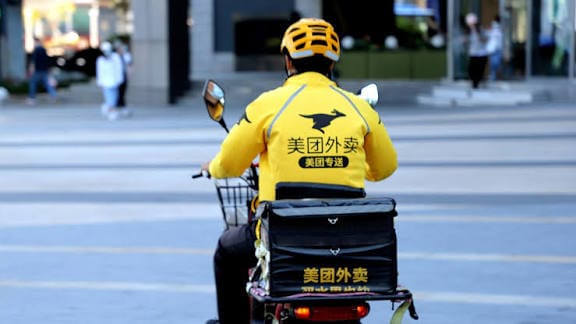
Chinese food delivery giant Meituan launched its open-source large language model LongCat in September, marking a strategic pivot toward artificial intelligence as competition in China's local services sector intensifies beyond traditional subsidy wars.
The launch came amid heightened rivalry with Alibaba Group Holding, which reported strong AI and e-commerce growth in its latest quarterly results, sending its Hong Kong-listed shares surging and adding over HK400billion(US$51 billion) in market value in a single trading session. The timing underscores how major Chinese internet platforms are increasingly betting on AI capabilities to differentiate their services.
Meituan's move represents a shift from cash-burning competition to technology-driven efficiency improvements, as the company seeks to defend its dominant position in food delivery while expanding into broader "everything-to-home" services. The three major players—Meituan, Alibaba, and JD.com—collectively saw profits decline by over 20 billion yuan in the first quarter due to subsidy wars.
Industry analysts view the AI arms race as the decisive battleground for China's local services market, where operational efficiency and fulfillment capabilities increasingly determine market leadership over promotional spending.
Technical Innovation Drives Cost Efficiency
LongCat employs a "zero-computation" expert mechanism that dynamically adjusts computational resources based on task complexity. Unlike traditional large language models that activate all parameters regardless of task difficulty, LongCat can handle simple queries like "nearby bubble tea recommendations" using only 27 billion parameters.
This selective activation approach directly addresses Meituan's core business needs for cost optimization while maintaining performance standards. The model's architecture allows the company to process millions of real-time delivery orders during peak hours without proportional increases in computational costs.
Meituan has invested over 10 billion yuan in AI development as part of its 21.1 billion yuan (US$2.9 billion) total R&D spending in 2024. The company began internal testing of LongCat in early 2024, subsequently launching vertical AI assistants including "Ask Xiaodai" for restaurant recommendations and "Milu" for intelligent customer service.
Competitive Landscape Intensifies
Alibaba's latest quarterly results highlighted the effectiveness of its AI-integrated approach to local services competition. The company's cloud division reported 26% year-over-year revenue growth, with AI-related products achieving triple-digit growth for eight consecutive quarters. Its instant retail business reached 300 million monthly active buyers, demonstrating successful ecosystem integration.
Alibaba's strategy extends beyond the 50 billion yuan (US$6.9 billion) in subsidies, leveraging its Tongyi series large language models and cloud computing infrastructure to support Taobao's instant delivery service. This integrated approach combines e-commerce, cloud services, mapping, and payment capabilities.
JD.com has also intensified competition despite reporting 14.7 billion yuan losses in its new business segments during the second quarter, primarily from food delivery operations. The company's founder Liu Qiangdong recently conducted high-profile visits to his hometown, generating significant social media attention for JD's discount supermarket launch.
AI Integration Across Operations
Meituan's AI deployment spans multiple operational layers, from order matching algorithms to supply chain optimization. The platform processes hundreds of millions of delivery requests during peak periods in major cities, requiring real-time coordination between users, merchants, and delivery personnel while accounting for traffic conditions, weather, and order priorities.
The company has invested in over 30 robotics-related companies over the past three years, including stakes in Unitree Robotics, Galbot, and StarMap. These investments focus on logistics drones, warehouse automation, and last-mile delivery solutions that complement Meituan's core services.
Beyond operational efficiency, AI capabilities enable Meituan to expand its product catalog and improve price competitiveness through better demand forecasting and inventory management. The technology integration supports the company's evolution from food delivery to comprehensive local services.
Market Implications
The shift toward AI-driven competition reflects broader changes in China's internet sector, where sustainable growth increasingly depends on technological advancement rather than capital deployment. Local services represent a particularly complex operational challenge due to the real-time coordination required across multiple stakeholders.
Meituan's defensive strategy through technology investment aims to maintain market leadership while improving unit economics. The company's willingness to sacrifice short-term profits for market position indicates management's confidence in AI-driven long-term competitive advantages.
The 2025 local services battle will likely center on AI capabilities as platforms seek to differentiate through superior user experience, operational efficiency, and service reliability rather than promotional spending alone.