
Mixue's Global Ambitions Hit a Wall: Overseas Stores Shrink for the First Time
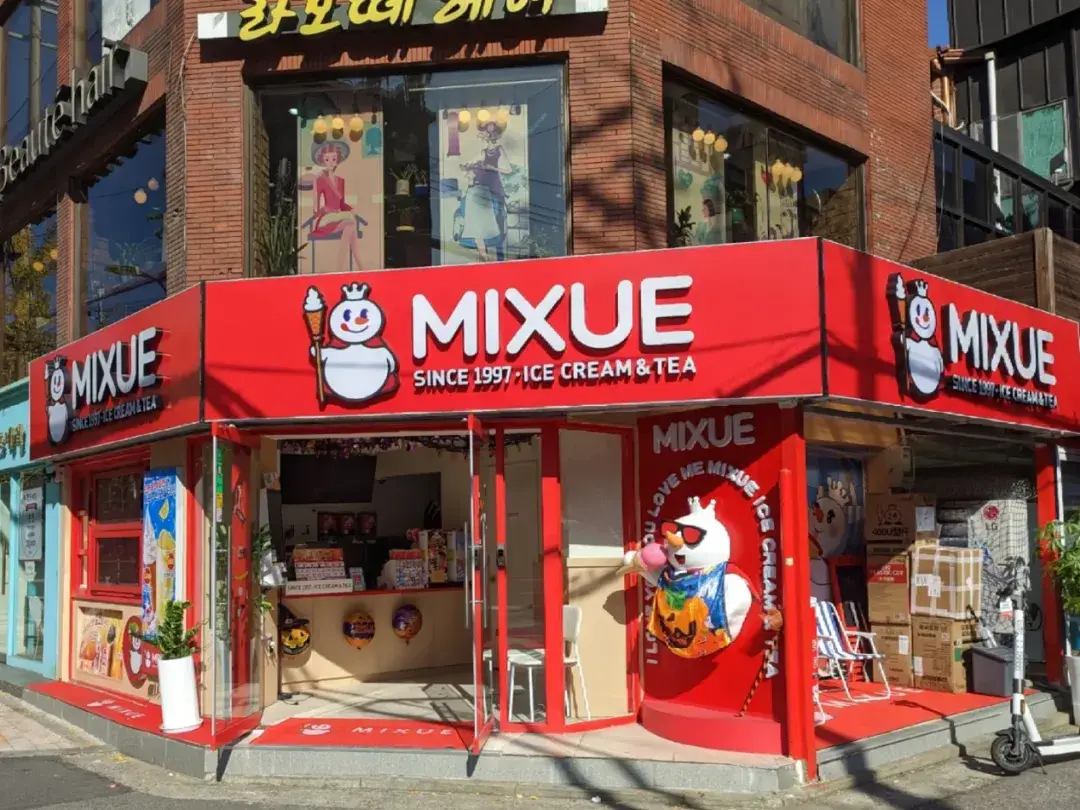
The world's second-largest fresh beverage chain by store count posted its first-ever annual net decline in overseas locations in 2025, exposing the limits of a supply-chain flywheel that conquered China but struggles to spin at scale beyond its borders.
Mixue Group, the Zhengzhou-based bubble-tea-and-ice-cream franchisor that operates nearly 60,000 outlets globally, shed a net 428 overseas stores in 2025—a contraction of 8.7%—even as its domestic network expanded by 13,772 locations, or 33%, to 55,356 shops. The divergence is stark: the same franchise engine that added more than 14,000 net stores worldwide in a single year is now running in reverse internationally, raising questions about whether the company's post-IPO growth narrative can survive contact with higher-cost, higher-scrutiny markets.
The company's Hong Kong-listed shares closed at HK$201.2 on July 10, 2026—below the IPO issue price of HK$202.5—having shed roughly two-thirds of their peak value of HK$618. The stock's decline reflects a market reassessment of a growth story that once commanded a 5,258-times oversubscribed listing and froze approximately HK$18.4 trillion in subscription funds, a record for the Hong Kong exchange.
Japan Exposes the Flywheel's Blind Spot
The most visceral illustration of the overseas slowdown is Japan. When Mixue opened its debut store on Tokyo's Omotesando strip in June 2023, management had already signaled an ambition to operate 1,000 Japanese outlets by around 2028, according to Nikkei reporting at the time. As of June 2026, four stores remain—a completion rate of 0.4% against that target.
The Japanese experience is not an isolated data point. Hong Kong has seen at least three closures, leaving five stores. Korea's expansion has stalled well below initial projections.
The root cause is structural, not operational. Mixue's domestic model is built on a virtuous cost loop: centralized procurement and manufacturing at its Jiaozuo mega-campus—which produces ice-cream powder, milk tea base, plant-based creamer, fresh dairy, syrups, packaging and even coffee-machine components—feeds a franchise network whose scale continuously drives down per-unit input costs. More stores mean lower costs; lower costs enable lower prices; lower prices attract more franchisees and consumers.
That flywheel requires two preconditions: low fixed costs at the store level and sufficient outlet density to justify regional logistics infrastructure. Japan satisfies neither.
Store fit-out costs in Japan run approximately five times China's equivalent, with construction typically consuming 70%–80% of total initial investment. Prime commercial landlords routinely demand 10–15 months of rental deposits upfront, and new brands face rigorous financial and operational vetting—sometimes requiring third-party guarantors—before securing leases in core catchment areas. A single Mixue store in a Hong Kong shopping center, such as the Mong Kok flagship where monthly rent is approximately HK$200,000, would need to sell more than 22,000 cups of lemonade at HK$9 each just to cover rent. Local beverage workers earn HK$16,000–HK$22,000 per month, with part-time hourly rates of HK$50–HK$60.
When store density cannot be built quickly, the supply chain advantage inverts: raw materials must be imported in small batches, layering in freight, tariffs and currency risk that can push landed costs above those of established local competitors.
Saturated Markets Reject the Low-Price Playbook
Cost arithmetic alone does not fully explain why Mixue cannot retain Japanese consumers once they walk through the door. Japan's beverage market has been mature since the late 1970s, when canned and bottled tea first proliferated. Convenience-store chains now offer tea and coffee at ¥120–¥200 per unit, covering virtually every consumer touchpoint. Mixue's menu prices in Japan start above ¥300—making it a mid-tier option rather than the value disruptor it is in China and Southeast Asia.
Taste preferences compound the challenge. Japanese consumers skew toward lower-sugar, higher-tea-intensity profiles and rank among the world's most sophisticated coffee drinkers; Japan Coffee Association data from 2020 recorded per-capita weekly coffee consumption of 11.53 cups, trailing only the United States and Germany. Mixue's high-sweetness, high-volume format drives trial but struggles to generate the repeat purchase rates needed to sustain franchisee economics.
Regulatory friction adds a third layer of friction. Mixue signaled its Japan entry intention in October 2022, but the Tokyo flagship did not open until June 2023—an eight-month gap attributed largely to import inspection, quarantine approvals and supply-chain calibration. In Hong Kong, a Mixue outlet was cited by regulators after a frozen dessert product tested above local thresholds for coliform bacteria and total bacterial count. For a brand still establishing trust in an unfamiliar market, food-safety incidents carry reputational costs that outlast the immediate regulatory penalty.
The compliance risk extends beyond food safety. In March 2025, rival chain CHAGEE had its Vietnam flagship shuttered before opening after its app login page triggered a local political controversy, canceling four planned stores and approximately RMB 20 million (US$2.78 million) in investment. In June 2026, Molly Tea was ordered to pay RMB 10.3 million (US$1.43 million) after a court found its brand visual elements too closely resembled Louis Vuitton's signature monogram. These episodes illustrate a consistent pattern: Chinese beverage brands entering new markets face intellectual property, cultural sensitivity and food-safety scrutiny that their domestic playbooks did not prepare them for.
Southeast Asia Retrenchment Signals a Strategic Pivot
The 2025 overseas net closures were concentrated in Indonesia and Vietnam—Mixue's two largest international markets and the foundation of its Southeast Asia logistics network, which spans seven proprietary warehouses totaling approximately 69,000 square meters and covers more than 560 cities. The company can move Sichuan-origin coconut jelly from Chengdu to a Jakarta store within 48 hours.
Management framed the closures as a deliberate culling of underperforming locations rather than a retreat. According to financial disclosures, relocated or optimized stores saw average daily sales increase by more than 50% post-adjustment, and new Southeast Asia openings are generating per-store revenue 1.7 times that of legacy outlets. The parallel is instructive: McDonald's, Starbucks and Saizeriya have each executed similar network rationalization programs before re-accelerating.
Yet the political environment is also tightening. In January 2026, Malaysia's Deputy Minister of Domestic Trade and Cost of Living told parliament that the government was reviewing foreign restaurant franchise guidelines specifically to curb rapid Chinese-brand expansion. Mixue—which had grown to approximately 500 Malaysian outlets before authorities imposed new-store restrictions—was named explicitly. The episode illustrates a pattern: host governments welcome early-stage Chinese investment for its job-creation and consumption effects, but shift toward protective measures once franchise density begins to pressure domestic competitors.
Lucky Cup Bets That Coffee Travels Better Than Tea
With the Mixue brand facing headwinds in developed markets and regulatory friction in Southeast Asia, the parent group — Mixue Group — is redirecting growth expectations toward its coffee sub-brand, Lucky Cup. The chain contributed close to half of the group's net 13,000-plus new stores in 2025. In August 2025, Lucky Cup opened its first overseas location in Malaysia, pricing products at MYR 3.5–7 (approximately RMB 5–11, or US$0.69–1.53), against MYR 12–15 for established local chains such as ZUS Coffee (586 Malaysian outlets), GIGI Coffee (160-plus) and Bask Bear (approximately 125).
The strategic logic is that coffee requires less consumer education than Chinese-style milk tea in Southeast Asian markets where Vietnamese drip coffee, Malaysian white coffee and Indonesian kopi are already embedded in daily routines. Lucky Cup's target is the gap between informal street-stall coffee and branded chain coffee—offering the latter's standardization at close to the former's price point.
The model replicates Mixue's franchise-over-direct-operation architecture: local franchisees absorb real estate, labor and regulatory risk; the parent monetizes through raw material and equipment sales. This structure is capital-light for the group but places the viability burden on franchisee-level economics. In Indonesia, opening a single Mixue outlet costs approximately IDR 1 billion (around RMB 380,000, or US$52,800)—equivalent to roughly 18 months of minimum wage in Jakarta. That threshold limits the franchisee pool in ways that have no domestic equivalent.
Supply-Chain Localization Determines the Endgame
The deeper strategic question—and the one that will ultimately determine Mixue's long-term overseas valuation—is whether the company can replicate its China supply-chain infrastructure in key international markets. Currently, the overseas operation is a partial model: core inputs including milk tea powder, syrups and even the Eureka lemons used in Indonesian stores are manufactured in China and shipped under cold-chain conditions. Announced plans to establish local production centers in Indonesia and Brazil have yet to yield confirmed commissioning dates.
Until regional procurement, warehousing and processing capacity is established in Southeast Asia and Latin America, overseas unit economics will remain structurally weaker than the domestic model. Logistics, tariff and currency costs will cap the price competitiveness that is the brand's primary consumer proposition. Conversely, if Mixue can build a Southeast Asian supply-chain footprint that mirrors what it has built around Jiaozuo, the cost flywheel could restart—and the current net-closure phase would be reframed as a necessary consolidation before a more durable second expansion.
For investors, the 2025 annual report presents a company at an inflection point. Domestic growth remains robust but faces natural saturation constraints in a market already exceeding 55,000 outlets. Overseas growth—once marketed as the second growth curve—has entered a phase of quality-over-quantity adjustment. The share price, now below its IPO level, reflects the market's unwillingness to pay a premium for a growth story whose next chapter has not yet been written.
Related Coverage:
Mixue’s Post-Subsidy Hangover: BofA Flags “Transitional” 2026 With Fading Store Economics