
MetaX's RMB 4B Valuation Faces Reality Check as Losses Mount
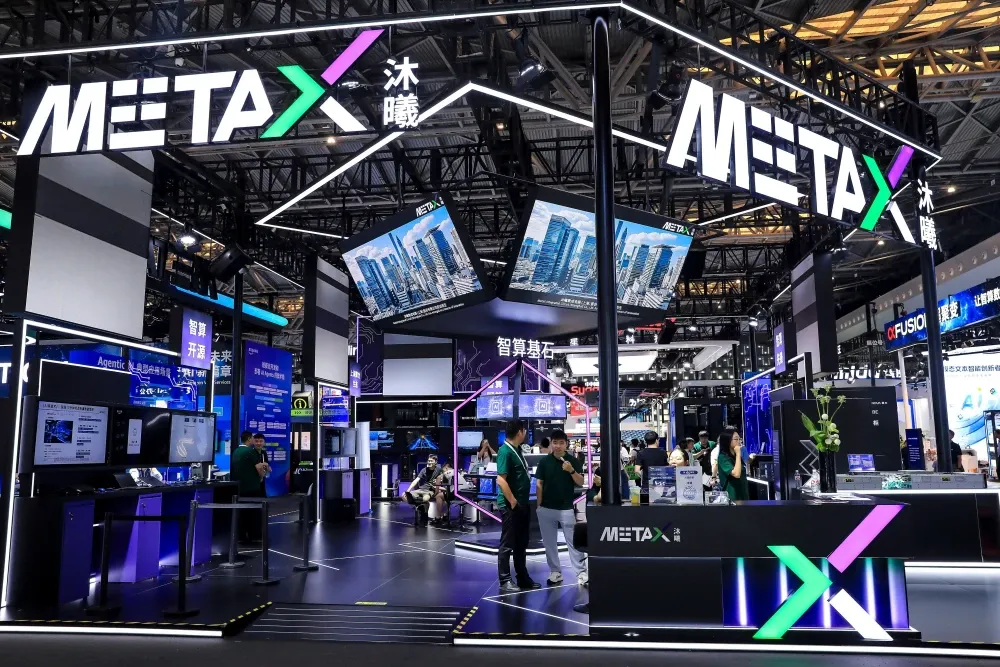
China's domestic GPU sector is minting paper billionaires faster than it is generating profits — and MetaX Integrated Circuits may be the starkest illustration of that disconnect.
Shares of the Shanghai-listed chipmaker briefly breached RMB 1,000 (US$138.9) on July 9, 2026, pushing its market capitalization to RMB 40 billion (US$5.6 billion). The same day, the company issued an emergency clarification denying market rumors that its product order backlog extended into 2027 — a rare act of self-deflation that sent the stock tumbling and exposed the fragility of a valuation built almost entirely on forward expectations.
The episode crystallized a fundamental tension: MetaX's revenue doubled in 2025, yet the company burned through RMB 1.26 billion (US$175 million) in operating cash flow and has accumulated losses of RMB 1.549 billion (US$215 million) since inception. For investors pricing the stock at more than 30 times book value — a multiple the company itself flagged as "significantly above industry average" in its own filing — the path to justification runs through a series of milestones that remain unachieved.
Revenue Doubling Masks a Deepening Cash Burn Spiral
MetaX's 2025 annual report, its first since listing on Shanghai's STAR Market in late 2025, showed revenue of RMB 1.644 billion (US$228 million), a 121.26% year-on-year surge. Shipments of its combined training-and-inference GPUs reached 33,600 units, up 147%, while inference-only GPU volumes rose more than 800%.
The headline numbers are impressive. The underlying economics are not.
Net loss attributable to shareholders narrowed 43.97% year-on-year to RMB 789 million (US$109.6 million), but the adjusted figure — stripping out non-recurring items — came in at RMB 830 million (US$115.3 million). The fourth quarter of 2025 was the worst single quarter on record: revenue of RMB 408 million (US$56.7 million) against a net loss of RMB 444 million (US$61.7 million), implying that incremental revenue is not yet covering incremental costs.
The first quarter of 2026 offered a modest reprieve. Revenue rose 75% year-on-year to RMB 562 million (US$78.1 million), and the quarterly loss narrowed 76% sequentially to RMB 98.84 million (US$13.7 million). Management had previously guided for breakeven as early as 2026, but the Q1 trajectory suggests that target hinges on an acceleration in the second half that is far from guaranteed.
The single largest drain on profitability is research and development. MetaX spent RMB 1.027 billion (US$142.6 million) on R&D in 2025, equivalent to 62.49% of revenue — down from a staggering 121.24% ratio in 2024, but still rising in absolute terms. Its 675-person R&D team represents 73% of total headcount, with more than 70% holding master's degrees or above. Cumulatively, the company spent RMB 2.247 billion (US$312 million) on R&D between 2022 and 2024, amounting to 282% of revenue over that period.
Receivables present a separate risk vector. Accounts receivable stood at RMB 615 million (US$85.4 million) in Q1 2025, equal to 192% of that quarter's revenue. Some clients operate on a back-to-back settlement model, meaning MetaX does not collect until its customers collect from their own end-users — a structural cash flow drag that contributed to credit impairment losses of RMB 29.14 million (US$4 million) in 2025 and RMB 55.66 million (US$7.7 million) in 2024.
Inventory write-downs added RMB 174 million (US$24.2 million) in asset impairment charges in 2025, a consequence of strategic stockpiling undertaken to hedge against geopolitical supply-chain disruptions.
Competitive Positioning Reveals a Two-Tier Market Forming
China's domestic AI accelerator market is bifurcating rapidly, and MetaX sits on the less advantaged side of the divide.
The first tier — Huawei's Ascend unit, Cambricon, and Hygon Information Technology — has secured anchor orders from the country's largest internet platforms and telecommunications operators. Cambricon reported 2025 revenue of RMB 6.5 billion (US$902.8 million) and net profit of RMB 2.06 billion (US$286.1 million), completing a full exit from years of losses. Hygon posted revenue of RMB 14.4 billion (US$2 billion) and net profit of RMB 2.55 billion (US$354.2 million) in 2025, making it the most profitable domestic AI chip company by absolute margin. Even Moore Threads, a peer in the second tier, recorded its first profitable quarter in Q1 2026, booking RMB 29.36 million (US$4.1 million) in net income.
In aggregate, domestic vendors shipped approximately 1.65 million AI accelerator cards in 2025 out of a total Chinese market of roughly 4 million units, a 41% share. Huawei Ascend alone accounted for 812,000 units. Cambricon delivered 120,000 cards for the full year, with its largest customer, ByteDance, holding a pre-purchase commitment for 200,000 units.
MetaX's customer base, by contrast, is concentrated in state-backed AI computing platforms, carrier-operated intelligent computing centers, and commercial data center operators. Its prospectus disclosed that two internet companies under active engagement remained in product-testing phases as of the filing date — one began sample-card evaluation in H1 2024 and was not expected to complete performance testing until September 2025, with commercial procurement still contingent on subsequent cost assessment and product qualification rounds. The second company initiated discussions in Q1 2025, with small-batch trial orders projected no earlier than Q4 2025.
In practice, MetaX had not entered the core supply chain of any major internet platform by end-2025. Meanwhile, a Reuters report in June 2026 cited sources indicating ByteDance was in procurement talks with Tianshu Zhixin and Baidu's Kunlun chip unit — a reminder that the window for second-tier vendors to win flagship accounts is narrowing.
On the technical side, MetaX's self-developed MXMACA software stack, designed for high compatibility with NVIDIA's CUDA ecosystem, represents a genuine differentiator. However, large-scale cluster deployment capability — increasingly the decisive criterion for hyperscaler procurement — remains a gap. Moore Threads has completed a 10,000-card cluster deployment; Hygon has demonstrated large-scale cluster operations in production environments. MetaX is closing the gap but cannot erase it quickly.
The company's next-generation product, the Xiyun C600, was developed on a domestic advanced process node and completed initial wafer return and power-on verification in July 2025, with risk production targeted for end-2025. The transition from engineering validation to volume manufacturing involves performance tuning, software stack completion, supply-chain preparation, and customer qualification — a multi-stage process carrying meaningful execution risk. Any delay in C600's ramp would undermine MetaX's central positioning as a domestically self-sufficient alternative.
Valuation Premium Rests on Assumptions the Financials Do Not Yet Support
At RMB 40 billion (US$5.6 billion) in market capitalization, MetaX trades at more than 30 times book value with no applicable price-to-earnings ratio — a fact the company disclosed proactively in a regulatory filing, an unusual step for an A-share issuer.
Peer comparisons offer limited comfort. Cambricon trades at more than 170 times forward earnings on a market cap exceeding RMB 86 billion (US$11.9 billion). Hygon trades at roughly 75 times earnings on a RMB 73.62 billion (US$10.2 billion) market cap. Moore Threads carries a RMB 34.05 billion (US$4.7 billion) valuation despite still being in the red on an annual basis.
The entire domestic GPU sector is priced for a future that none of its participants has fully delivered. But within that cohort, MetaX's valuation premium is the hardest to defend on fundamentals: it is the only major listed player that has not yet achieved a single profitable quarter, has not entered a top-tier internet client's core supply chain, and faces a product-cycle inflection point — C600 — whose commercial timeline remains uncertain.
In February 2026, MetaX drew market attention when it deployed RMB 2.9 billion (US$402.8 million) of IPO proceeds into cash management products, a technically compliant move that nonetheless signaled a shortage of near-term investment targets commensurate with the capital raised. As of end-2025, the company held cash and liquid financial assets exceeding RMB 7 billion (US$972.2 million) against total assets of RMB 13.675 billion (US$1.9 billion) and a debt-to-asset ratio of just 37.26%. The balance sheet is sound; the question is whether that liquidity runway translates into competitive advantage before the sector's valuation premium compresses.
The concurrent IPO pipeline — Biren Technology, Tianshu Zhixin, and Enflame Technology are all advancing toward public listings — will structurally dilute the scarcity premium that has underpinned domestic GPU multiples since 2025.
Impact Assessment
MetaX's technology credentials, CUDA-compatible software stack, and government-backed customer base provide a viable foundation. What the company lacks — and what the market is paying as if it already possesses — is a demonstrated ability to convert that foundation into recurring, scalable profit. Until C600 reaches volume production, internet clients move from testing to procurement, and quarterly cash flow turns positive on a structural rather than seasonal basis, the gap between MetaX's RMB 40 billion market cap and its underlying earnings power will remain the central risk for shareholders.
Related Coverage:
China’s Second GPU Stock MetaX Explodes 569% in Blockbuster STAR Market Debut