
BYD Cracks Germany's Top 15 as Tesla Surges 318%, But European Moat Holds Firm
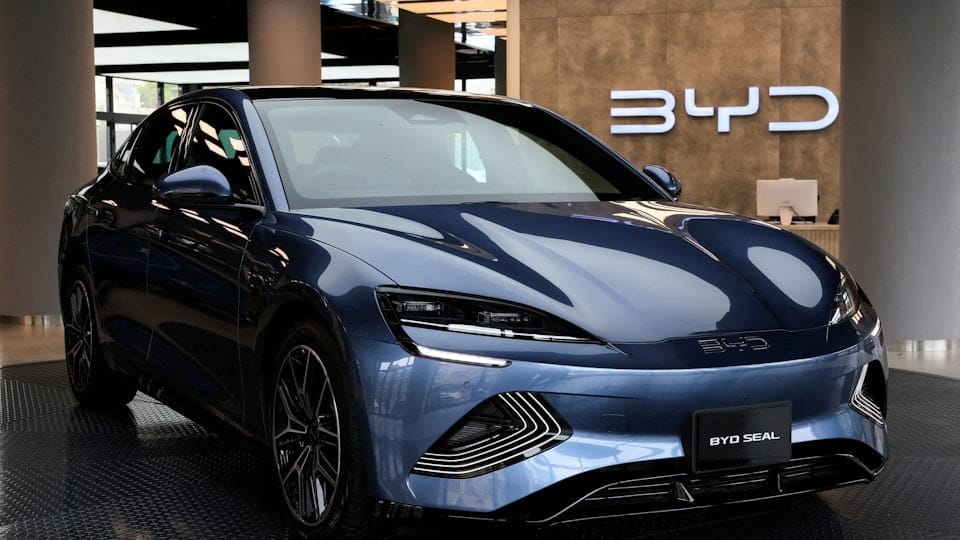
Chinese automakers are gaining measurable ground in Europe's most competitive car market, yet Volkswagen's near-30% grip on German sales underscores how far the challengers remain from disrupting the established order.
Germany registered 296,000 new vehicles in June 2026, a 15.7% year-on-year increase that lifted the first-half cumulative total to 1.484 million units — up a more modest 5.8%, signaling that the monthly surge was partly driven by seasonal end-of-quarter delivery pushes rather than a sustained acceleration in underlying demand.
The headline number that drew immediate market attention: Tesla's German registrations rocketed 317.6% year-on-year to propel the Model Y to third place in the model rankings with 6,023 units. Analysts should treat that figure with caution — the base period in June 2025 was exceptionally depressed, and the spike reflects catch-up deliveries rather than a structural re-rating of Tesla's European position.
Volkswagen Tightens Its Grip on a Recovering Market
Volkswagen Group remains the structural anchor of German auto sales. The VW brand alone posted 51,058 units — a 17.2% market share — while the Golf (8,117 units) and T-Roc (6,808 units) swept the top two model positions. Factor in Skoda's 24,963 units and Seat, and the group accounts for close to 30% of total monthly volume, a concentration that rivals have failed to meaningfully erode across multiple product cycles.
BMW recorded 26,119 units and Mercedes-Benz 23,728, keeping the German premium trio intact in the top four. A notable intra-German subplot: Skoda outsold both Mercedes and Audi by leaning on the Octavia and entry-level SUVs — a data point that illustrates where actual German consumer demand is concentrated. Value-for-money, not badge prestige, is driving incremental volume in the current economic environment.
Hyundai, at 8,436 units in tenth place, remains the lone Asian brand in the top ten — a ceiling that has barely shifted in recent years and reflects the structural loyalty premium German buyers attach to domestic marques.
Tesla's Recovery Masks a Low-Base Distortion
Tesla's 317.6% surge is arithmetically striking but analytically misleading. The company's German delivery pattern has historically been lumpy, with sharp quarter-end spikes followed by soft months. The Model Y's 6,023 units in June place it third in the model chart — a genuine achievement — but the annualized run-rate implied by a single promotional month would materially overstate Tesla's normalized German market share. Investors pricing a structural Tesla recovery in Europe on the basis of this print risk misreading the signal.
BYD Enters the Top 15, Validating a Multi-Model Strategy
BYD registered 6,259 units in June 2026 — a 273.7% year-on-year increase — marking the first time the Shenzhen-based automaker has broken into Germany's overall brand top 15. Critically, the volume was distributed across three models: the Seal U contributed 2,159 units, the Atto 2 added 1,506, and the Seal posted 1,130. All three clearing the 1,000-unit threshold in a single month signals that BYD's European expansion has moved beyond the single-hero-car phase that characterized its early market entry.
The strategic implication is significant. A diversified product matrix — spanning SUVs and sedans across different price bands — provides BYD with demand resilience that single-model plays cannot replicate. For investors tracking BYD's European revenue contribution, June's data suggests the German channel is transitioning from a brand-building exercise to a commercially meaningful volume stream.
Leapmotor Validates the Contract-Manufacturing Model; Xpeng Bets on G6
Leapmotor, operating through its Stellantis joint-venture manufacturing arrangement, posted 2,662 units — up 366.2% year-on-year — with the T03 city car carrying 1,912 of those registrations. The result is the most concrete proof yet that an asset-light, contract-manufacturing route into Europe can generate scalable volume without the capital intensity of building proprietary European production.
Xpeng recorded 922 units, with the G6 contributing 423 and the G9 adding 391. The G6 is Xpeng's designated hero car for the European market; at current run-rates, it remains a niche product, but the model mix data suggests the company is concentrating marketing resources rather than spreading thin across its full lineup.
MG — the British-heritage brand now owned by SAIC Motor — held second position among Chinese marques with 3,974 units, anchored by the ZS (1,314 units) and MG3 (910 units). MG's relative stability reflects the advantage of an established European dealer network that newer entrants are still building.
Nascent entrants Zeekr and Deep Blue remain in double or low triple-digit monthly territory — present on the market but not yet registering as competitive factors in volume terms.
Electrification Holds Steady at 39% Combined Share
Battery electric vehicles (BEV) accounted for 28.4% of June registrations, with plug-in hybrids (PHEV) adding 10.9%, bringing the combined electrified share to approximately 39.3%. The figure is more resilient than many external observers anticipated given the withdrawal of federal EV subsidies in Germany in late 2023 — now nearly three years in the rearview mirror — suggesting that German EV adoption has found a self-sustaining floor driven by total-cost-of-ownership calculations rather than incentive dependency.
Impact Assessment: A 5% Beachhead With Outsized Strategic Value
Chinese brands collectively hold just over 5% of the German market by volume — a number that, in isolation, might appear marginal. The analytical reframe is more instructive: within that 5%, BYD is now competing directly against European models in individual nameplate rankings, and Leapmotor has demonstrated that a non-traditional market-entry structure can achieve commercial viability. The quality of the foothold is higher than the headline share implies.
The near-term constraint for Chinese brands is not product competitiveness — June's data largely dispels that concern — but distribution depth, after-sales infrastructure, and the residual EU tariff regime on Chinese-made EVs, which continues to add cost pressure that domestic European producers do not face. How BYD and its peers navigate that structural headwind over the next 12 to 18 months will determine whether June 2026 is remembered as an inflection point or a statistical anomaly.
Related Coverage:
BYD Hits Record 12th in Germany as EV Share Surges to 25%, Squeezing Home-Market Giants