
BYD Hits Record 12th in Germany as EV Share Surges to 25%, Squeezing Home-Market Giants
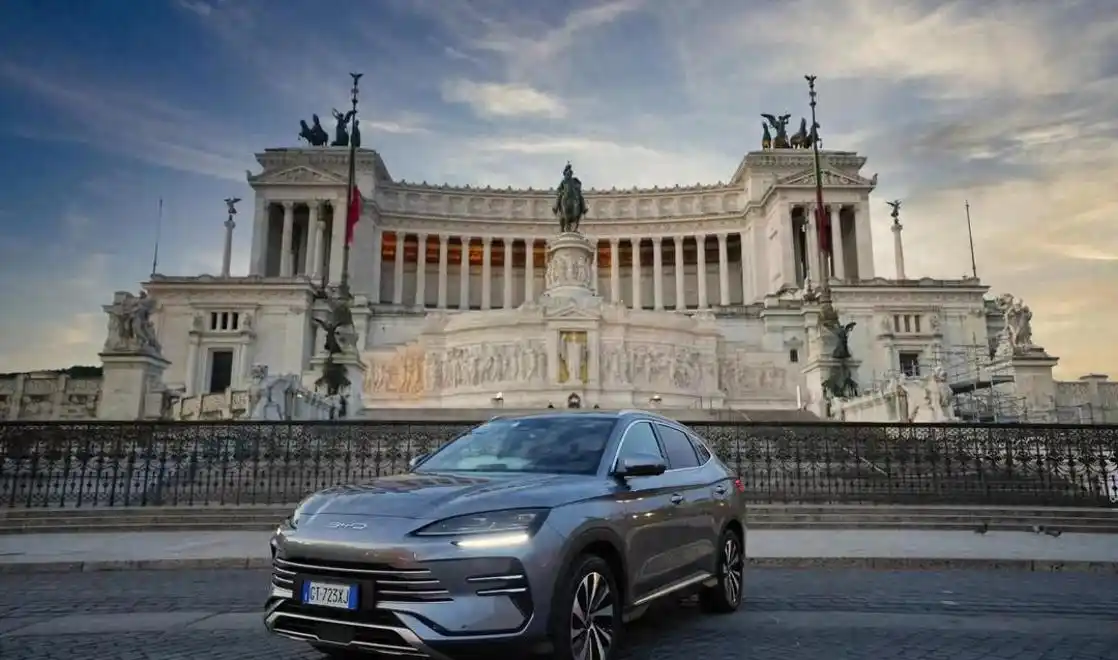
BYD registered 6,168 vehicles in Germany in May 2026 — its highest-ever brand ranking in Europe's most competitive auto market — as pure electric vehicles captured a quarter of total new-car sales, a threshold that signals the country's long-delayed EV inflection point has arrived.
Germany's Federal Motor Transport Authority (Kraftfahrt-Bundesamt, KBA) recorded 239,448 new vehicle registrations in May, a near-flat 0.1% year-on-year gain that masks a structural shift accelerating beneath the surface. Battery electric vehicles (BEVs) accounted for 59,969 units — up 39.3% year-on-year — pushing BEV market share from 18% in May 2025 to 25% in May 2026. Plug-in hybrids added another 27,921 units (+10.8%), bringing combined new-energy penetration to 36.7%. In practical terms, one in every three cars sold in Germany last month carried a plug.
For investors tracking the European EV transition, the convergence of two data points in a single month is significant: the BEV share crossing 25% and a Chinese brand — BYD — cracking the German top-12 for the first time. Both milestones arrived simultaneously, and neither appears transitory.
Domestic Champions Lose Ground as Electrification Reshapes the Ranking
Germany's five largest brands by volume — Volkswagen, Mercedes-Benz, BMW, Škoda, and Audi — collectively held the top five positions in May, yet every single one posted a year-on-year sales decline. Volkswagen led with 45,576 units and a 19% market share, but volume fell 8.9% from a year earlier, with all three of its core combustion-engine models contracting. Mercedes-Benz and BMW each shed 8.9% and 3.4% respectively, registering 19,846 and 19,665 units.
The erosion at the top is not uniform, however. BMW's X3 surged 82.5% to 3,410 units in May, with the fully electric iX3 variant contributing 37% of that volume — a clear indicator that the brand's EV pivot is beginning to generate tangible sales lift. Mini jumped 37.7% to 3,660 units across its full lineup, another data point consistent with buyer migration toward electrified product.
Outside the traditional German bloc, Opel delivered 11,501 units (+9.9%) to claim sixth place, while Renault returned to the German top 10 for the first time since December 2023, posting 6,336 units on a 43.5% year-on-year surge. Renault's re-entry is directly attributable to its electrified model refresh, reinforcing the pattern that brands investing in EV product cycles are taking share from those defending combustion-engine strongholds.
Tesla's Model 3 delivered a statistically striking 848% year-on-year increase to 2,664 units, though the base-period distortion — likely tied to delivery timing — limits direct comparability. The Model Y registered 2,410 units, up 162%.
BYD's 232% Surge Establishes a Beachhead, Not a Blitz
BYD's 6,168-unit result in May 2026 — a 232% year-on-year increase — places it 12th among all brands sold in Germany, the highest ranking any Chinese automaker has achieved in the market. The performance was driven by a multi-model strategy rather than a single hero product. The Atto 2 contributed 2,275 units (up 539%), ranking 29th among all models and closing to within 135 units of Tesla's Model Y in the pure-electric segment. The Seal U and Dolphin added approximately 1,500 and 1,200 units respectively, anchoring BYD's presence across the compact SUV and sedan segments.
The strategic implication is notable: BYD is not relying on a single price point or body style. A three-model spread across distinct segments reduces concentration risk and builds dealer infrastructure simultaneously — a longer-term market-entry architecture rather than a volume spike.
That said, the broader Chinese brand cohort remains subscale. Fourteen Chinese marques combined for approximately 11,758 units in May, representing a 4.9% aggregate market share. MG held second place among Chinese brands at 3,174 units (23rd overall). Leapmotor delivered 1,217 units (+139%) and Xpeng posted 633 units (+240%), both recording triple-digit growth from low bases. At the other end of the spectrum, Geely registered 102 units, Zeekr 38 units, and Jaecoo 101 units — brands whose German presence remains embryonic.
The aggregate picture is one of gradual perimeter infiltration rather than a frontal assault. In Volkswagen's home market, with entrenched dealer networks, brand loyalty, and regulatory familiarity working against new entrants, Chinese OEMs are pursuing a measured volume ramp that prioritizes footprint consolidation over near-term share maximization.
Two Inflection Points Converge, Compressing the Window for Legacy Automakers
The May 2026 data presents a compounding pressure scenario for German OEMs. BEV penetration at 25% has historically been the threshold at which early-majority buyers — more price-sensitive and brand-agnostic than early adopters — begin entering the market in volume. That demographic is precisely the segment Chinese brands, with structurally lower cost bases, are best positioned to capture.
Volkswagen's 8.9% volume decline in its domestic market, occurring simultaneously with BYD's record ranking, is not coincidental. The Golf — still Germany's best-selling single model at 7,183 units in May — fell 4.2% year-on-year. The T-Roc and Tiguan, both combustion-dependent, also contracted. Volkswagen's EV transition, while underway, has not yet generated sufficient volume to offset ICE attrition.
For the year to date through May 2026, Germany has registered 1.188 million new vehicles, up 3.6% — a macro environment that is mildly supportive but not expansionary. Within that context, BEV share gains are a zero-sum reallocation: every percentage point captured by electrified vehicles, and by the Chinese brands disproportionately competing in that space, is a point extracted from the combustion-engine franchises that have historically defined German automotive profitability.
The KBA's May data does not suggest German automakers face an imminent existential crisis in their home market. But the directional signal is unambiguous: the structural moat that once made Germany impenetrable to foreign volume brands is narrowing, and it is narrowing fastest in the segment — affordable electrics — where Chinese manufacturers hold their sharpest competitive advantage.
Related Coverage:
Chinese Automakers Outpace Tesla in Europe as EV Market Shifts