
Moonshot AI Detonates Open-Source Race With Kimi K3, Triggering Immediate Global Adoption
China's leading AI startup releases full model weights, technical report, and three core infrastructure libraries — forcing a direct performance comparison with Anthropic's Claude Fable 5 and reshaping the economics of frontier AI deployment
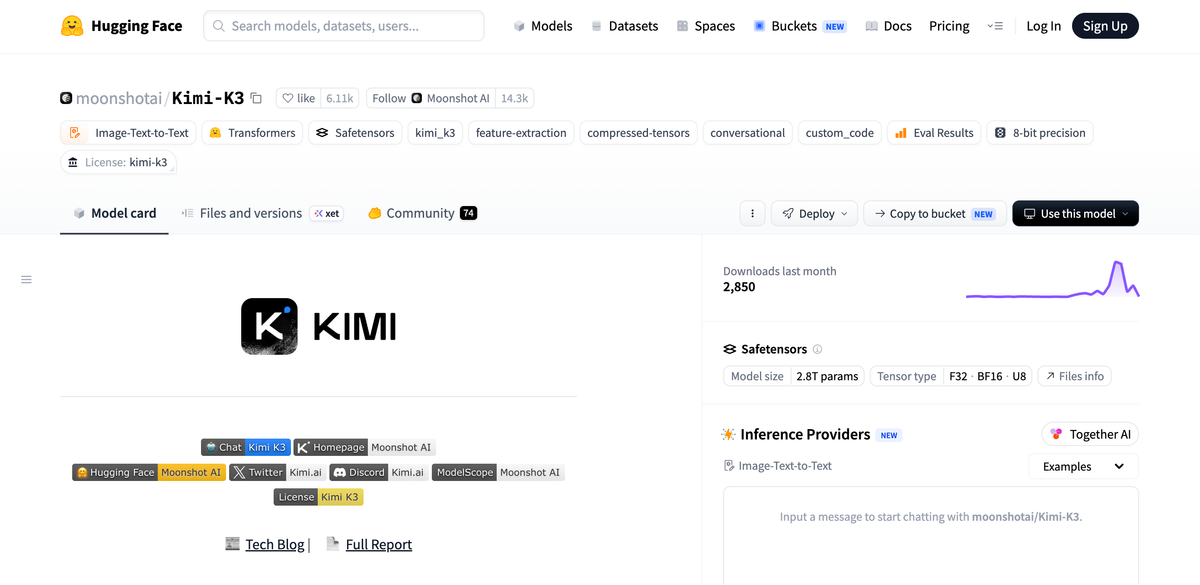
Moonshot AI on July 28, 2026 open-sourced Kimi K3 — a 2.8-trillion-parameter Mixture-of-Experts model with native vision understanding and a one-million-token context window — alongside the full training infrastructure stack, a move that within 30 minutes made it the fastest-rising model in Hugging Face history and prompted immediate Day-0 integration commitments from U.S. AI infrastructure providers.
The release lands eleven days after Kimi K3's closed debut on July 17, which had already drawn comparisons to Anthropic's Claude Fable 5 across developer communities. By opening the weights and publishing three previously proprietary infrastructure libraries — MoonEP, FlashKDA, and AgentEnv — Moonshot AI has shifted the competitive calculus: what was a benchmark curiosity is now deployable infrastructure that any enterprise or developer can embed into production systems at near-zero marginal cost.
Hugging Face CEO Clement Delangue confirmed the model accumulated more than 4,000 upvotes within 30 minutes of going live, a platform record. Nearly 3,700 developers had queued on the model's landing page before launch — demand so acute that the page briefly returned a 404 error ten minutes prior to release.
Moonshot AI Opens the Engine Behind Its Frontier Model
The strategic depth of the release lies not in the weights alone but in the simultaneous open-sourcing of the training infrastructure that produced them — a layer most frontier labs treat as a durable competitive moat.
MoonEP is a high-performance communication library purpose-built for ultra-large fine-grained MoE architectures, maintaining near-optimal expert-parallel communication efficiency even under load imbalance conditions. FlashKDA, previously open-sourced, is a high-performance operator for Kimi Delta Attention; benchmarks show prefill speed improvements of 1.72× to 2.22× over the flash-linear-attention baseline on Nvidia H20 hardware. AgentEnv, co-developed with KVCache.ai, is a sandbox system engineered for large-scale agent training, supporting rapid snapshotting, restoration, and forking to manage massively parallel agent workflows.
Together, the three libraries address the three most computationally expensive phases of building a frontier model at scale: expert routing communication, attention computation, and agent environment simulation. Releasing all three simultaneously signals that Moonshot AI is prioritizing ecosystem velocity over infrastructure secrecy — a bet that community adoption will compound faster than any proprietary advantage the stack might otherwise confer.
Benchmarks Reveal a Narrowing Gap — With Caveats
Official benchmark data positions Kimi K3 as the leading open-weight model across several high-value enterprise categories, while acknowledging persistent deficits against top-tier closed models.
In software engineering, Kimi K3 ranked first on SWE Marathon (long-horizon continuous development) and Program Bench (software reverse engineering), and scored 88.3 on Terminal Bench 2.1 — within striking distance of GPT-5.6 Sol. On FrontierSWE, a high-difficulty software engineering evaluation, K3 scored 81.2, placing second behind Claude Fable 5 only.
In agent and knowledge-work tasks, K3 scored 91.2 on BrowseComp (deep web research) and ranked first on both Automation Bench and SpreadsheetBench 2. On Moonshot's internal Knowledge Work Bench — covering general reasoning, deep document analysis, and financial modeling — K3 outperformed GPT-5.5 and Claude Opus 4.8 under maximum reasoning depth settings.
The honest caveat: on GDPval-AA v2 and APEX-Agents, which simulate real-world white-collar workflows more holistically, K3 trails Claude Fable 5. On Zerobench (zero-shot visual tool tasks), the gap to Fable 5 also persists. The picture that emerges is a model that matches or exceeds closed-source frontier performance on discrete, well-defined engineering tasks — but has not yet replicated the generalist office-productivity ceiling set by Anthropic's flagship.
Cost Asymmetry Accelerates Enterprise Switching
The economic argument for Kimi K3 adoption may prove more durable than any single benchmark. In a comparative game-design test conducted by overseas developer @He1s_Sammy, Kimi K3 was rated 9.5/10 on overall quality at an API call cost of $0.030 per query. Claude Fable 5 scored 7.5/10 at $0.38 per call — a 12.7× price premium. GPT-5.6 Sol scored 7/10 at $0.11 per call.
For enterprises running high-volume agentic workflows — the precise use case K3 is architected for — that cost differential is not marginal. At 10 million daily queries, the gap between Kimi K3 and Claude Fable 5 exceeds $3.5 million per month in API expenditure alone, before accounting for self-hosting economics enabled by the open weights.
Cognition, the U.S. AI startup behind the autonomous software engineer Devin, announced Day-0 integration of Kimi K3 into both its desktop client and command-line interface, stating the model is "the first open-source model we've tested that approaches frontier-level performance on FrontierCode 1.1." AI infrastructure providers Nebius, Baseten, and Fireworks AI also announced immediate support.
On the hardware side, Huawei's Ascend CANN platform announced Day-0 native support for MXFP4 quantization of Kimi K3, with deployment guidance for Ascend 950PR/DT and Atlas A3 cluster configurations. Qujing Technology, leveraging the open-source SGLang inference engine, completed Day-0 adaptation for the Huawei Ascend 910C supernode and simultaneously open-sourced the adaptation code — a signal that China's domestic AI hardware ecosystem is moving in deliberate lockstep with model releases to reduce dependency on Nvidia supply chains.
Long-Horizon Capability Demonstrations Reframe the Agent Market
Moonshot's official showcase goes beyond standard benchmark tables. In a 48-hour continuous autonomous run, Kimi K3 used open-source EDA tools and the Nangate 45nm process library to independently construct, optimize, and verify a chip design — a task category that has historically required specialized human engineering teams.
In scientific research, K3 analyzed 391 gravitational wave events from the GWTC-5 catalog in a single session, deploying more than 20 concurrent sub-agents to produce seven scientific visualizations, two data tables, and a synthesis of over ten academic papers. In GPU programming, it independently developed MiniTriton, a Triton-like compiler that converts developer-written programs into GPU-executable code, with performance exceeding existing tools in select scenarios.
These demonstrations are not controlled benchmarks — they are proof-of-concept runs designed to position Kimi K3 in the emerging "agentic infrastructure" market, where the competitive moat belongs to models that can sustain coherent reasoning across hours-long task horizons rather than single-turn completions.
Geopolitical Headwinds Sharpen as Influence Grows
The open-source release arrives against an increasingly adversarial U.S. regulatory backdrop. Senators Tim Scott and Bill Hagerty have introduced legislation to expand Commerce Department authority to restrict foreign adversary access to AI technology. The Commerce Department previously considered adding Moonshot AI, DeepSeek, and Alibaba's Qwen team to the Entity List. The White House has separately evaluated executive orders that would make U.S. companies using Chinese AI models liable for security incidents. OpenAI and Anthropic have each submitted proposals to ban Chinese open-source models from U.S. deployment.
China's Commerce Ministry characterized such proposals as "typical AI hegemonism," and noted that nearly 200 U.S. startups have lobbied the government against restricting access to Chinese open-source models, arguing it would structurally disadvantage American enterprises competing in cost-sensitive AI product markets.
The lobbying data point is analytically significant. It suggests the U.S. AI supply chain has already absorbed Chinese open-weight models as a cost layer — and that any blanket restriction would impose asymmetric harm on smaller American firms that lack the resources to train frontier-scale alternatives. The open-source distribution mechanism makes enforcement structurally difficult: once weights are downloaded, they are not retrievable.
Structural Implications for the Global AI Stack
Six months ago, when DeepSeek-V3 was open-sourced, the dominant reaction in Western developer communities was dismissive — "another Chinese model." The community discourse around Kimi K3 has measurably shifted: developers are now framing it as a direct replacement for Claude Fable 5 in production pipelines, and the conversation centers on capability parity rather than provenance skepticism.
That shift in framing has direct implications for the competitive positioning of closed-source U.S. AI labs. If open-weight Chinese models continue to compress the performance gap with closed frontier models while maintaining a 10× to 12× API cost advantage, the sustainable business model for proprietary AI inference faces structural pressure — particularly in the developer tooling, enterprise automation, and agentic workflow segments where Kimi K3 benchmarks strongest.
The 2.8-trillion-parameter architecture, the 1-million-token context window, and the full infrastructure stack release collectively represent a deliberate attempt to make Kimi K3 not just a model but a platform — one that third-party hardware vendors, inference providers, and application developers can build on without dependency on Moonshot AI's own cloud. Whether that platform strategy translates into durable commercial advantage will depend on how quickly the ecosystem integrations compound, and whether U.S. regulatory action can interrupt the distribution before adoption becomes irreversible.
Related Coverage:
Moonshot AI's Kimi K3 Rattles Wall Street as Hong Kong IPO Looms Within Six Months