
Morgan Stanley Bets on China Humanoid Robots: 50K Units, $2B Market in 2026
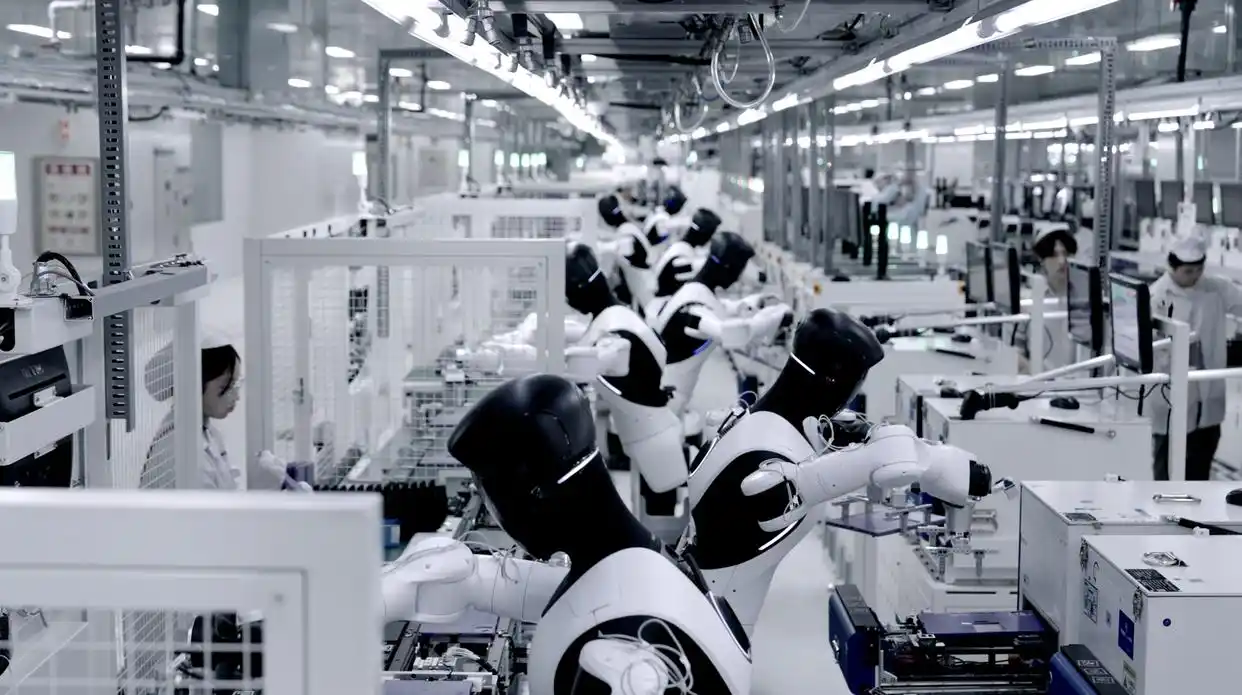
Morgan Stanley's Asia industrials team published a sweeping upgrade to its China humanoid robot outlook on June 23, 2026, lifting its full-year shipment forecast by 79% to 50,000 units — up from a prior estimate of 28,000 — and projecting the market will scale to 446,000 units by 2030, implying a 106% compound annual growth rate. The revision is not a routine model tweak. It reflects a convergence of commercial verification, government mandate, and supply-chain readiness that, taken together, suggests China's humanoid buildout is transitioning from pilot theater to genuine industrial deployment.
The report deserves attention not just for the headline numbers, but for what it reveals about the structural forces now accelerating adoption across the world's largest manufacturing economy.
From Demo Floor to Factory Floor
The key shift Morgan Stanley's analysts identify is the move from demonstration to commercialization. In the first half of 2026, humanoid robots began appearing in continuous livestreams from factory and logistics settings — not staged showcases, but live operational footage. State Grid placed an order worth RMB 6.8 billion (US$940 million) for 500 humanoid robots, 3,000 dual-arm robots, and 5,000 quadrupeds. SF Express and China Post are deploying Robotera's humanoids across logistics centers. XPeng has announced mass production of its Iron humanoid robot by end-2026.
"As business verification typically takes several months," the report notes, "we expect projects that began testing in 1H26 to translate into adoption from 2H26 onward." That pipeline dynamic — verification today, orders tomorrow — underpins the confidence behind the forecast upgrade.
Policy Turns From Aspiration to Obligation
China's policy architecture has shifted from aspirational to operational. In March 2026, Beijing included robotics as a strategic emerging industry in the 15th Five-Year Plan for the first time. By June 2026, the Ministry of Industry and Information Technology (MIIT) and the State-owned Assets Supervision and Administration Commission (SASAC) jointly mandated that local governments identify at least 20 operational humanoid deployment sites per province, while each central state-owned enterprise must designate at least 10. Progress will be evaluated in November 2026.
The government's stated targets — 10,000-unit-level deployment capacity and over 100 high-value application scenarios by year-end — are ambitious, but the structural mechanism is now in place to compel action rather than merely encourage it.
Supply Chain Checks: Capacity Is Being Built
Morgan Stanley's on-the-ground supplier visits paint a picture of a supply chain moving from sample-stage to early volume ramp. Three trends stand out:
Capacity expansion is accelerating. Leader Harmonious Drive Systems (688017.SS) — the report's top pick — has expanded monthly harmonic reducer capacity from 50,000 units in Q1 2026 to approximately 70,000 currently, targeting 100,000–120,000 by year-end. Jiangsu Hengli Hydraulic (601100.SS) is building out its Mexico plant to support roughly 100,000 robot units annually.
Component revenues are scaling fast. Zhaowei guides humanoid-related revenue to at least double to RMB 40 million this year, with a bull case of approximately RMB 100 million. Huayan expects humanoid revenue to approach RMB 100 million in 2026 and reach RMB 400–500 million in 2027.
Equipment demand is emerging. Topstar reports that humanoid robotics already accounts for 30–40% of downstream demand for its CNC machine tools — a leading indicator that capacity expansion is beginning to generate second-order capital expenditure.
Top Picks: Leaderdrive, Hengli Hydraulic, Shuanghuan
Morgan Stanley's preferred names reflect a deliberate focus on component suppliers with defensible market positions rather than integrators still burning cash on commercialization.
Leader Harmonious Drive Systems receives the most detailed treatment. The bank raises its price target 72% to RMB 464, based on a DCF model assuming 40% near-term and 25% long-term global market share in humanoid harmonic reducers. Humanoid-related revenue is forecast to contribute 35% of total sales in 2026 and 50% in 2027. The bull case target sits at RMB 908 — more than double the current price.
Jiangsu Hengli Hydraulic is flagged as a key planetary roller screw supplier with over 70% share in body screw products, potentially expanding into motor and linear actuator assembly. Its Mexico capacity build targets approximately 100,000 robot units by year-end.
Zhejiang Shuanghuan Driveline (002472.SZ) has been co-developing a new reducer with a leading U.S. humanoid integrator for over two years, with precision gear expertise seen as transferable to humanoid components.
Market Size and Mix Shift
Combining revised volume and ASP assumptions, Morgan Stanley now projects China’s humanoid robot market to reach US$2 billion in 2026 and US$15 billion by 2030. ASP dynamics remain mixed: prices are expected to fall 15% in 2026 as half-size robots dominate shipments, before recovering in 2027–28 as full-size, manipulation-capable humanoids — with higher price points — expand from ~30% of the market today to ~70% by 2028.
The sector's year-to-date performance tells a story of divergence: component suppliers ("body") are down just 8.7%, while robot "brain" companies have shed 27.2%. With a wave of catalysts ahead — WAIC in July, the World Robot Conference in August, potential Optimus Gen 3 updates, and multiple humanoid IPOs in the pipeline — the second half of 2026 may prove to be the period when China's humanoid ambitions are either validated at scale or face their first serious commercial reckoning.
Related Coverage:
China's Humanoid Robots Win Global Orders as Industry Shifts from Follower to Leader