
China's Humanoid Robots Win Global Orders as Industry Shifts from Follower to Leader
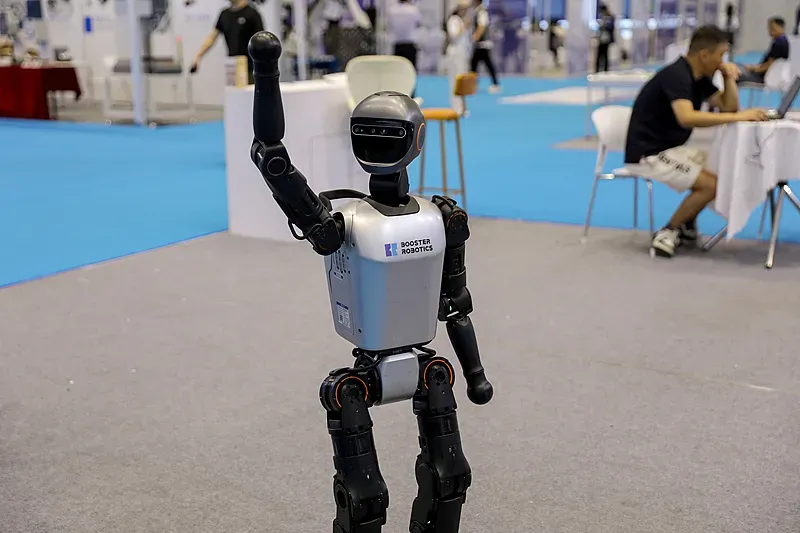
China's robotics industry is completing a strategic leap from market follower to global leader, with humanoid robots spearheading an international expansion that spans from technology exhibitions in Las Vegas to operational deployments in Dubai's desert facilities. The transformation encompasses breakthroughs in core components, mass production capabilities, and comprehensive global supply chain integration.
At the 2026 International Consumer Electronics Show (CES), Chinese robotics companies secured full order books for their exhibition inventory, validating global market acceptance of Chinese manufacturing capabilities. Multiple exhibitors reported selling out their entire display units before the show concluded, with overseas markets now accounting for over 40% of sales for leading manufacturers.
The Middle East has emerged as a critical testing ground, posting a 32% compound annual growth rate that reflects strong regional demand for high-end automation solutions. Companies like RobStride Dynamics in core components and Hikrobot in integrated systems exemplify China's full-chain export capability, moving beyond simple product sales to technology transfer and supply chain integration.
This wave of humanoid robot exports is reshaping global competitive dynamics while marking China's evolution from product exporter to a comprehensive provider of technology, supply chains, and potentially industry standards.
CES Validates Market Demand
The 2026 CES in Las Vegas served as a proving ground for Chinese robotics capabilities, with companies including Robot Era, Beijing Innovation Center of Humanoid Robotics, LOVEAXI, and GALBOT mounting their largest-ever exhibition presence.
Accelerando achieved the most extensive booth presence, showcasing its Booster K1 entry-level embodied development platform launched in October 2025. A company representative confirmed that dozens of Booster K1 units displayed at the show were fully pre-ordered before the exhibition ended. "This exhibition was a stress test for our product's market strength. Demand from the market side is very robust," the representative told the Science and Technology Innovation Board Daily.
Accelerando's overseas markets now exceed 40% of total sales, with cumulative global shipments approaching 1,000 units. The company's success reflects broader industry momentum captured in recent Omdia research showing global humanoid robot shipments reaching 13,000 units in 2025, with Chinese manufacturers demonstrating particular strength in scaled production. AgiBot captured 39% global market share, with Unitree following closely.
LOVEAXI, a Beijing Zhongguancun Science City enterprise, presented its loviPeer emotional companion robot to unexpectedly strong reception. CEO Yan Jin reported that the AI companion robot "lovi" generated above-forecast market interest and concrete business progress. "We achieved immediate results in direct sales and channel development. During the exhibition, lovi simultaneously launched on Amazon's North American platform. Many visitors who experienced the product on-site placed orders immediately through the product link, expressing enthusiasm to experience Chinese AI application technology firsthand," Yan said.
The exhibition attracted professional distributors and channel partners from the United States, Europe, Japan, and South Korea, who expressed strong agency interest while providing constructive feedback on product positioning, marketing strategies, and localized operations tailored to local consumption patterns.
Middle East Emerges as Premium Market
While CES provided global visibility, the Middle East has become a critical battlefield demonstrating Chinese robots' ability to penetrate high-end markets. The region's unique economic structure, demographic profile, and strategic requirements create ideal conditions for product validation, brand building, and premium ecosystem integration.
An Abu Dhabi-based robotics distribution platform manager explained the region's distinctive characteristics: "The Middle East is very unique. Our preliminary research found young people constitute a large proportion of the population. They are very enthusiastic about technological, intelligent products, and young people are heavily influenced by the internet—products shared by online influencers gain easier acceptance. Meanwhile, Middle Eastern countries are relatively wealthy with strong purchasing power, preferring high-priced products with comprehensive functionality."
"Although we typically promote only one product in the Middle East—the newest, most advanced model—because low-end products cannot satisfy Middle Eastern consumers and would actually diminish brand image," the manager added.
The market potential is substantial. As an emerging market, the Middle East posts a 32% compound annual growth rate with significant consumption potential and high unit prices, providing Chinese sellers with vast blue ocean growth opportunities. The region's scarce industrial and manufacturing base means most goods—including home products, consumer electronics, and apparel—depend on imports. Robot dogs currently perform well in Middle Eastern sales.
In the UAE, Chinese robots have achieved scaled deployment, becoming an important force in local intelligent transformation. Local distributor Ednex Automation stated that through cooperation with Unitree, they are redefining future human-machine collaboration. "Through our cognitive physical interaction system, which enables intelligent decision-making through physical actions, we will demonstrate how these robots achieve adaptive bionics, enhance human capabilities, and drive social intelligent robot development—thereby transforming industries from healthcare to warehousing."
Lingzu Times Co-founder and COO Shao Yuanxin explained that economically stronger nations like the UAE and Saudi Arabia prioritize robots' performance attributes, mainly purchasing complete machines from brands like Unitree, Agibot, and Zhongqin, with relatively limited demand for joint modules "because their capabilities in robot R&D are relatively weak. Meanwhile, unstable Middle Eastern regions have greater need for complete machines to execute dangerous tasks."
Behind this interest lies accelerating industrial transformation in Middle Eastern nations led by the UAE and Saudi Arabia. The UAE has launched its AI Strategy 2031, explicitly targeting global AI leadership by 2031. On November 12, during the first Abu Dhabi Smart and Autonomous Technology Week, the 2025 Asia-Pacific Robot World Cup opened in Abu Dhabi—the Gulf region's largest robotics competition to date. Chinese companies provided technical support, with Unitree supplying boxing competition robots and Accelerando providing motion capture technology hardware for 5v5 soccer matches.
Dr. Hamad Obaid, Chairman of the 2025 Asia-Pacific Robot World Cup and Associate Professor in Khalifa University's Mechanical and Nuclear Engineering Department, explained the selection rationale: "When I visited China in 2025, I was impressed by China's achievements in artificial intelligence technology, particularly in robotics, where China's embedded AI development is excellent. Technology plays an important role in Robot World Cup preparation. We need robots with strong performance, fast response, easy programming, and the ability to get up after falling. Currently, only Chinese robots can meet our requirements."
Stefan Klaksnár, Competition Development Advisor at Abu Dhabi's Department of Economic Development, previously told the Science and Technology Innovation Board Daily: "We foresee the AI field will have enormous markets in the future. Therefore, we established the Smart and Autonomous Vehicles Industries (SAVI) cluster in Abu Dhabi to attract technology providers and leading companies in aerial autonomous driving, land-based autonomous taxis, and even maritime water taxis. Additionally, robotics and embodied intelligence technology are key focus areas for SAVI, and Chinese companies play very important roles in these fields. We hope these technologies can achieve commercial deployment and application in daily life."
The UAE has also established the Robotics and Automation (RAX) Association, planning to deploy over 200,000 robots with a target of robotics contributing 9% to GDP by 2030.
Core Components Provide Foundation
China's rapid rise in complete robot systems globally is fundamentally supported by strong competitiveness established in core components and supply chains. Lingzu Times' export story vividly illustrates this point.
As a supplier focused on robots' "motion heart"—joint modules—Lingzu Times achieved over 100,000 units shipped in 2025, with customers covering virtually all major domestic robot manufacturers. Its overseas shipment of approximately 26,000 units with high gross margins demonstrates that Chinese core components have gained value recognition in global premium markets.
Lingzu Times' global customer roster is highly persuasive. According to Shao Yuanxin, it includes not only Physical Intelligence (PI), Stanford University, Hugging Face, and other American institutions and companies representing world-class R&D capabilities, but also robotics companies from France, the UK, Japan, and South Korea, plus regional technology giants like VinMotion under Vietnam's VinGroup. This clearly indicates that in the global robotics innovation network, China's high-performance core hardware has become a foundational, default choice.
Shao's overseas market deployment strategy is highly representative: focusing on economically strong countries willing to build cutting-edge technology images, such as Vietnam, Singapore, Japan, South Korea, and Australia—regions whose industrial support logic resembles China's with significant market potential. Overseas demand divides into three customer types: first, robot body manufacturers as the core customer group; second, research institutions for laboratory R&D and agricultural automation projects; third, DIY individual enthusiasts who constitute the main audience for overseas retail business, using joint modules to create simulators, automatic bicycles, and similar equipment.
Lingzu Times practices a "technology-driven" and "deep service" model in overseas expansion. Rather than deploying large dedicated sales teams, the company relies on technical engineers to directly interface with customers. Co-founders personally lead technical teams visiting Vietnam, the United States, Europe, and other locations to deeply understand local cultures and work habits, ensuring smooth communication.
Hikrobot focuses on machine vision, mobile robots, and articulated robot products and solutions. Overseas head Feng Libo explained that the company's overseas deployment emphasizes sustainable local automation and intelligence demand, hoping products and solutions can serve local factories and warehouses long-term, helping achieve sustained commercial success and sustainable social value—approaching overseas markets with an industrial mindset.
According to Feng, the company began overseas operations in 2017, emphasizing localized operations. For localization, subsidiaries have been established in the Netherlands, France, Germany, Hungary, South Korea, Japan, Singapore, and Malaysia (as of July 2025), with business networks covering over 50 countries and regions while actively conducting market development and ecosystem building.
Products follow international enterprises' applications across their global factory networks. Customers are primarily enterprises, with industry coverage including automotive, lithium batteries, retail, e-commerce, pharmaceutical distribution, semiconductors, and consumer electronics. Major client projects span South Korea, Japan, Germany, France, and Spain.
Navigating Certification and Localization Challenges
Despite strong momentum, Chinese robot exports face considerable challenges from market access to cultural integration. Both complete machine manufacturers and component suppliers confront complexities from certification to deep localization, particularly in mature markets.
Feng candidly acknowledged numerous practical issues in project implementation: "Overseas major manufacturers have requirements for enterprise employment, sustainable development, product certification, and safety. Additionally, in European and American markets with high automation levels and complete manufacturing ecosystems, products must align with local ecosystems and automation markets (such as Siemens and Rockwell ecosystems)."
"Enterprise system certification must meet local overseas access standards. Frankly speaking, Chinese robotics enterprises have a long road ahead," Feng said. "From our product business perspective, the global market is a blue ocean (long-term), though competition exists. Overall, our customer stickiness is relatively high—once they select us, they generally continue cooperation."
Regarding customization adaptation, Feng revealed: "Product customization needs exist. Chinese national standards differ from European and American standards across food safety, electronic products, and many categories. For example, in European projects, robot laser components must comply with European standards, requiring component replacement. Fire protection ratings impose different construction requirements—in Europe, fire sprinklers must be installed at fixed shelf intervals, requiring shelves and supporting equipment to reserve appropriate space with scenario-adapted solutions."
Deep localized operations present another critical challenge extending far beyond establishing overseas subsidiaries or hiring local employees. Hikrobot's construction of business networks covering over 50 countries through subsidiaries in the Netherlands, Germany, Japan, Singapore, and elsewhere directly addresses this challenge. Lingzu Times' emphasis on "cultural respect" and "technical engineers facing customers directly" tackles localization from another dimension, building trust through professional, sincere direct communication.
A senior executive in the embodied intelligence field analyzed that Chinese robotics exports have formed a clear, multi-layered strategic framework evolving from simple "product exports" toward higher-dimensional "ecosystem exports" and "standards exports."
First, the industrial chain collaborative export model is maturing. Upstream players like Lingzu Times provide "hearts" to global innovators, midstream companies like Unitree and Accelerando provide advanced "bodies," and downstream integrators like Hikrobot provide scenario-based "solutions"—forming a resilient, competitive global Chinese robotics industrial chain.
Second, technological routes and business models are increasingly diversified. Chinese robotics enterprises no longer limit themselves to cost-performance routes, but compete with international giants across multiple dimensions including high-end performance (such as Unitree G1's motion capabilities), open platforms (such as Accelerando Booster K1), and specific scenario solutions (such as firefighting and warehousing).
Finally, Chinese companies are becoming participants and contributors to global technology governance. As Chinese robot products penetrate global infrastructure, research frontiers, and daily life, Chinese enterprises are positioned to gradually increase influence over product safety standards, data ethics, and human-machine collaboration norms.