
Morgan Stanley Flags China's Chip Ambitions Amid CXMT IPO and $7.8 Billion SMIC Injection
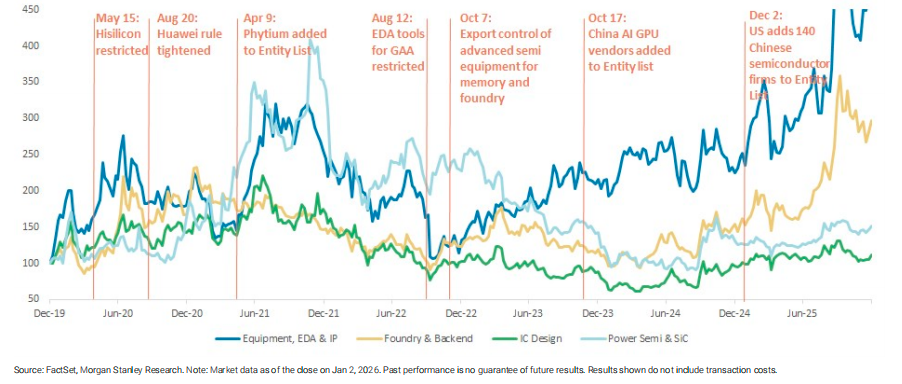
Morgan Stanley released a comprehensive analysis on January 7, 2026, tracking China's semiconductor localization efforts, highlighting major capital raises and evolving dynamics around Nvidia's H200 chip demand. The report, authored by analysts Charlie Chan, Daisy Dai and Daniel Yen, provides critical insights into how Beijing's domestic chip industry is gaining momentum despite ongoing U.S. export restrictions—a development with significant implications for global semiconductor supply chains.
The investment bank's assessment arrives as Chinese memory and foundry players secure substantial funding for capacity expansion, while U.S. policy shifts on advanced GPU exports create uncertain but potentially lucrative crosscurrents for both domestic and foreign chipmakers.
CXMT's $4.2 Billion Shanghai Listing Fuels DRAM Ambitions
ChangXin Memory, China's leading domestic DRAM manufacturer, has filed for an initial public offering on the Shanghai Stock Exchange, seeking to raise RMB 29.5 billion (US$4.2 billion) through the issuance of 10.6 billion shares. Morgan Stanley's analysis suggests the capital injection will fund approximately RMB 34.5 billion (US$4.9 billion) in investments over three years, translating to roughly 50,000 wafers per month in additional capacity.
While CXMT maintains RMB 43 billion in cash reserves, the analysts note the company may also pursue partnerships with local governments to further accelerate expansion—a familiar playbook in China's state-backed semiconductor development strategy. The IPO represents another milestone in China's quest to reduce dependence on foreign memory suppliers, particularly as geopolitical tensions continue restricting access to cutting-edge equipment and technology.
SMIC Consolidates Operations with $7.8 Billion Capital Injection
Semiconductor Manufacturing announced it will bring in Big Fund Phase III alongside six major state-owned banks for a capital increase of US$7.8 billion into SMIC South. Simultaneously, the company plans to acquire the remaining 49% equity interest in SMIC North currently held by Big Fund Phase I and the Beijing Integrated Circuit Fund, converting it into a wholly owned subsidiary.
SMIC North operates primarily 12-inch fabs producing mature node chips ranging from 28nm to 65nm—processes critical for automotive, industrial and consumer applications where China seeks self-sufficiency. Morgan Stanley views the acquisition as accretive to net profit margins while the capital injection "strengthens its balance sheet for future capacity expansion." The analysts maintain an Overweight rating on SMIC, positioning it as "a key enabler of China's AI localization."
Nvidia H200 Demand Creates Complex Calculus for Beijing
According to Reuters reporting cited in the Morgan Stanley note, Chinese technology companies have placed orders exceeding 2 million Nvidia H200 chips for 2026, yet Nvidia holds only 700,000 units in inventory. The H200, designed for AI training workloads, remains subject to U.S. export controls, creating uncertainty around whether Beijing will approve all purchases from Chinese cloud service providers.
"It remains uncertain whether the Chinese government will approve all the purchase demand from Chinese CSPs, because it may dilute the adoption of local chips," the Morgan Stanley analysts observe. This tension was evident at ByteDance's Force Conference in Shanghai on December 18, 2025, where the company unveiled 256-node AI server racks compatible with both Nvidia chips and domestic alternatives—suggesting a deliberate strategy of balanced adoption.
The analysts estimate that every 1 million H200 chips could contribute approximately US$1.3 billion in foundry revenue to Taiwan Semiconductor Manufacturing, though packaging shifts to Amkor's 2.5D SWIFT technology may reduce TSMC's dollar content per chip even as volumes increase.
China's AI Inference Demand Accelerates Despite Constraints
Morgan Stanley highlights explosive growth in token consumption as evidence of surging AI inference demand in China. ByteDance's token processing reached 50 trillion daily as of December 2025, representing a monthly run-rate of 1,550 trillion tokens—up 67% from 30 trillion daily in September 2025. For context, China's aggregate token consumption stood at 30 trillion daily by end-June 2025, a 300-fold increase from just 0.1 trillion at the beginning of 2024.
This voracious demand is driving Chinese design houses to develop "within-spec" AI inference chips using TSMC's 6nm and 7nm processes that comply with U.S. Export Control Classification Number 3A090 performance thresholds. Companies like Enflame, along with potential designs from Alibaba's T-Head and ByteDance, are pursuing lower-performance accelerators for inference workloads that fall within regulatory parameters.
For more aggressive designs exceeding export control specifications, Morgan Stanley expects Chinese firms will leverage domestic foundries such as SMIC's 7nm node or potentially Samsung's 4nm process—further fragmenting the global semiconductor supply chain along geopolitical lines.
Equipment Import Data Reveals Localization Progress
China's semiconductor equipment imports totaled US$2.1 billion in November 2025, down 10% year-over-year, though the three-month moving average showed 11% growth. Notably, lithography equipment imports from the Netherlands—primarily deep ultraviolet (DUV) tools from ASML—declined 36% month-over-month in November but maintained 11% year-over-year growth on a three-month average basis.
Year-to-date through November 2025, equipment imports from the U.S., Netherlands and Japan decreased 32%, 7% and 5% respectively, while imports from South Korea and Singapore rose 9% and 16%—reflecting ongoing efforts to circumvent restrictions through alternative suppliers and equipment types.
Morgan Stanley projects China's semiconductor self-sufficiency ratio will reach 30% by 2027, up from an estimated 24% in 2024 and 20% in 2023. The analysts attribute this acceleration to memory capacity ramps, breakthroughs in advanced logic nodes including Huawei's Ascend 910B and 910C AI chips, and continued strength in automotive semiconductor demand driving domestic image sensor and power semiconductor production.
The report maintains Overweight ratings on SMIC and various Chinese semiconductor equipment players, arguing that "ongoing strong demand for leading-edge logic for local AI computing chips" will support growth despite near-term uncertainties around export controls and foreign chip availability. As China's semiconductor localization enters a new phase of substantial capital deployment and capacity expansion, the strategic competition over advanced chipmaking capabilities shows no signs of abating.