
Neolix CEO: China's Autonomous Vehicles Lead the World, 10,000 Unit Milestone Just the Beginning
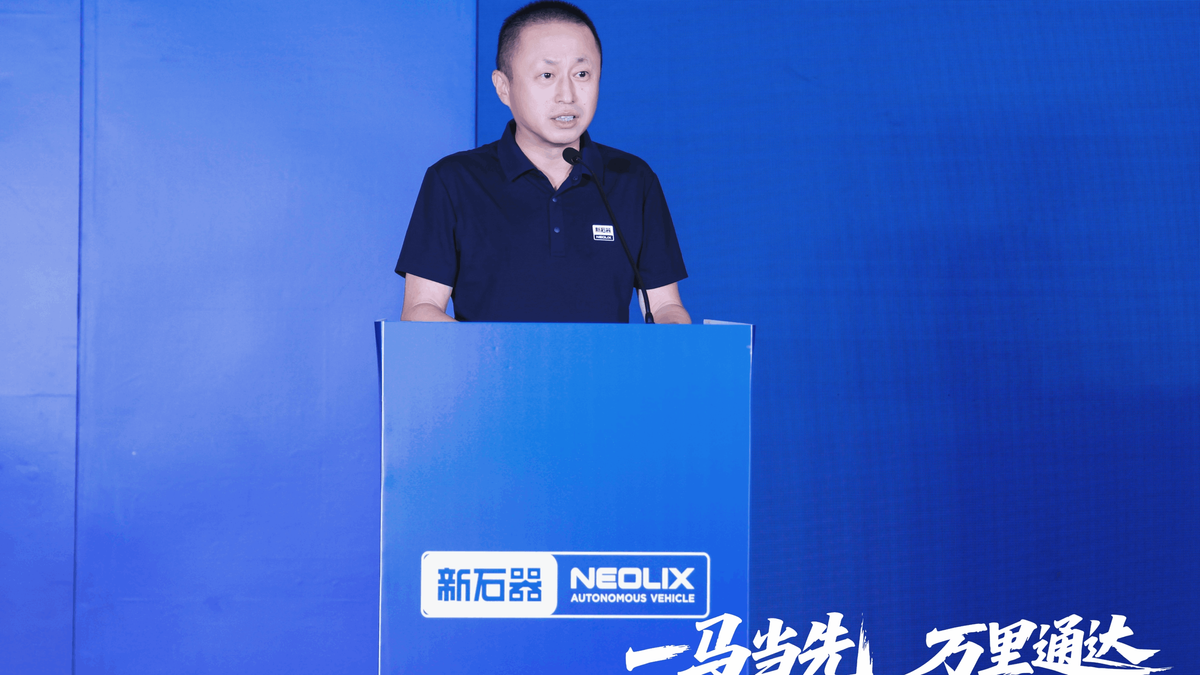
Beijing-based autonomous delivery vehicle manufacturer Neolix announced on September 23rd that its 10,000th vehicle rolled off the production line in Tonglu, Zhejiang Province, marking a significant milestone for the industry. Founded in 2018, the company has established what it claims is the world's first 10,000-unit autonomous delivery fleet, signaling the industry's transition from technology validation to large-scale commercial deployment.
The achievement highlights China's growing dominance in the autonomous vehicle sector, particularly in commercial applications where cost efficiency and scalability are paramount. Neolix's milestone comes amid intensifying competition in China's autonomous delivery market and growing international expansion opportunities.
Since its establishment in 2018, Neolix has pursued the mission of "making autonomous vehicles ubiquitous globally," completing the leap from technological breakthroughs to large-scale deployment over seven years. The company achieved several key milestones: launching the world's first 10,000-unit capacity factory in 2019, obtaining China's first batch of road permits for autonomous delivery vehicles in 2021, breaking the 1,000-unit delivery threshold in 2024, and now officially rolling out its 10,000th autonomous vehicle, achieving a leap from "pioneer" to "leader."
It's worth noting that beyond express delivery scenarios, Neolix has accelerated deployment in instant logistics, fresh goods delivery, pharmaceutical cold chain, group meal transportation, and community retail scenarios, which will become new growth drivers. Particularly since the second half of 2025, Neolix has extended into real-time dispatch logistics through cooperation with Didi Freight. By the end of 2025, Neolix expects to deploy 4,000 to 5,000 autonomous vehicles in non-express delivery scenarios, with the majority used for real-time logistics dispatch.
"The rollout of the 10,000th vehicle is a small step for Neolix, but also a new beginning for the autonomous delivery industry's development," said Yu Enyuan, founder and CEO of Neolix. He believes autonomous vehicles will reconstruct global logistics infrastructure in the future, better helping customers reduce costs and increase efficiency while bringing greater value to society.
On the occasion of the 10,000th vehicle rollout, Neolix founder and CEO Yu Enyuan shared his thoughts on the current autonomous vehicle sector and future prospects with "IPO Morning Post" and others.
According to Yu Enyuan, Neolix has achieved monthly profitability. "Whether from the perspective of L4 autonomous driving or from the perspective of robotics and embodied intelligence, autonomous vehicles are very likely to be the first segment to achieve large-scale commercial application and positive profitability."
Autonomous Vehicles May Lead the New Era of Embodied Intelligence Must Be Both Good Business and Provide Maximum Customer Value
Q: In your view, why has the autonomous vehicle sector been so popular this year?
Yu Enyuan: I believe it's influenced by DeepSeek at the beginning of 2025, when everyone suddenly realized how close AI technology is to their daily lives. Based on this point, the capital market began seeking industries and targets that could be the first to use AI technology on a large scale, and the business model of autonomous vehicles is viable.
In fact, whether from the perspective of L4 autonomous driving or from the perspective of robotics and embodied intelligence, autonomous vehicles are very likely to be the first segment to achieve large-scale commercial application and positive profitability. In other words, autonomous vehicles might be the opening chapter of the L4 autonomous driving or embodied intelligence new era. I think this is the core reason why autonomous vehicles have been so popular this year.
Q: But it seems the industry has been fighting a fierce "price war" this year.
Yu Enyuan: Frankly speaking, there is some "involution" in the autonomous vehicle industry.
The logistics industry is inherently a deflationary industry, with the first principle being cost reduction - how to provide customers with the lowest cost, highest cost-performance products to help reduce costs and increase efficiency. This is our mission. Our mission is to use the best AI to help users reduce costs and improve efficiency.
Today there are many players in this industry, and everyone is starting to "compete on price" to grab market share at this stage. This is all very early-stage behavior. Because the real business model of autonomous vehicles is not about selling cars, but about providing transportation capacity services. Whoever can provide customers with the best experience and lowest cost operational services will win customers.
The business model of autonomous vehicles has moved beyond the previous commercial vehicle stage of selling one vehicle to one driver, so whether autonomous vehicle prices are high or low is not the most critical factor determining success or failure. All our customers focus on whether we can help them reduce costs and increase efficiency through the best service.
Q: How do you achieve "cost reduction"?
Yu Enyuan: Neolix is a software-hardware integrated company - we use the best algorithms, primarily vision-based technology, to simplify all hardware sensors and hardware configurations, achieving modularization. Reducing hardware manufacturing costs and operational maintenance costs is our approach.
Q: What is Neolix's current profitability?
Yu Enyuan: From a monthly dimension, we have already achieved profitability.
We don't fight price wars; the products we create must be products that allow us to achieve profitability. When monthly sales break through 1,000 units or a certain number, we can achieve monthly break-even or even profitability because we maintain sufficiently high gross profit margins.
Going deeper, how can we maintain sufficiently high gross profit margins without fighting price wars while still serving customers well and letting them enjoy the lowest cost services? This relates to a series of comprehensive capabilities including technological capability, product quality, operational maintenance costs, and service capabilities.
Neolix's underlying logic is that we must be a good business and a good company, while also letting our customers enjoy maximum value.
Exceeding Expected Goals, Demand Surges in Non-Express Industries China's Autonomous Vehicles "Far Ahead" Globally
Q: Today you held the ceremony for the 10,000th vehicle rollout. Do you have expectations for your future development speed?
Yu Enyuan: Our goal at the beginning of 2025 was to cumulatively deliver 10,000 vehicles this year. Now it's faster than I imagined - we completed the goal a quarter ahead of schedule. For the remaining quarter of 2025, we will maintain production capacity and sales of around 2,000 units per month, so our delivery volume this year could potentially exceed 15,000 units.
Financially speaking, cash flow can also turn positive in the final few months, which is our operational goal.
As for next year, based on current market demand, we expect demand of 30,000 to 50,000 units (excluding overseas markets). We are now preparing to increase production capacity at all our bases, including the Tonglu base, and joining with the entire ecosystem to welcome the market demand explosion of 30,000 to 50,000 units per year.
Assuming next year has demand of 30,000 to 50,000 units, plus overseas markets, the year after will definitely have demand of over 100,000 units. We hope to plan ahead.
Q: Besides the express delivery industry, what is the incremental space in other industries?
Yu Enyuan: At the end of 2024 and beginning of 2025, sales in the express delivery industry were almost 100%. Today, sales in non-express industries have reached about 30%. This is accompanied by our overall sales growing from 200-300 units per month at the beginning of the year to around 2,000 units per month now.
Strictly speaking, demand in the express delivery industry is growing rapidly, and demand in non-express industries is also growing rapidly. Moreover, the growth rate of demand in non-express industries has already exceeded the growth rate of demand in the express delivery industry.
Among these, the main demand outside the express delivery industry comes from two major scenarios: 1. Real-time/instant logistics and technical logistics scenarios similar to Didi Freight. 2. Urban delivery - demand from various urban delivery clients in pharmaceuticals, spare parts, textiles, and other sectors. We have encountered over a hundred scenarios. In various locations, there have already appeared large numbers of express scenarios and urban delivery scenarios where vehicles are being reused. We expect that sales in non-express industries may even exceed 50% next year.
Q: What is your current understanding of overseas markets?
Yu Enyuan: We have a huge strategic-level globalization plan.
In the commercial vehicle field, only China has the supply chain. This sector has very high requirements for cost, reliability, and scale, so it's a software-hardware integrated sector. Our overseas competitors either have only algorithms without hardware or supply chains, which creates a very interesting phenomenon - we actually don't have real American competitors. The US also sees similar market opportunities, but their manufacturing costs are roughly 10 times ours or more.
After going overseas, we found that we can't see real competitors in any country, and they won't appear in the short term. We have no competitors in Middle East, Europe, Southeast Asia, Latin American markets, or even the US market. We only have competitors domestically, which is a very exciting point for us.
In the AI era, China actually has a sector that is "断层式领先" (leading with a gap) globally. This is obviously a strategic-level opportunity, and I hope everyone can encourage the development of this sector together. This can truly be called "far ahead."