
NIO Revives In-House Battery Push with EVE, Gotion and CATL
A dual-track battery strategy—outsourced cell production plus an entrenched supply relationship with the world's largest battery maker—reveals how NIO is managing risk as China's EV sector enters a fractious new competitive era.
NIO has reactivated its long-stalled proprietary battery program, with media outlet Jipian Lab reporting that EVE Energy and Gotion High-tech have been confirmed as contract manufacturers for NIO's self-designed large-format cylindrical cells, with a token production run scheduled before year-end 2026. The development marks a meaningful inflection point for a program that was quietly shelved during the company's financial turbulence—but the strategic picture is more nuanced than a simple pivot to vertical integration.
Even as NIO advances its proprietary cell program, the Hefei-based automaker continues to deepen its commercial relationship with Contemporary Amperex Technology, whose cells power models across NIO's sub-brands Firefly and Onvo. The simultaneous pursuit of in-house capability and incumbent-supplier dependency is not a contradiction—it is a calculated hedge that a growing number of Chinese OEMs are now executing with varying degrees of success.
A Troubled Program Finds Its Footing Again
NIO's battery self-development timeline reads like a case study in how capital constraints can derail industrial ambition. The company initiated its cell R&D unit as early as 2021, pairing the effort with a blueprint for a factory with 100 gigawatt-hours of annual capacity. By 2022, internal targets called for proprietary cells to reach production vehicles by 2024.
That schedule collapsed. The 46105 large cylindrical cell—unveiled at NIO Day 2023—was originally earmarked for the 120 kWh battery pack in the NIO ET9, only to be replaced in the commercial launch version by CATL cells. The substitution was a public signal that the program had hit both technical and financial walls.
The turnaround began in the second half of 2025, as NIO's delivery volumes recovered and its balance sheet stabilized. In February 2026, the company formally incorporated NIO Battery Technology (Shanghai), an entity dedicated exclusively to battery R&D. Company officials have since indicated the new subsidiary is also accelerating solid-state battery development, targeting commercial-scale deployment post-2027.
The current program therefore runs on two parallel tracks: near-term cylindrical cells manufacturable through toll partners, and a longer-horizon solid-state bet that, if realized, could reshape NIO's cost structure and product differentiation by the end of the decade.
Toll Manufacturing Model Signals Limits—and Realism
The choice of EVE Energy and Gotion as contract manufacturers rather than self-owned production lines deserves scrutiny. NIO joins Li Auto in adopting a design-in, manufacture-out model: Li Auto announced in September 2026 that it would transition all models except the L9 to proprietary cells, with Sunwoda Electronic and CALB handling production. Leapmotor has gone a step further, bringing its own cell production line online in 2026 with an initial capacity sufficient for 500,000 to 600,000 vehicles annually.
Against that backdrop, NIO's end-of-year pilot run—described as "extremely small batch"—underscores that the company is still in the validation phase rather than scale-up. The practical gap between a limited engineering run and volume production capable of supplying NIO's battery-swap network is substantial.
The Swap Network Adds a Layer of Complexity No Rival Faces
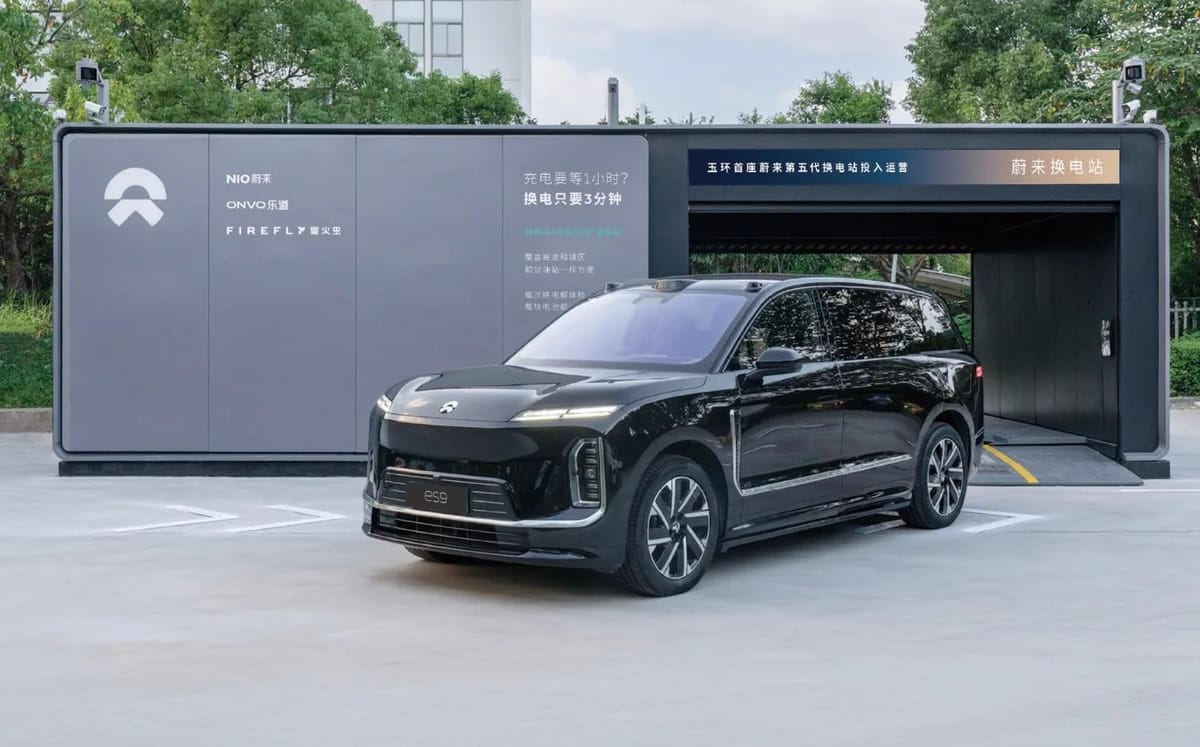
Here lies NIO's singular strategic complication. Unlike any other major Chinese EV brand, NIO operates a proprietary battery-swap ecosystem. Cells from CATL, EVE Energy, and Gotion must not only meet individual vehicle performance specifications—they must be physically and electronically interoperable within a swap station network that, as of 2026, spans thousands of locations across China.
Managing cell chemistry variations, energy density differentials, and state-of-health algorithms across a multi-supplier pool in a live swap environment is an operational and engineering challenge with no direct precedent in the industry. The stakes intensified earlier in 2026 when NIO announced a charging and swapping infrastructure partnership with Zhejiang Geely Holding Group. Once Geely-affiliated swap-compatible models enter the market, NIO's network will need to absorb yet another set of cell specifications—further stress-testing the company's battery management and logistics capabilities.
In short, NIO's self-development risk profile is structurally higher than that of Li Auto or Leapmotor, neither of which must guarantee cross-brand, cross-chemistry cell interoperability at scale.
OEM Battery Arms Race Reshapes Supplier Dynamics Without Displacing Them—Yet
NIO's move is part of a broader industry pattern that merits an impact assessment for battery suppliers.
Geely Holding's in-house battery unit, Weiyuan Energ, and its manufacturing arm, Quzhou Jidian, have already delivered what Geely describes as 1.03 million battery sets in 2025 under the Shendun Gold Brick brand, deployed across Zeek, Lynk & Co., and Galaxy vehicles. Yet even Geely continues to source CATL cells for models including the Zeekr 9X and Galaxy TT—illustrating that in-house capability functions as a complement to, rather than a replacement for, established suppliers.
BYD remains the sole OEM that is genuinely self-sufficient in cell production at scale, a position rooted in its origins as a battery manufacturer. Every other automaker pursuing in-house batteries—NIO, Li Auto, Leapmotor, and others—retains a material dependency on external suppliers for volume or core technology.
The competitive implication is therefore asymmetric. OEMs with proprietary programs gain negotiating leverage—an ability to credibly threaten supply diversification that improves pricing terms and secures capacity priority during supply crunches. CATL and its peers face a gradual erosion of pricing power rather than an existential volume threat, at least within the current business cycle.
Industry Consolidation Likely to Follow the Current Fragmentation
The proliferation of OEM battery ventures in 2025–2026 echoes earlier fragmentation cycles in Chinese consumer electronics and first-generation EV manufacturing—industries that ultimately consolidated around a small number of dominant players once capital efficiency became the governing constraint.
Battery cell manufacturing is capital-intensive, highly scale-sensitive, and technologically demanding. Without sufficient volume to amortize fixed costs, OEM battery subsidiaries risk becoming a recurring drag on parent-company margins. The more probable long-term outcome, absent a BYD-scale commitment, is a hybrid model: OEMs define battery architecture and performance requirements in close collaboration with suppliers, while retaining cell manufacturing within the supply chain. Xiaomi Corp.'s Dragon Armor battery—where Xiaomi led product definition and pack design while cell production remained with a supplier—offers one template.
For NIO, the immediate question is whether its end-of-2026 pilot batch translates into a credible ramp trajectory by 2027, or whether the program once again yields to commercial pragmatism. The answer may well be announced at NIO Day 2026.
Related Coverage:
NIO, Xpeng, BYD and Huawei Target 2028 for L3 Autonomy
From Battery King to One of Many: How China’s EV Makers Are Reducing Their Dependence on CATL