
NIO, Xpeng, BYD and Huawei Target 2028 for L3 Autonomy
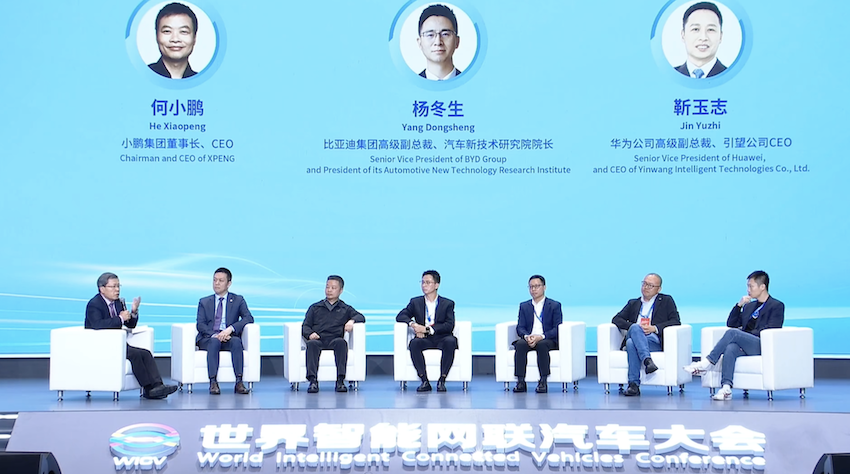
Six top executives from NIO, Xpeng, BYD, Huawei's Yinwang, Horizon Robotics and Momenta converge at Beijing's marquee auto-tech summit to declare the industry's "second half" has begun — and that the real prize won't arrive until 2028 at the earliest.
The 2026 World Intelligent Connected Vehicles Conference (WICV) opened Tuesday with a rare public collision of views from China's autonomous driving establishment, as executives debated timelines, business viability and supply-chain positioning in a sector where L2-and-above penetration has already crossed 70% of new vehicle sales. The gathering marks what several panelists explicitly labeled a structural turning point: from proof-of-concept to monetization.
Market sentiment around the session reflected broader investor anxiety. China's smart-vehicle supply chain has expanded rapidly, yet subscriber-based revenue models remain nascent, and the regulatory framework for Level 3 handoff-of-liability has yet to be finalized. The six executives' willingness to publicly disagree on timelines signals that competitive differentiation — not just technological capability — is now the dominant strategic variable.
Xpeng's He Challenges Three Industry Orthodoxies on L3 Deployment
He Xiaopeng, Chairman and CEO of Xpeng, delivered the session's most provocative set of arguments, framing them explicitly as "anti-consensus." His core thesis: the industry's conventional L1→L2→L3→L4 progression is analytically flawed.
He argued that L3 does not inherently deliver superior safety — it primarily transfers legal liability from driver to system, without guaranteeing a proportional improvement in user experience or accident prevention. "L3 may simply be skipped," He said, advocating instead for a direct leap from L2-assisted driving to genuine L4 capability. His second counter-consensus view: any company claiming L4 credentials must validate them through Robotaxi operations, where the absence of a safety driver forces systemic accountability. Third, He contended that L5 — full autonomy under all conditions — will eventually be redefined as AI capabilities mature, rendering current taxonomy obsolete.
On timing, He was specific: autonomous driving technology readiness will arrive in the second half of 2028, while regulatory implementation will span 2028 to 2032, varying materially by jurisdiction, region and use-case scenario.
NIO's Li Bin Separates Technology Convergence From Regulatory Readiness
Li Bin, Founder, Chairman and CEO of NIO, pushed back with a structural distinction that carries direct implications for investor valuation frameworks. Technology development from L2 through L5 is converging on a shared architecture — broadly described as "world models plus closed-loop reinforcement learning" — meaning R&D investment is not being duplicated across levels. However, Li stressed that deployment timelines are not a function of engineering readiness alone.
"L3 commercialization depends on when regulators permit it, not when engineers achieve it," Li said. Three parallel preparation tracks must align: hardware maturity, technical validation, and the operational-response infrastructure required for liability transfers. He identified user willingness to pay and safety performance as the two non-negotiable commercial metrics for the second half of the autonomous driving era.
BYD, Huawei's Yinwang Flag Safety Accountability as the Defining Second-Half Variable
Yang Dongsheng, Senior Vice President of BYD and President of its Automotive New Technology Research Institute, reframed the competitive landscape around what he called the "trust cycle" — moving consumers through the stages of "able to use," "willing to use," and "using daily." Achieving that progression, Yang argued, requires OEMs to maintain full-stack control over electronic architecture, vehicle execution systems and data pipelines. Critically, manufacturers must underwrite responsibility to lower the psychological barrier for first-time users.
Jin Yuzhi, Senior Vice President of Huawei and CEO of Yinwang Intelligent Technology, quantified a structural shift: L2-and-above penetration has reached 70% of China's new vehicle market. He identified three defining characteristics of the second half — accelerating transition from driver-assist to autonomous operation, a shift in liability from driver to system under L3 conditions, and a fundamental restructuring of the mobility paradigm itself.
Horizon Robotics and Momenta Define Roles as Ecosystem Enablers, Not Disruptors
Yu Kai, Founder and CEO of Horizon Robotics, offered the session's most measured outlook, cautioning the industry against conflating current "usability" with technological maturity. "The revolution has only just begun," Yu said, noting that 2026 represents an early inflection — city-level NOA (Navigate on Autopilot) is now entering sub-RMB 100,000 (approximately US$13,900) vehicle segments, a meaningful democratization milestone. But he calibrated the remaining distance using what he called "Pacific crossings" — each representing a 10-fold performance improvement. "We may need to cross several Pacifics before we reach the goal. I hope we can complete that journey in the next four to five years."
Yu also issued the session's clearest positioning statement, drawing hard boundaries around Horizon Robotics' business scope: no vehicle manufacturing, no fleet operations, no full hardware-software system delivery. Horizon operates as a Tier 2 supplier — currently delivering approximately 95% of its vehicle project engagements through Tier 1 integration partners — providing compute chips and foundational software only. "We are value creators, not system disruptors," Yu said, explicitly framing the company as a respectful participant in existing supply-chain hierarchies rather than a challenger to them.
Cao Xudong, Founder and CEO of Momenta, anchored his remarks in commercial model innovation. He argued that "smart driving Moore's Law" is accelerating: performance gains that previously took two years to achieve a 10x improvement may now occur annually. On supply-chain dynamics, Cao pushed back against narratives of OEM dominance over software vendors. As one concrete example, Momenta has helped at least one OEM client consolidate separate L3 and L4 development programs into a single unified L4 architecture — reducing development cost while preserving dual-level commercial capability. Subscription revenue sharing, he argued, aligns incentives structurally: as user adoption rises, distributable economics expand for both supplier and manufacturer.
Industry Giants Converge on 2027–2028 as the Regulatory-Commercial Nexus
Despite meaningful disagreements on the utility of the L3 classification itself, a notable consensus emerged across the panel on timing. Momenta's Cao and Huawei Yinwang's Jin each cited 2027–2028 as the window when L3 and early L4 deployments could achieve commercial-scale penetration, contingent on regulatory approval. BYD's Yang echoed the safety-infrastructure prerequisite; NIO's Li placed the policy lever entirely in government hands.
The alignment is commercially significant. China's Ministry of Industry and Information Technology has been advancing L3 access standards, and the panel's convergence on a two-year policy runway suggests that tier-one OEMs and their suppliers are positioning procurement cycles and software investment schedules around a late-2020s regulatory unlock — with 2032 as the outer bound for broader global policy normalization.
For investors tracking China's intelligent vehicle supply chain, the session's subtext was equally instructive: the three technology enablers — Huawei Yinwang, Horizon Robotics and Momenta — each took deliberate steps to articulate non-competing postures toward OEM partners. In a sector where consolidation pressure is intensifying, public boundary-drawing of this kind typically precedes a wave of deeper partnership agreements and, potentially, equity-level collaboration structures.
Related Coverage:
XPENG Launches YOYO Robotaxi Brand in China’s Shift to Commercial Autonomy
Huawei's Aito Zhijie RX Bets on L3 Architecture as China Legalizes Conditional Autonomy