
NIO, Xpeng, Li Auto Abandon Auto Identity to Claim Next Computing Platform
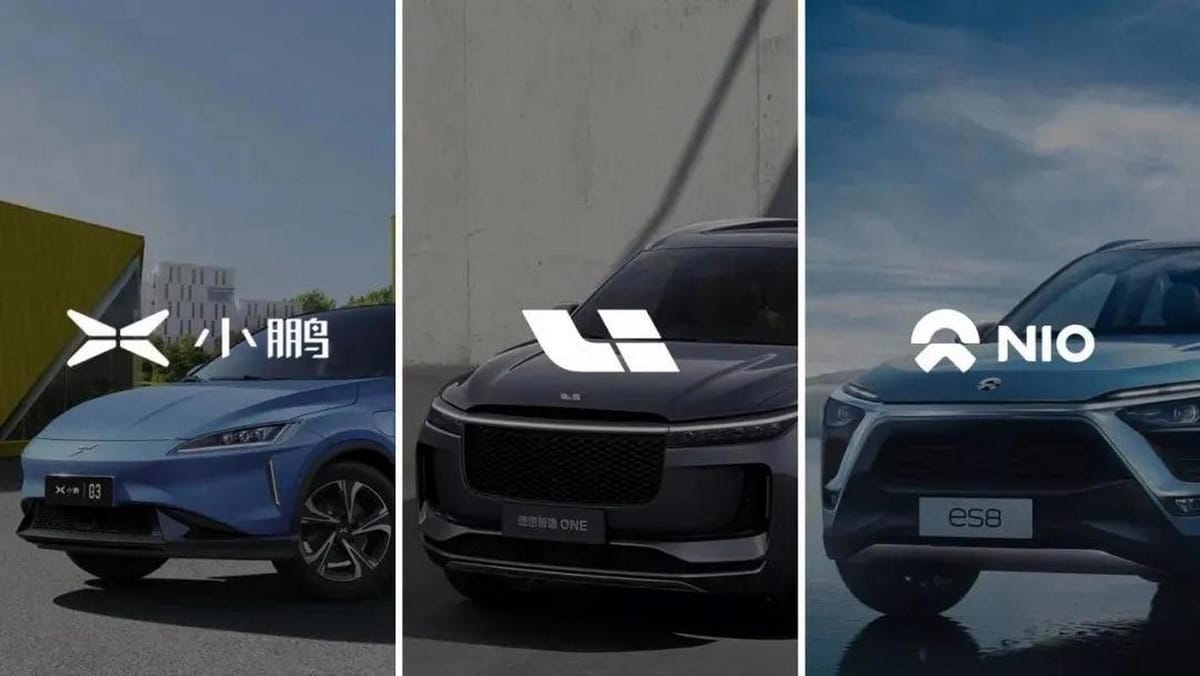
China's three leading EV startups have collectively crossed a strategic Rubicon: their self-developed AI chips are no longer automotive components — they are bids for dominance over the next generation of physical-world computing infrastructure.
The inflection point arrived June 15, 2026, when Li Auto unveiled the Mach M100, a 5nm automotive-grade AI chip delivering 1,280 TOPS of single-chip compute, at what CEO Li Xiang himself designed to look nothing like a car launch. The two-hour Livis Day event covered AI chips, agents, world models, and embodied intelligence — with the vehicle itself treated as an afterthought. With the Mach M100 now in production, NIO, Xpeng and Li Auto have each delivered a proprietary silicon answer, completing a trifecta that redraws the competitive map of China's technology industry far beyond automotive.
Market observers who frame this as a defensive supply-chain maneuver are, the data suggests, looking at the wrong scoreboard entirely.
Shifting Cost Centers Reveal Who Controls the Margin Stack
The economics of a premium electric vehicle have been restructured three times in a decade. Through roughly 2015, the powertrain — engine and transmission — commanded both the highest bill-of-materials share and the deepest moat. Between 2020 and 2024, the lithium battery pack displaced mechanical complexity as the primary value driver; Contemporary Amperex Technology (CATL) effectively held veto power over delivery schedules and profit structures across the industry.
In 2026, the third transition is no longer theoretical. NIO's founder and CEO Li Bin has publicly calculated that battery and chip costs already exceed 50% of the total bill of materials in a high-end intelligent EV. For any vehicle equipped with four NVIDIA Orin chips — the baseline for premium autonomous-driving configurations — the chip procurement cost alone exceeds RMB 20,000 (approximately US$2,778) per unit, paid directly to a supplier with no strategic alignment to the buyer's software roadmap.
That arithmetic is what originally forced NIO's hand. In 2021, a global chip shortage severed supply of ESP modules, cutting ET7 production by 42% during a critical quarter and erasing an estimated RMB 1.9 billion (US$264 million) in revenue. Li Bin's subsequent dictum — that supply-chain chokepoints cannot remain in third-party hands — was not a strategic vision statement. It was an autopsy report.
Mach M100 Performance Data Reframes the Benchmark Conversation
Li Auto's Mach M100 arrives with specifications that collapse the distinction between automotive and data-center silicon. The chip's AI compute utilization rate reaches 82% when running Li Auto's proprietary VLA (Vision-Language-Action) model, compared with a 30%–40% utilization rate that general-purpose automotive chips such as NVIDIA's Orin and Thor achieve on equivalent large-model workloads. Under matched compute ratings, Li Auto claims the Mach M100 delivers three to four times the effective output of a general-purpose chip.
The edge-inference benchmark is more striking. Running large language model prefill tasks on-device, the Mach M100 achieves 2.7 times the throughput of NVIDIA's desktop supercomputing solution — at automotive power envelopes and a fraction of the cost. A chip engineered to sit inside a car door is, on specific tasks, outperforming professional AI workstations retailing at tens of thousands of renminbi.
The real-world safety implication is equally pointed. Li Auto's Mach VLA system records a composite reaction time of 0.28 seconds, against a human driver's physiological average of 0.45 seconds. At 120 km/h, that gap translates to a 6-meter earlier stop. The company has committed to compressing that figure below 0.20 seconds in a year-end OTA update.
When a vehicle's reflexes exceed human biological limits, the object is no longer meaningfully classified as a car.
Three Chips, Three Corporate Identities Diverge
The strategic architectures behind each chip reveal fundamentally different theories of where value accrues in the AI-hardware cycle.
NIO has pursued maximum vertical integration paired with explicit commercialization. The Shenji NX9031 entered mass production in September 2024; cumulative shipments have surpassed 550,000 units as of mid-2026, spanning the flagship ET9 down to the Onvo L90. In 2025, NIO carved the chip business into a standalone entity, Shenji, which raised RMB 2.257 billion (US$313 million) in its first funding round at a valuation approaching RMB 10 billion (US$1.39 billion). The financial payoff is already visible: NIO achieved its first quarterly operating profit in Q4 2025. Li Bin's stated ambition — transforming Shenji from a cost center into an industry-wide revenue engine — is no longer aspirational.
Xpeng has chosen deep ecosystem entanglement over financial separation. Rather than spinning out its Turing chip into an independent entity, Xpeng packaged the technology as a core asset in its technology partnership with Volkswagen AG. In March 2026, the Volkswagen ID. UNYX and Zhong 08 — each equipped with dual Turing chips delivering a combined 1,500 TOPS — entered mass production. A Chinese EV startup's proprietary silicon is now defining the technical architecture of a legacy European automaker. CEO He Xiaopeng has set a target of 1 million Turing chip shipments for the full year of 2026, targeting the top position in China's high-compute edge AI chip market. His declared end-state is a "physical AI" company, with Turing silicon eventually governing automobiles, humanoid robots, and flying vehicles simultaneously.
Li Auto is the most architecturally radical of the three. The Mach M100 was designed in reverse: engineers first spent years running the VLA model, mapped the data-flow bottlenecks, and only then drew the chip blueprint. The result is a dataflow architecture in which computation is triggered at the point of data arrival, eliminating the memory-bandwidth waste inherent in conventional von Neumann designs. Li Auto has no stated plans to commercialize the chip externally. The Mach M100 is a proprietary instrument in a full-stack vertical: chip plus model plus operating system plus vehicle. Li Xiang has restructured the company's R&D organization to match: AI spending now accounts for 50% of the annual R&D budget, the foundation model team has been split into three second-tier departments — embodied engineering, embodied interaction, and embodied behavior — and autonomous driving has been demoted to a parallel unit rather than the central function.
Computing Platform Race Eclipses the EV Narrative
The historical parallel that Li Xiang himself invokes — Apple's transition from a computer company to a device-software-services platform — is analytically precise. Apple's M1 chip launch did not announce a faster Mac; it announced the termination of Intel's architectural control over the Mac ecosystem. Tesla's FSD chip and Dojo supercomputer were never about building a better electric vehicle; they were about owning the training and inference stack for full autonomy.
NIO, Xpeng, and Li Auto are executing the same logic at the layer of physical-world AI. The automobile provides an unusually favorable incubator: sufficient volume to house sensors and compute, sufficient complexity to train general AI behavior, sufficient price points to fund the research, and several hours of daily use generating proprietary data at scale. But the vehicle is the incubator, not the product.
The deeper signal is organizational. When a company reallocates half its R&D budget to AI, restructures its engineering hierarchy around embodied intelligence, and produces a chip that benchmarks against data-center hardware, it has already internally completed the identity transition. The chip launch is the external announcement — the equivalent of Apple dropping "Computer" from its corporate name.
China's EV sector entered 2026 as the world's most competitive automotive market. It is exiting 2026 as the proving ground for the next generation of AI computing platforms. The companies that survive the transition will not be remembered as automakers.
Related Coverage: