
Not Ready for Primetime: Goldman's Take on the First Humanoid Robot Games
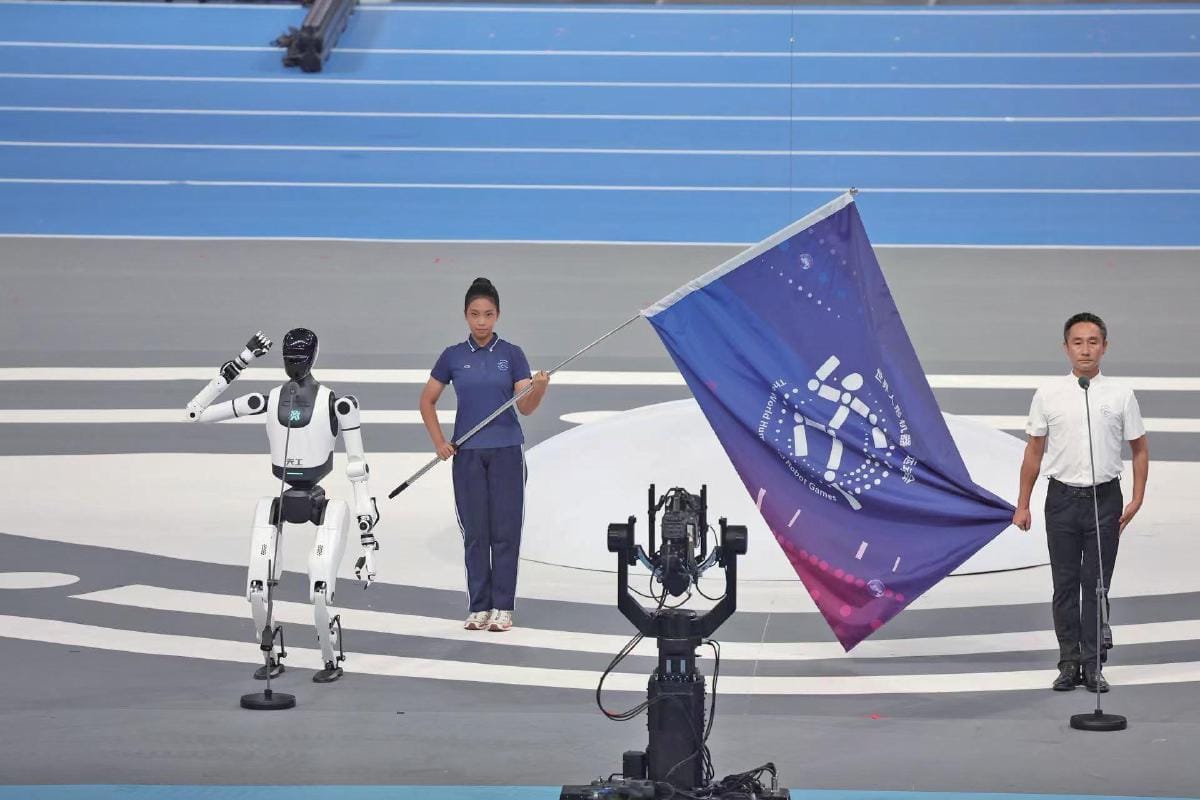
In a note that cuts through the hype surrounding one of the market's hottest sectors, Goldman Sachs has cast a sober eye on the state of humanoid robotics. Following the first-ever World Humanoid Robot Games (WHRG) held in Beijing from August 14-17, the bank’s analysts offered a detailed assessment that is essential reading for any investor tracking the space. The event was seen as a critical litmus test for the industry's real-world capabilities, particularly in the crucial area of autonomy.
While Goldman observed "some positive progress," the key takeaway is that a significant gap remains between current demonstrations and robust commercial viability. The games, which featured over 500 robots from global teams, provided a unique public arena to evaluate both hardware durability and the sophistication of AI control systems.
A Push for Autonomy, With Mixed Results
A core focus of the analysis was the push toward autonomous operation, which the games explicitly incentivized. As Goldman notes, the rules were designed to separate the truly intelligent machines from their remotely operated peers.
"The scenario-based events... award[ed] 50% more points for autonomously operating robots than remotely controlled ones... [and] the Games actively encouraged the shift towards full autonomy... allowing a 20% discount on the running time for autonomously controlled robots..."
This incentive structure produced some notable achievements. The Tiangong Ultra robot, developed by the Beijing Humanoid Robot Innovation Center, demonstrated a significant leap forward.
"Tiangong Ultra added autonomous control capabilities in all the running events, a step-up vs its remote-controlled performance in a marathon back in April... Xiong Youjun, CEO of the Beijing Humanoid Robot Innovation Center... emphasized this as a key differentiator, citing Tiangong Ultra’s ability to use visual perception for environmental sensing and autonomous route planning, making real-time decisions."
However, not all top performers operated with the same level of freedom. The H1 robot from Unitree Robotics, which won the 400m and 1,500m races, was remote-controlled, though the company’s CEO claimed a switch to autonomous mode "should not be too hard to achieve."
Glimpses of the Future, Stumbles in the Present
When the tasks grew more complex than simply running, the current limitations of the technology became more apparent. The multi-robot soccer matches, in particular, highlighted the immense challenge of real-time collaboration and strategic decision-making.
"...challenges still arose in several instances when multiple robots converged on the ball, resulting in multi-robot collisions and requiring human intervention to disentangle them. Additionally, the robots’ performance near the goalposts was relatively rigid, demonstrating a current limitation in AI’s ability to 'anticipate' rather than merely react..."
In scenario-based events designed to mimic practical applications like hotel and factory work, another pragmatic compromise was evident. Goldman points out a telling trend: many winners opted for wheels over feet.
"All the top 3 robots in hotel services (guest reception and cleaning) categories operated an AGV-style wheeled base with functional grippers rather than bipedal locomotion, which seems to stem from their inherent stability and positioning accuracy. This reflects a trend... where companies were focusing on designs that are closest to near-term commercial viability."
Other real-world obstacles, such as the need for VR-handled remote operation for delicate tasks and "wireless communication interference in large venues," further underscored the challenges ahead for practical deployment.
The Sobering Reality Check
While acknowledging incremental gains in motor control, hardware robustness, and specific autonomous functions, Goldman’s ultimate conclusion is one of cautious realism. The flashes of progress were observed in highly controlled and limited scenarios.
"But we found the test samples were still limited during the games, which still reflects a gap in robustness and speed compared to real commercial applications."
Critically, the bank adds a disclaimer that what was seen in Beijing may not even represent the industry's absolute cutting edge, suggesting the performance gap could be even wider than observed.
For investors, the report is a reminder that while the long-term potential is significant—Goldman remains Buy-rated on key component suppliers like Sanhua Intelligent Controls—the path to commercialization is not a sprint. Based on the evidence from the 2025 WHRG, the industry is still learning to walk before it can truly run, let alone take over the world's logistical, service, and manufacturing jobs. For now, the hype remains a few steps ahead of the hardware.