
NVIDIA's Hugging Face Acquisition: What It Means for China's Open-Source AI Models
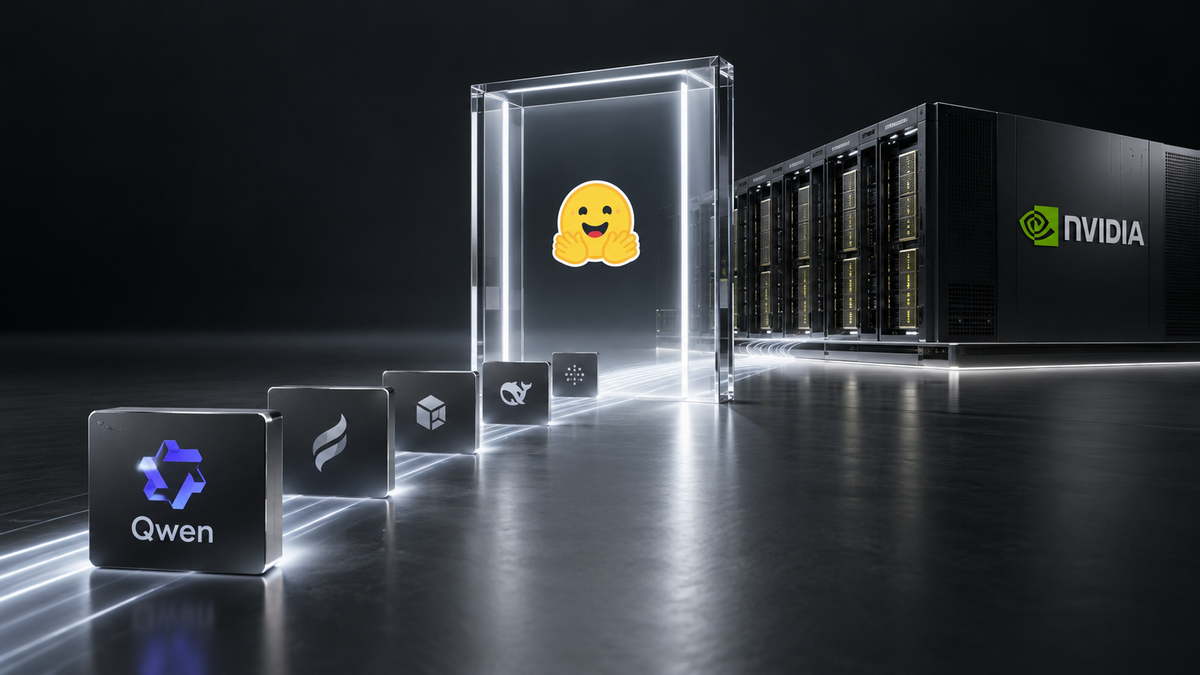
Why Does NVIDIA Want to Buy Hugging Face?
Hugging Face is the de facto distribution hub for AI models. Developers searching for model weights, deployment guides, and benchmarking data typically start here. The platform itself generates modest revenue — roughly $150 million annually — but its strategic value lies entirely in its position inside the developer workflow.
NVIDIA's reported $12.9 billion acquisition bid values Hugging Face at more than 80 times its annual revenue. That premium is not irrational when viewed through the right lens: NVIDIA is not buying a business, it is buying a chokepoint.
Today, the vast majority of open-source models default to running on CUDA — NVIDIA's proprietary software stack. Competitors including AMD, Google TPU, and cloud-vendor custom ASICs are all trying to erode that default. By owning the platform where developers first discover, evaluate, and deploy models, NVIDIA gains the ability to shape which hardware feels like the path of least resistance — without ever explicitly blocking anyone.
Why This Matters Beyond a Single Deal
The acquisition does not fundamentally change the legal risk environment for Chinese models on Hugging Face. The platform has always been a US-incorporated entity, and export-control exposure has existed for years.
What changes is the incentive structure of the platform's operator.
A neutral Hugging Face has no reason to favor any hardware vendor. An NVIDIA-owned Hugging Face has every reason to make subtle adjustments: which models receive day-one hardware optimization support, how performance benchmarks are framed, which cloud destination a "one-click deploy" button points to, and which integrations are promoted in documentation. None of these adjustments require explicit discrimination. Each individually appears minor. Collectively, they can tilt the competitive landscape in ways that are difficult to challenge or even measure.
For Chinese open-source models that have relied on Hugging Face as their primary channel to global developers, the platform shifts from a neutral distribution rail to one operated by a company with direct commercial interests in the compute layer.
How Dominant Are Chinese Models on Hugging Face Right Now?
The scale of Chinese model adoption on Hugging Face is larger than most outside observers recognize.
According to Hugging Face's own State of Open Models: Summer 2026 report, models derived from Alibaba's Qwen number 151,448 — nearly double the 82,506 derivatives built on Google's models, and approximately 4.7 times the number derived from Meta's Llama series. Hugging Face's report explicitly describes Qwen as having become "the community's base model."
Local deployment data reinforces this. In the GGUF format — used when developers run models on their own hardware — Qwen records approximately 39.6 million monthly downloads, compared to 20.8 million for Google's Gemma and 7.5 million for Llama. Qwen is downloaded more than five times as often as Llama for local inference.
The growth trajectory is also notable. In the first seven months of 2026, Hugging Face added between 180 and 210 new Qwen-derived repositories per day. At that rate, the ecosystem expands by more than 60,000 projects annually.
Even NVIDIA's own models reflect this reality. Its OpenCodeReasoning-Nemotron-7B model card explicitly identifies the model as derived from Qwen2.5-7B-Instruct and carries a Qwen2 tag — meaning the acquirer of Hugging Face is itself building on the Chinese open-source model it will now have platform-level influence over.
Why Do Chinese Companies Release Models for Free?
Open-sourcing model weights under permissive licenses such as Apache 2.0 is not altruism. It is a deliberate infrastructure strategy with three distinct commercial rationales.
First, it is a funnel, not a giveaway. Model weights are free; inference, APIs, agent frameworks, and cloud compute are not. Developers who build products on an open-source model face switching costs when they reach production. At that moment, the model's originator — in this case Alibaba or DeepSeek — has a natural opportunity to capture the deployment contract.
Second, it bypasses the brand moat of closed-source incumbents. OpenAI and Anthropic have established strong API habits and brand recognition. Convincing developers to switch closed-source subscriptions is difficult. Offering free weights eliminates that friction: developers can adopt the model without any upfront commitment, then decide later whether to migrate their production workloads to the associated cloud.
Third, 150,000-plus derivative models function as a distributed testing program. Developers deploy Qwen in contexts — mobile devices, medical Q&A, legal document processing, low-resource language translation — that no single company could cover internally. Edge cases, failure modes, and optimization opportunities surface organically and feed back into the model development cycle.
The same logic applies to hardware companies. The Hugging Face report notes that the two organizations releasing the most new open models in 2026 are AMD and NVIDIA — both using open models as performance demonstrations for their respective hardware ecosystems.
Two Competing Strategies: Buying the Road vs. Building the City
NVIDIA and Alibaba are executing structurally different versions of the same underlying insight: open models drive compute demand, and compute demand is where the money is.
NVIDIA's approach is to own the distribution layer. Acquiring Hugging Face gives NVIDIA influence over the first point of contact between a developer and a model. It does not need to block competitors; it only needs to ensure that its own software-hardware stack remains the lowest-friction option. This is a fast, expensive, and defensible move — the platform position is difficult to replicate.
Alibaba's approach is to build a vertically integrated ecosystem. Alibaba is assembling what it describes as a chip-cloud-model stack:
- Model layer: Qwen series, spanning edge-deployable small models through flagship large models, all open-source
- Cloud layer: Qwen Cloud (international version launched in Singapore, May 2026), MuleRun agent platform, Qoder coding environment
- Chip layer: T-Head Zhenwu M890 training-inference chip, Panjiu AL128 supernode; cumulative shipments approximately 560,000 units across 400-plus customers
The financial results of this strategy are visible. In the quarter ending August 2026, Alibaba's AI Cloud and Compute Services segment reported revenue of RMB 48.4 billion, up 45% year-on-year. AI-related product revenue reached RMB 12.4 billion — the twelfth consecutive quarter of triple-digit growth, meaning the segment has at least doubled year-on-year every quarter for three years.
Alibaba is not building a competing model repository to challenge Hugging Face on its own terms. Model hosting generates thin margins — Hugging Face's $150 million annual revenue illustrates the ceiling. The target is the inference layer: the API calls, agent orchestration, and cloud compute consumed when models run at production scale.
What Are the Structural Risks for Chinese Models?
The acquisition crystallizes a risk that was latent but manageable when Hugging Face was independent.
Open-source models distributed through a neutral platform carry export-control risk as a legal matter, but the platform itself has no commercial incentive to enforce restrictions beyond legal compliance. Under NVIDIA ownership, the platform operator has both the means and the motive to make Chinese models less visible or less convenient — not necessarily through explicit restriction, but through the accumulation of small defaults.
Benchmark framing, deployment toolchain recommendations, day-one hardware support timelines, and featured placement in search results are all levers that a platform operator controls and that a model originator cannot influence from the outside.
This creates a structural dependency that Alibaba's Singapore-based Qwen Cloud launch is designed to address. The strategic logic is explicit: do not compete for model hosting, which is low-margin; instead, establish direct inference entry points so that the path from open-source model to production deployment runs through Alibaba's own infrastructure rather than through a third-party platform whose neutrality can no longer be assumed.
The Qwen Paradox: Who Actually Benefits from Open-Source Dominance?
Qwen's position as the community's base model creates a genuine strategic tension.
In the short term, widespread Qwen adoption benefits NVIDIA more directly than it benefits Alibaba. Every developer who builds on Qwen and runs inference on CUDA generates GPU demand that flows to NVIDIA. Under Apache 2.0 licensing, NVIDIA owes nothing to Alibaba for this. The model is free to use, the compute revenue accrues to whoever sells the hardware.
Over the medium term, however, model consolidation around a small number of families reduces the cost for NVIDIA's competitors to achieve hardware compatibility. When workloads were fragmented across thousands of unrelated models, AMD needed to demonstrate stable support for an impractically large model zoo. If the majority of developer workloads converge on Qwen, AMD needs only to demonstrate robust Qwen support to capture a meaningful share of inference demand. AMD has already acted on this: it has provided day-one hardware support for Qwen 3.5, 3.6, and 3.8, progressively reducing the practical advantage of CUDA for developers whose primary workload is Qwen inference.
This is what the $12.9 billion acquisition is ultimately insuring against. NVIDIA's concern is not which model wins. Its concern is the scenario in which models become genuinely hardware-agnostic — where developers stop caring whether the underlying compute is CUDA, ROCm, or a cloud vendor's custom ASIC. Owning the platform where developers form their initial hardware habits is a hedge against that outcome.
What Happens Next: Key Variables to Watch
Several indicators will determine how this competitive dynamic resolves over the next two to three years.
Developer retention rate on Alibaba's infrastructure. Qwen's community dominance is a leading indicator, not a business result. The meaningful metric is the share of developers who move from open-source Qwen usage to Alibaba Cloud API subscriptions, MuleRun deployments, or Qwen Cloud compute. If that conversion rate remains low, Alibaba wins influence but not revenue.
Platform neutrality under NVIDIA ownership. Hugging Face's value depends on developer trust in its neutrality. If NVIDIA makes changes that are perceived as discriminatory — even subtly — it risks accelerating the development of alternative distribution infrastructure. The Chinese ecosystem is already motivated to build one; a credible neutrality failure would extend that motivation to Western developers as well.
Hardware compatibility convergence. If AMD continues to match NVIDIA on day-one Qwen support, the switching cost for developers choosing between the two GPU ecosystems shrinks. The pace of AMD's Qwen optimization cadence is a direct measure of how quickly CUDA's default status is being challenged.
Apple Intelligence integration. Alibaba has confirmed that Apple Intelligence's China version will integrate Qwen deeply. This places a Chinese open-source model inside one of the world's highest-volume consumer hardware ecosystems — a distribution channel that neither NVIDIA nor any other model provider controls.
Regulatory environment. Export controls on AI models remain an evolving policy area. The acquisition does not resolve that uncertainty; it concentrates the relevant decision-making authority within a single US-domiciled entity with clear commercial interests.
The Bottom Line
The NVIDIA–Hugging Face deal is best understood as an infrastructure acquisition, not a technology acquisition. NVIDIA is paying a large premium to own the point in the developer workflow where hardware defaults are formed.
For Chinese open-source models, the acquisition converts a manageable background risk into an active strategic constraint. The response — building direct inference infrastructure outside the Hugging Face ecosystem — was already underway before the deal was announced. The acquisition makes it urgent.
The underlying competitive structure is straightforward: NVIDIA controls the road that most AI workloads currently travel. Alibaba is building a city at the end of that road. The road generates toll revenue regardless of who wins the model competition. The city generates revenue only if residents stay.
Whether that city becomes a destination or a waypoint depends on variables that have nothing to do with model quality — and everything to do with infrastructure, developer habits, and the degree to which a platform that once appeared neutral continues to be trusted as one.
Related Coverage:
Qwen Office Beats Claude and Codex as Harness Emerges as AI's New Moat