
Omoway Pushes Self-Balancing E-Motorbike in Indonesia, Testing Japan’s Grip
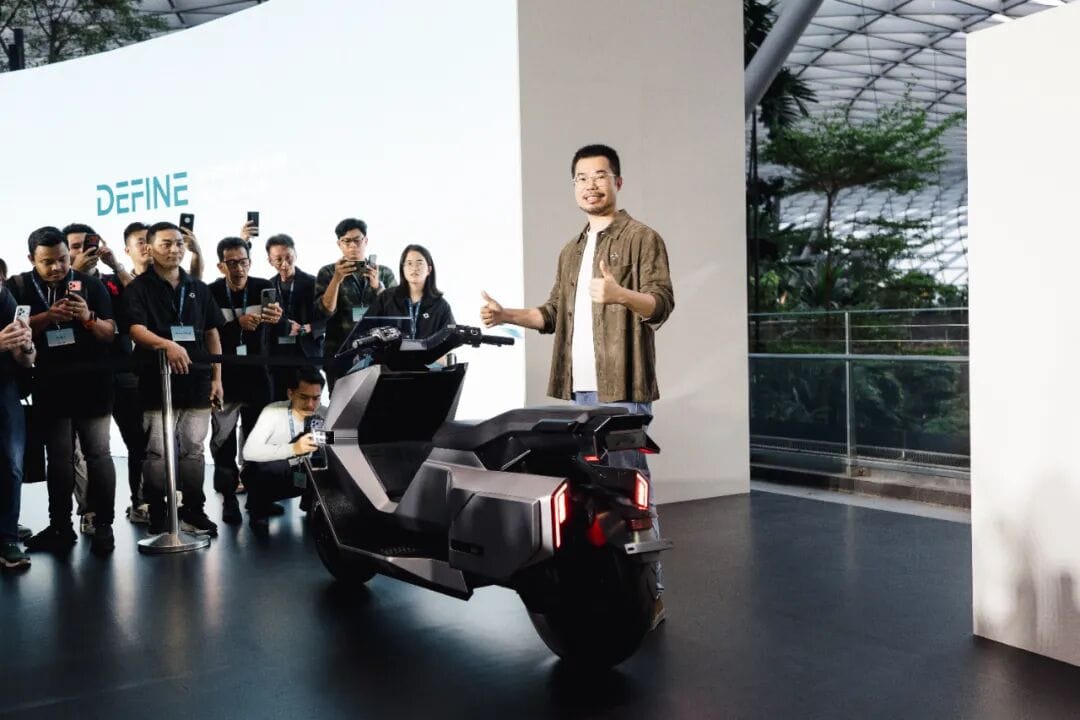
OMOWAY , a startup founded by former XPeng Inc. executive He Tao, is betting that a self-balancing electric motorbike can crack Indonesia’s Japan-dominated two-wheeler market—an arena where Honda and Yamaha control more than 95% of sales and where profits can outstrip their car businesses by multiples.
The company used a showcase at Singapore’s Changi Airport to highlight its first model, the OMO X, including a low-speed riderless demonstration designed to underline its core pitch: stability in stop-and-go city traffic and added safety support in challenging road conditions. The launch puts a new, China-built “tech stack” into direct competition with decades of Japanese dealer networks across Southeast Asia.
Early market signals are emerging at the retail edge. OMOWAY said more than 20 stores at key Indonesian transport nodes had refurbished and switched signage ahead of formal deliveries, with handovers scheduled from May. The company has not disclosed pricing, but He said the first product targets the top 20% of the market—an explicit choice to compete on features rather than entry-level cost.
Targeting Indonesia Reframes Two-Wheeler EVs as a Profit Pool
For global investors and suppliers, OMOWAY’s strategy highlights a structural mismatch in Southeast Asia’s electrification: electric cars and e-bikes are gaining share, yet the largest mass market—motorcycles—remains predominantly internal combustion. Indonesia alone sits within a Southeast Asian parc estimated at about 300 million motorcycles, making two-wheelers a primary transport tool rather than a discretionary product.
He has compared Indonesia’s current two-wheeler landscape to China’s pre-2020 passenger-car market, when entrenched brands looked unassailable before rapid EV adoption reshaped the industry. OMOWAY’s bet is that motorcycles will be the next “middle layer” to flip, with product differentiation—rather than pure price competition—pulling demand once adoption crosses an inflection point. He has cited 5% as a critical threshold for Indonesia’s electric two-wheeler penetration to accelerate.
Using Self-Balancing Tech Shifts Competition From Powertrains to Software
OMO X’s signature feature is a self-balancing system built around a miniaturized gyroscope generating counter-torque, paired with control software that ramps output when needed and idles in steady-state riding to manage energy use. OMOWAY said it trained its control logic with reinforcement learning in simulation, logging more than 1 million “falls” to distinguish normal rider body motion from destabilizing events—an effort to translate autonomy-style development methods into two-wheel dynamics.
The market implication is that the competitive battlefield may move from batteries and motors to software-defined safety and ride-control—areas where Japanese incumbents have showcased prototypes but have not widely commercialized comparable systems. If OMOWAY can industrialize this at scale, it could force incumbents to respond with higher electronic content per vehicle, raising bill-of-materials complexity and reshaping supplier demand toward sensors, compute, and automotive-grade controllers.
Recycling China’s Auto Supply Chain Lowers Cost of “Premium Features”
OMOWAY said more than 80% of its suppliers come from the automotive sector, reflecting a deliberate attempt to “downshift” passenger-car components—such as multi-link chassis concepts, automotive-grade chips, and perception solutions—into motorcycles. For China’s broader supply chain, the company’s approach illustrates a new export pathway: not just finished goods, but modular automotive subsystems repackaged for two-wheel platforms.
That could matter in 2026 as China’s auto parts ecosystem looks for incremental overseas growth while domestic vehicle price competition compresses margins. A successful two-wheeler electrification wave in Indonesia would open demand for vehicle-grade electronics at motorcycle volumes, potentially changing scale economics for Chinese component makers that previously relied on four-wheel programs.
Pulling Dealers Away From Honda and Yamaha Tests the Go-to-Market Playbook
OMOWAY is not building a greenfield network. Instead, it is trying to recruit dealers historically tied to Honda and Yamaha, leaning on local channel expertise—led by Indonesia-based executive Chen Bifeng, who previously worked on vivo’s distribution buildout—to persuade long-standing “mom-and-pop” motorcycle retailers to switch brands.
This matters because distribution and service density—not product specs—have been the primary moat in Indonesia’s motorcycle market. OMOWAY’s decision to price into the premium band may help dealers justify the switch via higher unit economics, but it also raises execution risk: the company must prove reliability, parts availability, and after-sales capability fast enough to retain dealer trust before incumbents counter with promotions, financing, or accelerated EV rollouts.
He has set aggressive milestones—Indonesia leadership in 2026 and Southeast Asia leadership in 2027—framing the next two to three years as a narrow window before incumbents fully mobilize. For markets, the key variable is whether a “software-led” motorcycle can translate demonstration-grade stability into mass-market durability on Indonesia’s roads, under real-world maintenance constraints.
Related Coverage:
Xpeng Motors Reports First Quarter with Revenue Exceeding RMB 20 Billion as Recovery Takes Shape
Chinese Electric Vehicles Race to Add Home Appliances as Competition Intensifies