
Pop Mart Deliberately Pumps the Brakes on Its Own Hypergrowth
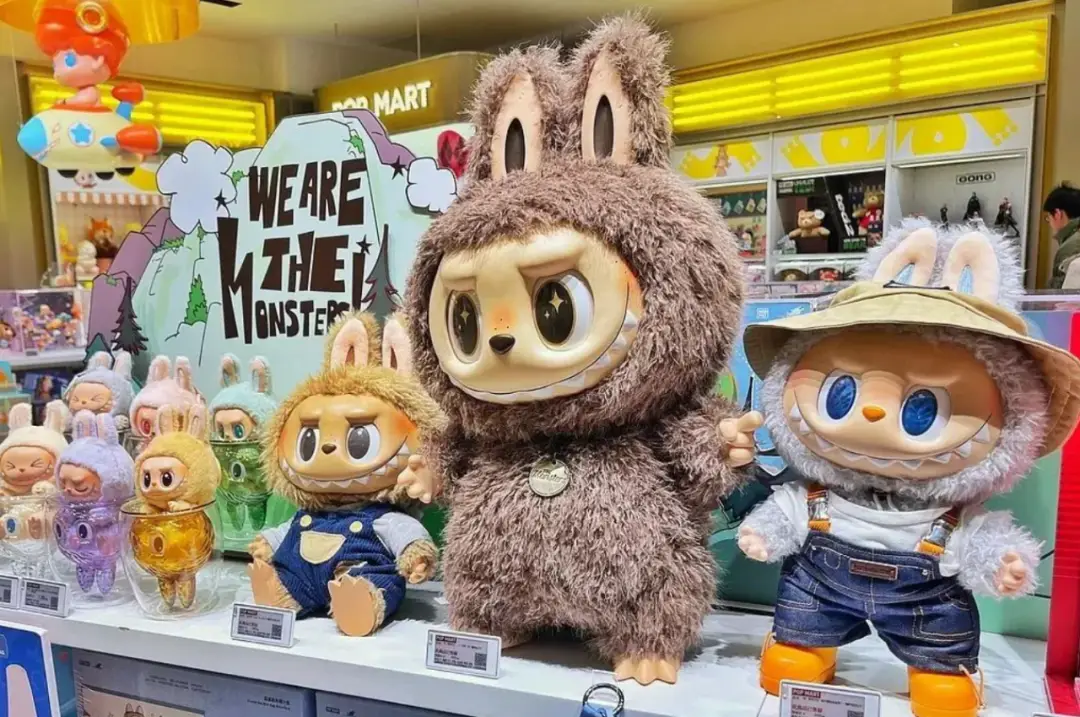
Pop Mart is doing something almost unheard of in China's consumer sector: voluntarily decelerating at the peak of its momentum, betting that restraint today is worth more than a revenue spike tomorrow.
The Beijing-based designer toy company set its 2026 revenue growth target at approximately 20%—a sharp retreat from the triple-digit expansion that defined 2025—even as its flagship LABUBU IP generated RMB 14.16 billion (US$1.97 billion) in annual sales and accounted for 38.1% of total group revenue. The guidance reset rattled investors. Pop Mart shares fell following both its full-year 2025 results and its Q1 2026 earnings release. Bank of America, executing what analysts described as the most aggressive rating adjustment on the stock this year, cut Pop Mart from "Buy" to "Neutral."
The market's discomfort, however, may be precisely the point.
CEO Wang Ning Actively Suppresses LABUBU's Own Momentum
In an industry where brands routinely milk viral IP until consumer fatigue sets in—Nike's Air Jordan line being the cautionary archetype Pop Mart's founder and CEO Wang Ning cites explicitly—Pop Mart is engineering scarcity rather than chasing volume.
Wang has set an internal target to bring LABUBU's revenue contribution down to approximately 35% of group sales, and has indicated he would welcome further compression beyond that. "If one day it can be reduced even further, I think that would be better," he said in a recent interview.
The operational evidence is concrete. In 2025, Pop Mart suspended multiple LABUBU product launches, deliberately pushed new releases into 2026, and rejected the majority of third-party co-branding requests. In LABUBU's tenth anniversary year, licensed collaborations remain deliberately sparse: a Sanrio family tie-up in March sold out across multiple platforms within one minute, with Tmall moving 30,000-plus units instantaneously. The marquee partnership with FIFA saw secondary-market prices on Dewu hit RMB 718 on the day after release—a RMB 119 premium, or roughly 20% above retail—signaling that controlled supply is sustaining, not eroding, brand equity.
Wang's internal framework, which he calls the "70% full" doctrine, formalizes this logic: if genuine market demand for an IP series is 100,000 units, Pop Mart produces 70,000. The approach has historically been read as hunger marketing; the more precise interpretation is inventory discipline designed to preserve long-cycle IP value.
LABUBU 4.0 is scheduled for release in the second half of 2026, and Wang has expressed public optimism about its reception—suggesting the company views the current slowdown as a recharge, not a retreat.
Store Expansion Hits the Brakes, Quality Metrics Take Over
The deceleration is not limited to product cadence. Pop Mart's physical retail strategy has undergone an equally deliberate reset.
The company operated 630 stores across 20 countries as of end-2025, adding a net 109 locations globally during the year. The domestic figure, however, is striking: only 14 net new stores were opened in China, representing approximately 3% growth—a collapse from the double-digit domestic expansion rates of prior years. Internally, sources familiar with management thinking told 36Kr that even this pace was considered "a little fast" by senior leadership.
The strategic logic, articulated by Pop Mart China President Chu Yin, is blunt: "We will never open ten stores to solve a problem that one store can solve." The company is now relocating underperforming outlets from basement retail floors to ground-floor positions, in some cases situating stores adjacent to luxury brands such as Givenchy. New openings are predominantly large-format flagship or "S-tier" stores. Low-efficiency locations are being systematically closed.
The discipline is extending overseas. Pop Mart management disclosed it is now scrutinizing a Southeast Asian outlet that generates strong revenue and profit but occupies only 50 square meters—questioning whether a store that small can function as an adequate brand showcase, regardless of its P&L contribution.
The payoff is visible in Q1 2026 data: Pop Mart's China revenue grew 100% to 105% year-on-year, a result COO and China President Si De attributed to "a highly efficient retail operating system" across channels, intensified new-customer acquisition on e-commerce and live streaming platforms, and improved repeat-purchase rates among existing members.
A Diversified IP Portfolio Reduces Single-Character Risk
The strategic case for slowing LABUBU rests partly on the strength of what sits beneath it.
Pop Mart has constructed what it describes as a "one dominant, many strong" IP matrix. Four IPs currently operate at approximately the RMB 3 billion revenue tier: DIMOO posted 205.3% growth in 2025; SKULLPANDA and CRYBABY both exceeded 100% growth. MOLLY, the company's original flagship character, grew 38.4%—slower, but notable given that China International Capital Corporation (CICC) research indicates standard IP life cycles of three to five years before structural decline sets in. MOLLY's ability to sustain meaningful revenue a decade after launch represents a meaningful proof of concept for Pop Mart's IP management capabilities.
Further down the portfolio, Twinkle Twinkle posted 1,602% year-on-year growth and is generating early signals of breakout potential—consumers at Pop Mart's theme park 1.5-phase trial operations in 2026 were observed purchasing park-exclusive Twinkle Twinkle plush toys at a rate that drew internal attention. Separately, Pucky—originally launched in 2017—has re-emerged via a new "knock-knock" design series that tapped consumer emotional resonance, with secondary prices rising from RMB 99 to RMB 300.
The IP diversification narrative materially weakens the bear case that Pop Mart is structurally dependent on a single character.
Organizational Maturity Becomes the New Growth Variable
Perhaps the most analytically significant signal from Pop Mart's current posture is Wang Ning's public acknowledgment of organizational risk.
Wang rated Pop Mart's internal management at 70 out of 100 for 2025—a year in which the company delivered some of the strongest consumer brand results in China. He has described 2026 as a year for the company to "pit stop," using an F1 racing metaphor, and has stated that the prior year's hypergrowth was substantially attributable to "luck and market conditions" rather than execution. "This year," Wang said, "we truly need to rely on the team's effort."
For investors benchmarking Pop Mart against peers in the global collectibles and lifestyle IP space—including Funko (FNKO.US) and Bandai Namco Holdings (7832.T)—the company's willingness to publicly cap its own growth expectations and restructure operations during a period of peak momentum is an unusual signal. Whether the market re-rates that discipline as a premium or continues to penalize the guidance cut will likely depend on whether LABUBU 4.0 and the emerging second-tier IP cohort can deliver measurable traction in the second half of 2026.
The structural argument Wang is making is straightforward: a platform-model IP company that can incubate, scale, and sustain multiple characters across multiple cycles is worth more than a single-IP story running at maximum velocity. The 20% growth target is not a ceiling—it is a floor built on a more durable foundation.
Related Coverage:
Pop Mart Faces Diverging Signals as Q1 Revenue Surge Meets US Data Drop