
Pop Mart's Labubu Hangover Exposes a Single-IP Risk
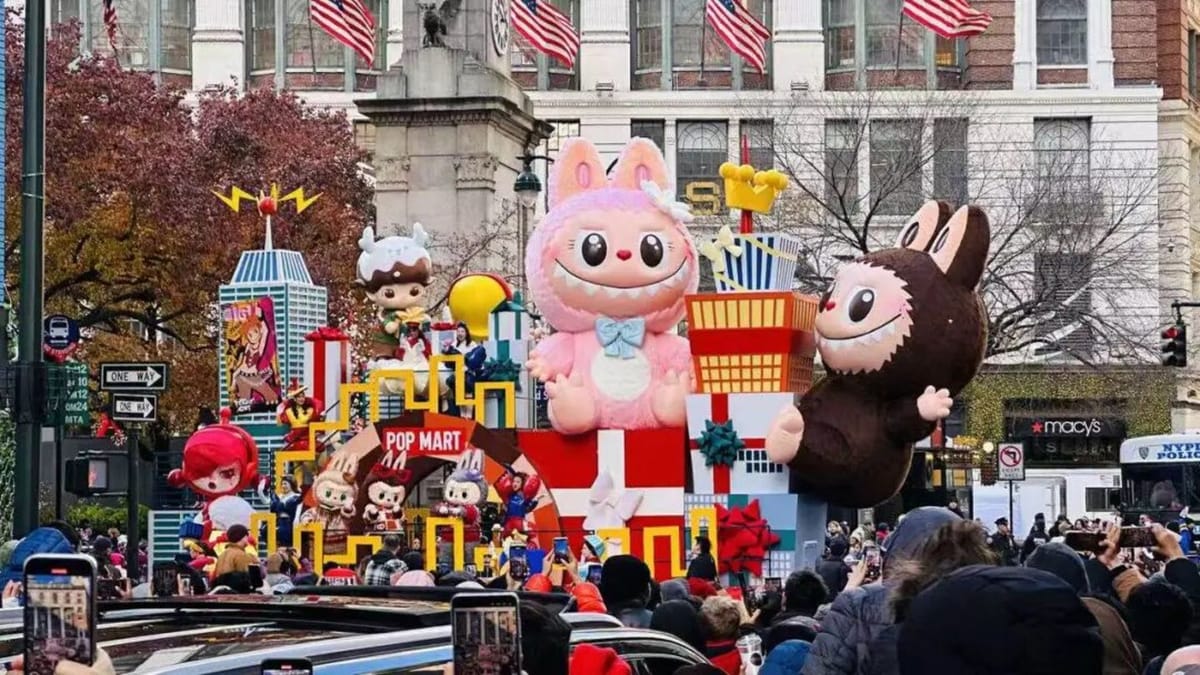
The world's most-hyped collectible toy is losing its pricing power, and the company built around it is running out of time to prove it was never just a one-trick pony.
Pop Mart, the Beijing-based designer toy platform listed in Hong Kong, is confronting the steepest test in its six-year public market history: the very IP that turbocharged its RMB 37.1 billion (US$5.15 billion) 2025 revenue is visibly deflating, and the secondary-market mechanics that validated its premium pricing have broken down. The stock has shed more than 50% from its August 2025 peak, a drawdown that began well before any earnings miss—a signal that institutional investors were re-pricing not the quarter, but the entire business model.
The inflection point arrived in June 2026. At the launch of the "Retro Barbershop" series, standard editions fell below their RMB 159 issue price within 30 minutes, settling near RMB 100. Hidden-edition premiums—once as high as 25x on comparable Labubu releases—compressed to roughly 5x. Goldman Sachs noted in a May 2026 research note that most secondary-market Labubu products were trading at zero premium or at a discount, a structural shift that signals speculative capital has already exited.
Secondary-Market Collapse Confirms the Scarcity Thesis Is Broken
The secondary-market deterioration is not noise—it is the earliest and most honest pricing mechanism in the collectible toy ecosystem. Labubu's hidden-edition premium had functioned as a real-time sentiment index, and its collapse from 25x to 5x within a single product cycle is a quantitative confirmation that the "scarcity arbitrage" logic underpinning Pop Mart's demand generation has been systematically impaired.
The root cause is supply-side hubris. Management accelerated production to democratize access and suppress scalper activity—a defensible consumer-welfare argument. The unintended consequence was the destruction of the social-currency status that made Labubu desirable in the first place. Once an IP transitions from scarce cultural artifact to mass-market SKU on an industrial production line, its psychological value to the core collector base—who are, by definition, anti-mainstream—evaporates. The hardest-core fans who built Labubu's original cultural capital have already moved on to the next underground obsession.
Hard Data Reveals Deterioration Across Every Channel
The secondary-market signal is corroborated by primary-channel data. Deutsche Bank data shows Pop Mart's China online channel revenue declined 5% year-over-year in May 2026, running approximately 25% below the monthly average of the second half of 2025. The U.S. market tells an even sharper story: Bloomberg Second Measure credit card data shows Pop Mart U.S. sales fell 45% year-over-year in March 2026 and a further 42% in April—a violent reversal from January's 130% and February's 41% growth. U.S. Q2 credit card spending is tracking down approximately 40% year-over-year.
The inventory position amplifies the concern. As of end-2025, Pop Mart carried RMB 5.473 billion (US$760 million) in inventory, up 259% year-over-year. Against a backdrop of decelerating sell-through, the write-down risk embedded in that balance sheet is not trivial. Inventory provisioning could become a direct and recurring drag on margins in 2026 and 2027.
Labubu's True Weight Is Far Greater Than Its 38% Revenue Share
The headline figure—Labubu contributed RMB 14.16 billion (US$1.97 billion) of 2025 revenue, or 38% of the total, up from 23.3% in 2024 and just 5.8% in 2023—understates the IP's systemic importance. Labubu was not merely a revenue line; it was the demand-generation engine for the entire ecosystem.
During its peak cycle, Labubu drove nearly half of the company's total growth increment. Celebrity organic endorsements—Lisa of BLACKPINK, Rihanna—functioned as hundreds of millions of dollars in unpaid brand media. Traffic drawn into stores by Labubu converted, at the margin, into purchases of SKULLPANDA, MOLLY, CRYBABY, and DIMOO. Pop Mart's Chief Operating Officer acknowledged in the 2025 earnings call that "a large number of new users entered stores because of Labubu, and they were not deeply familiar with designer toy culture"—an admission that the Labubu boom generated a "through-draft" of transactional consumers rather than a "reservoir" of loyal platform users.
The triple-compression mechanism now in play is: (1) direct Labubu revenue declining; (2) the halo traffic effect disappearing, driving customer acquisition costs structurally higher; and (3) the production capacity built to service peak demand converting into inventory overhang and margin-dilutive markdowns.
Growth Deceleration Forces a Valuation Re-Rating
Pop Mart's overall growth trajectory has undergone a regime change. The company's consolidated revenue growth ran at 184.7% in 2025. In Q1 2026, overseas growth decelerated to 25%-30% in Asia-Pacific and 55%-70% in Europe and North America—impressive in absolute terms but a fraction of the 300%-900% rates that justified a "high-growth platform" multiple.
When a company's blended growth rate compresses from 184% to 20%-30% in a single fiscal year, the valuation framework must change. Markets no longer apply a hyper-growth platform multiple; they reach for the consumer staples or mature IP company playbook. The current approximately 14x trailing P/E reflects precisely this re-rating—neither rewarding the bull platform narrative nor pricing in a terminal decline scenario. It is, as one analyst framed it, the market's best estimate of an unresolved binary: is Pop Mart a durable IP platform or a high-velocity trend-chasing operation?
The valuation comparables are instructive. Bandai Namco commands 25-30x earnings on the strength of demonstrable multi-decade user retention—fans who entered via Gundam in the 1990s are still spending, at higher ticket sizes, today. FunKo, the U.S. pop-culture collectible company, trades at single-digit P/E after failing to demonstrate cross-cycle retention. Pop Mart's 14x sits exactly between these two outcomes, pricing in maximum uncertainty.
The MEGA Pivot Signals a Cracked Narrative
The trajectory of Pop Mart's MEGA premium collectibles line offers the clearest window into the durability of its user upgrade thesis. MEGA grew 146.1% in 2024, which management presented as evidence of "upward migration"—core users maturing into higher-ticket, art-adjacent products. By 2025, MEGA growth had collapsed to 13.8%.
In the 2025 annual results cycle, management effectively abandoned the MEGA thesis: MEGA production orders were cut 30%-40%, more than 40% of standard SKUs were eliminated, and capital allocation pivoted sharply toward plush and soft-goods categories. Plush products—driven overwhelmingly by Labubu—generated RMB 18.71 billion (US$2.60 billion) in 2025 revenue, a 560.6% year-over-year surge, making it the company's largest category by revenue.
The strategic reversal is significant for two reasons. First, it constitutes an implicit acknowledgment that MEGA cannot serve as a second growth engine. Second, and more critically, MEGA's failure undermines the entire "lifetime value escalation" narrative. If the most loyal, highest-spending segment of Pop Mart's user base could not be retained and upgraded through MEGA, the retention assumptions embedded in the broader platform thesis are called into question.
The pivot to plush carries its own structural risk. Plush products have a materially lower repurchase ceiling than blind boxes. Consumers do not build floor-to-ceiling walls of plush accessories the way they do blind box collections. Over-indexing into plush trades near-term revenue stability for long-term category depth.
Three Verification Tests That Will Determine the Outcome
The next 12 months present a series of observable tests that will resolve the current valuation ambiguity.
Mid-tier IP independence. The critical question is not when the next Labubu arrives—it is whether SKULLPANDA, CRYBABY, MOLLY, and DIMOO can sustain organic growth without Labubu-driven foot traffic. If Labubu's revenue share declines but the absolute revenue of other IPs holds or grows, the platform thesis gains credibility. If they fall in tandem, the "through-draft" hypothesis is confirmed. A more granular signal is the "Labubu-free order" metric: the average order value and repurchase frequency of transactions containing CRYBABY or DIMOO but no Labubu product.
Regional IP differentiation. There are early signs that geographic markets are developing distinct IP preferences—Hirono gaining traction in the Philippines, SKULLPANDA resonating in Singapore, CRYBABY in Thailand. If this differentiation deepens into genuine local IP ecosystems—where more than 50% of repeat purchases in at least three overseas markets are driven by locally-originated or locally-signed designer IPs—it would validate a genuinely decentralized platform model rather than a China-export operation.
The Labubu film as a double-edged catalyst. The planned Labubu theatrical film is simultaneously the most powerful potential re-rating event and the highest-risk strategic bet. A successful film that drives non-collector consumers into stores and converts them across a diverse range of IPs—not just the film's protagonist—would validate the content-to-commerce funnel. A failure risks something more damaging than a box-office write-down: it could permanently strip the IP of the open-ended imaginative space that fans project onto it, accelerating irreversible disengagement among the core collector base.
Valuation Scenarios: From FUNKO to Bandai
Under a bear scenario, Labubu's deterioration spreads across categories, mid-tier IPs fail to demonstrate independent customer acquisition, same-store sales turn negative globally, and the company is confirmed as a high-velocity trend arbitrageur rather than a platform. Valuation converges toward the FunKo precedent: single-digit P/E.
Under a base scenario, Labubu stabilizes at a lower revenue level, overseas channels provide partial offset, mid-tier IPs show resilience, and revenue growth settles at 15%-20%. The platform story is partially validated but content-driven cross-cycle durability remains unproven. Valuation migrates toward Sanrio comparables: 15-20x P/E.
Under a bull scenario, multiple mid-tier IPs demonstrate self-sustaining acquisition and high repurchase rates, the film content funnel proves out, overseas same-store sales stabilize, and the company demonstrably transitions from "character distribution channel" to "emotional consumption infrastructure." Valuation approaches a Sanrio-Bandai blended multiple: 25-30x P/E.
At 14x P/E, the market is saying it cannot yet distinguish between these three futures. The answer will not come from the next blockbuster IP. It will come from the 2027-2028 financial statements—specifically from stable repurchase rates, positive same-store growth, and a mid-tier IP cluster that generates revenue without a superstar at the top of the funnel.
The tide of the super-cycle is receding. What it leaves behind—whether a resilient platform or an exposed speculative position—is the only question that matters for Pop Mart's next valuation chapter.
Related Coverage:
Pop Mart Deliberately Pumps the Brakes on Its Own Hypergrowth