
Reality Check: Morgan Stanley Warns China's Humanoid Robot Boom Is A Lot Further Away Than You Think
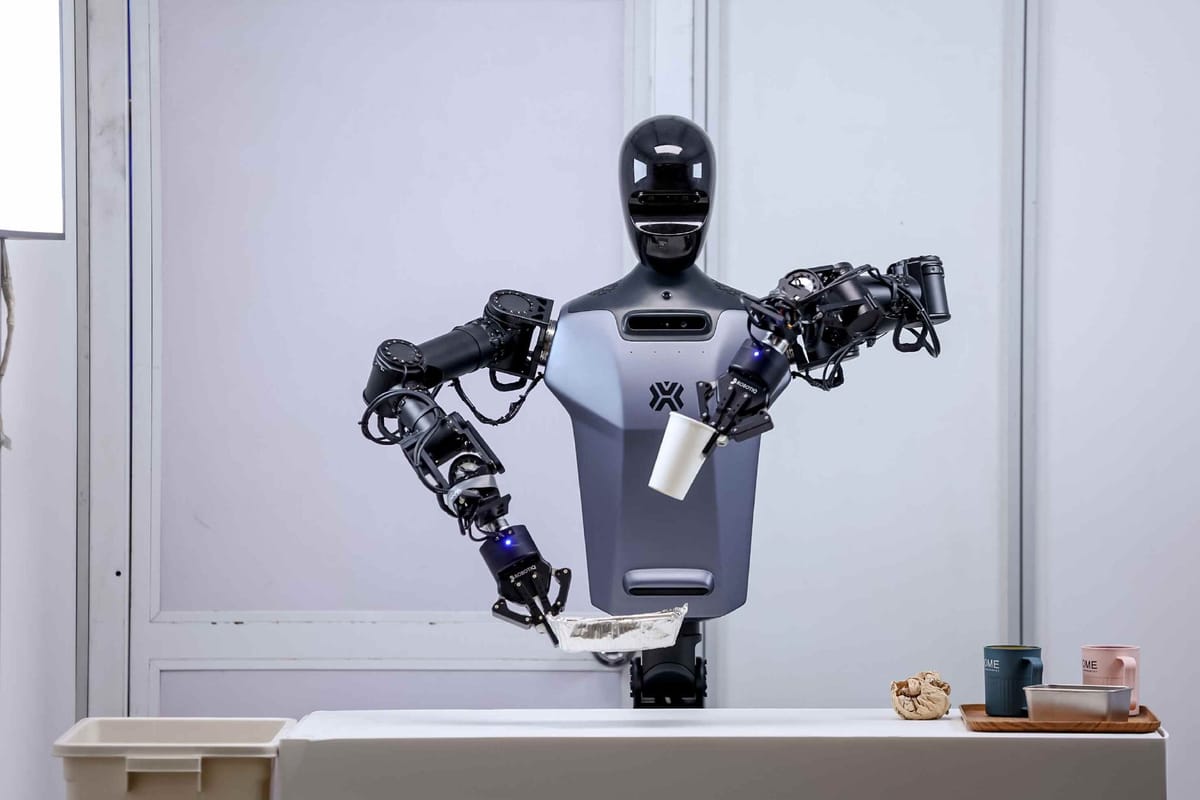
While the hype surrounding China's burgeoning humanoid robotics industry has reached a fever pitch, with some players forecasting a market of over 100,000 units by 2026, a new report from Morgan Stanley is pouring a hefty dose of cold water on the runaway optimism.
In a November 12, 2025 research note titled, "Humanoids: How Far Apart Are Reality and Ideal?", the investment bank offers a sobering counterpoint to the breathless predictions made at the recent GGII humanoid conference. The report is a must-read for anyone trying to separate science fiction from financial reality, as it methodically dismantles the bull case by highlighting the immense technical, commercial, and supply chain hurdles that remain.
While some industry voices project a massive ramp-up within two years, Morgan Stanley’s own forecast is dramatically more conservative, pegging 2026 volume at just 12,000 units. The bank doesn't see the industry crossing the 100,000-unit mark until 2030. The reason for the chasm between hype and likely reality? "Limited working capability," which will severely constrain near-term adoption.
The '100,000 Unit' Dream Meets A Wall of Reality
The conference showcased a wide spectrum of forecasts. Optimists like UBTECH see industry volume surpassing 100,000 units in 2026, while others like DroidUp expect that figure for commercial services alone. This stands in stark contrast to the bank's assessment, which points to a minefield of product development challenges.
As Morgan Stanley bluntly states:
These range from brain VLA model and training data, to body component design/material/quality consistency, to price/cost pressure. We understand that integrators are pushing adoption hard and some supply chain companies are planning capacity. We expect more companies to test humanoids in various use scenarios in 2026... However, we believe the mass deployment will only happen when ROI is attractive.
Industrial Flops and Commercial Props
A key battleground for adoption is the factory floor, but the report casts serious doubt on the near-term viability of humanoids in manufacturing. While labor shortages are real, the current generation of robots is simply not ready for prime time. The bank highlights a grim assessment of their current capabilities:
Others caution that current efficiency (estimated at only 20–30% of human) limits near-term ROI, as well as integration complexity, dexterity, thermal management, reliability and safety concerns, indicating that widespread deployment will be gradual.
Instead, the first wave of "adoption" is more likely to occur in less demanding commercial service roles—think retail guides or even performance bots. These scenarios, the report notes, are less about productivity and more about novelty. "These kinds of scenarios have lower requirements for efficiency/precision – robots mainly provide emotional value to the audience."
Even here, cost is a major hurdle. Clients have a clear price in mind, with the report noting that "preferred prices for full-sized humanoid robots are around RMB 100,000-200,000 yuan (approx. US13,900−US27,800)."
A "Structural Disconnect" In The Supply Chain
Digging deeper, the report uncovers fundamental weaknesses in the hardware supply chain. Far from a seamlessly integrated ecosystem, there is a "structural disconnect" between the system integrators designing the robots and the companies supplying the parts.
Product quality and consistency are primary obstacles hindering commercialization. The report paints a picture of a cottage industry struggling to scale:
Integrators indicated that yield dispersion, variable performance across batches, and field reliability gaps inflate delivery and quality-control costs. Currently, joints and actuators are still too often manually assembled, producing uneven performance, excess weight, and thermal limits.
This stands in sharp contrast to client expectations that components "should exceed automotive grade given the close interaction with humans." While some general component companies like Shenzhen Inovance Technology and Leader Harmonious Drive Systems may benefit from broader intelligent robot adoption, the specialized humanoid supply chain remains immature.
The 'Brain' Bottleneck: Scarce Data and Not-So-Smart Models
Perhaps the greatest challenge lies in the robot's "brain." The report makes it clear that the software and AI models required for true general-purpose intelligence are nowhere near ready. On the critical question of how Visual Language-Action (VLA) models will evolve, the bank's assessment is stark: "No clear answer yet." The core hurdles are a lack of high-quality data and a viable model architecture.
Achieving GPT-level capability for robotics requires trillions of tokens and heterogeneous data sets, including real-world force and contact data, which remain scarce. Despite the discussion of Sim2Real and synthetic data, the effectiveness is still under debate... software advancement appears exponential at some point, but uncertainty is very high.
In conclusion, while the long-term potential for humanoid robots remains compelling, Morgan Stanley's analysis serves as a critical reminder that the path from today's prototypes to tomorrow's mass deployment is neither short nor straight. The industry faces fundamental bottlenecks in efficiency, cost, component quality, and artificial intelligence that will take years, not months, to resolve.