
"The Rowdy Robot": Morgan Stanley Warns Of America's Staggering "Drone Deficit" To China
In a stark warning to clients, Morgan Stanley has laid bare the critical vulnerability at the heart of America's defense industrial base: a massive and growing "drone deficit" compared to China. A research note published on November 11, 2025, titled "The Rowdy Robot: America’s Drone Deficit," questions the very feasibility of Washington's recently announced military ambitions, suggesting the U.S. is dangerously unprepared for the new reality of technology-driven warfare.
The report's timing is critical, coming just after U.S. Army Secretary Daniel Driscoll unveiled an audacious plan to procure millions of drones. While the ambition is noted, Morgan Stanley's analysis suggests it's a fantasy disconnected from America's current manufacturing capabilities.
The Million-Drone Question
The Pentagon's plan represents a paradigm shift in scale. The U.S. Army, currently acquiring around 50,000 drones annually, now aims to purchase at least one million units over the next few years, with millions more annually thereafter. This rush is a direct response to lessons from recent global conflicts, where cheap, disposable drones have proven devastatingly effective. However, the investment bank questions whether the U.S. industrial base can even begin to meet this demand.
As the bank's analysts, led by Adam Jonas, pointedly ask:
"US Army to Acquire Millions of Drones – Is the Industry Ready? In an interview with Reuters, US Army Secretary Daniel Driscoll detailed plans for the U.S. Army to purchase at least one million drones over the next two to three years, with scope to acquire half a million to millions annually thereafter...While such an ambitious plan caught our attention, we are left wondering, can the US produce drones at such scale anytime soon?"
China's Unassailable Dominance
The answer, Morgan Stanley argues, is a resounding no. The core issue is that China not only dominates drone production but also controls the entire supply chain, a fact that has been a recurring concern for industry leaders like Elon Musk. This isn't a simple manufacturing gap; it's a chasm.
"From our discussions, China’s drone production capacity is a significant multiple of that of the US... Industry leaders...frequently express concern over the lack of a US drone supply chain and overreliance on China who controls the bulk of supply for critical components from motors, circuit boards, and rare earths, and more."
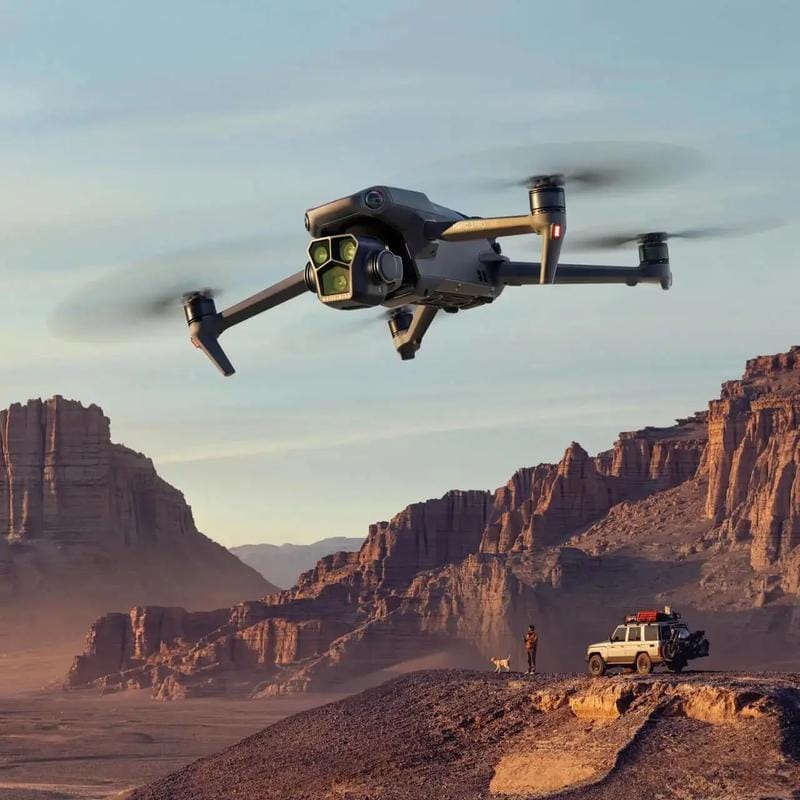
The report highlights the case of DJI Technology, the Shenzhen-based behemoth that controls an estimated 70% of the global commercial drone market. The capability and cost-effectiveness of Chinese-made drones are simply unmatched by Western counterparts. The impending U.S. import restrictions on DJI, set to take effect on December 23, will only exacerbate the problem by creating a vacuum no domestic company is prepared to fill.
Morgan Stanley puts this into perspective by examining DJI’s latest product:
"For example, a couple weeks ago, DJI unveiled its newest drone: the NEO 2 featuring 4K video, omnidirectional vision and forward-facing LiDAR for semi-autonomous flight, object/person tracking, and hand gesture control for $209 USD-equivalent... we are not aware of any non-Chinese company producing commercial/consumer drones at a scale anywhere comparable to DJI with the same combination of capability + price."
More Than Just Fireworks
China's lead is not just in components and assembly lines; it's also in the sophisticated software and control systems required to operate drone swarms. The report points to a recent synchronized light show in Liuyang, China—a dazzling display that was far more than entertainment.
"In the city of Liuyang...just shy of 16,000 drones were launched in to the sky for a dazzling synchronized light show. Navigation relied upon computer control and real-time kinematic positioning (RTK) in a mesh network."
This event, organized by the Chinese drone company High Great, was a barely-veiled demonstration of dual-use technology, showcasing a level of command-and-control that has direct battlefield applications. As the U.S. struggles to build a single drone, China is effortlessly coordinating thousands.
For Washington, the challenge is fundamental. This is not about funding giant defense contractors to build exquisite, multi-million-dollar platforms. The drone war is being won at the low end, in a sector that looks more like consumer electronics than traditional defense. As Morgan Stanley concludes, the real deficit is one of industrial policy and commercial manufacturing prowess.
"It’s important to recognize that the focus on the US manufacturing deficit in drones is in the lower end of the technology spectrum, which is more akin to consumer electronics manufacturing than traditional Defense manufacturing."
The Pentagon can write the checks, but for now, no one in America appears capable of cashing them.