
ROKAE’s HK$10.9B Debut Tests China's Embodied AI Market
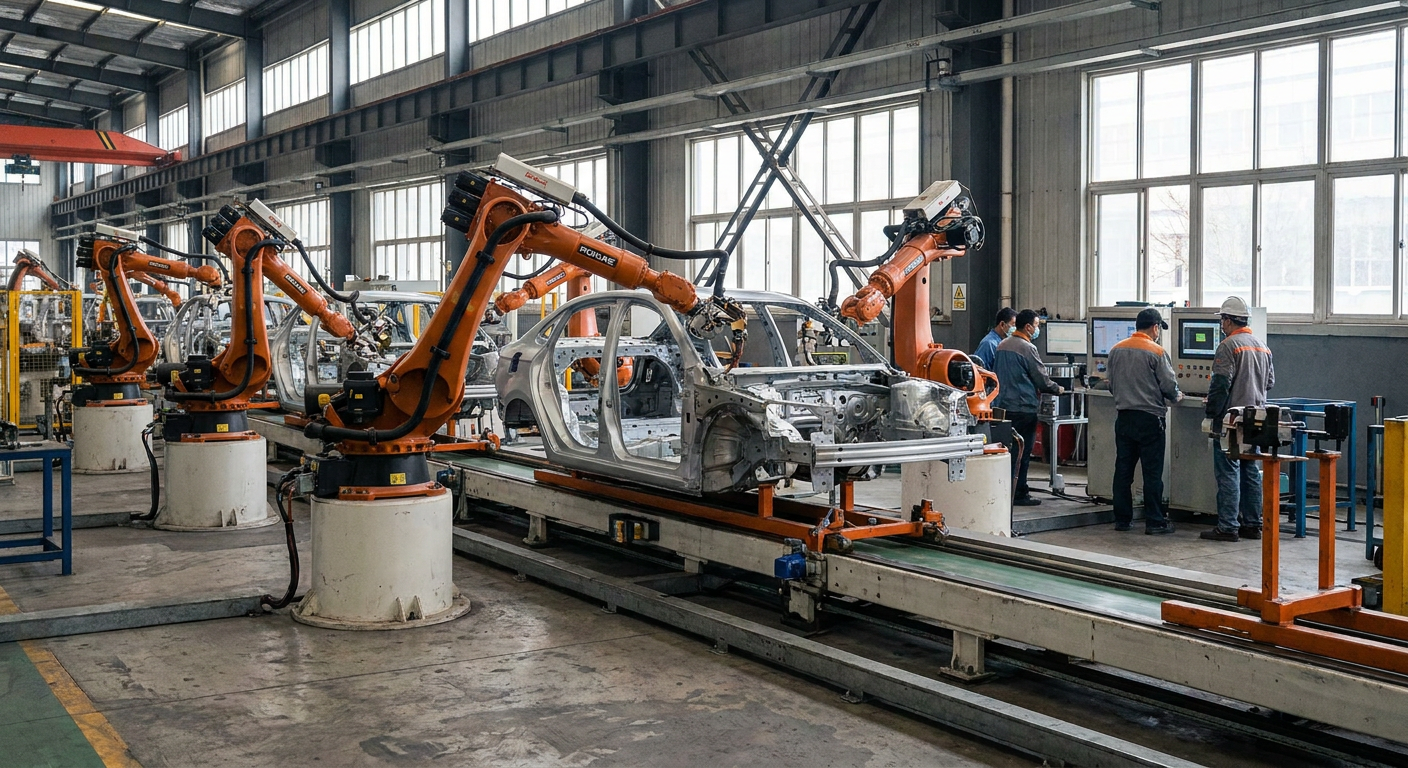
Beijing-based ROKAE surged past a HK$10.94 billion valuation in its Hong Kong trading debut, signaling public market appetite for Chinese robotics makers transitioning from industrial automation to embodied artificial intelligence.
Shares of the company (3752.HK) opened at HK$38.02 and climbed to HK$41.80 on their first day of trading. The strong reception underscores investor confidence in a hardware manufacturer that posted a 40% compound annual growth rate from 2023 to 2025 and secured a record RMB 580 million (US$84.05 million) in confirmed in-transit orders by March 2026—a first-quarter backlog that already surpasses its entire 2025 annual revenue.
Unlike peers chasing a singular, general-purpose humanoid, ROKAE’s public debut tests a contrarian thesis. Management explicitly rejects the expectation of an "iPhone moment" for embodied AI, betting instead that the sector will fragment across highly specialized ecosystems rooted in legacy industrial force-control technology.
Rejecting the 'iPhone Moment' Reshapes Industry Strategy
While venture capital poured RMB 93.5 billion (US$13.55 billion) into China's embodied AI sector in the first half of 2026 alone, ROKAE founder Tuo Hua maintains that the extreme fragmentation of use cases—from automotive assembly to commercial kitchens—precludes a winner-takes-all hardware platform.
Instead of building full-size humanoids to compete in a crowded consumer market, ROKAE is positioning itself as a "Tier 1" component enabler. The company leverages its nine-year accumulation of force-control algorithms to supply critical robotic arms to other AI firms. Because robotic arms account for up to 70% of a humanoid's total material cost, dominating this supply-chain node offers a high-margin structural moat.
Market data validates this localized monopoly strategy. Nearly half of China's top 10 embodied intelligence companies currently integrate ROKAE’s force-controlled arms into their proprietary models, granting the newly listed firm a 6.3% domestic market share and securing orders for over 10,000 embodied AI robotic units.
Surging Q1 2026 Orders Validate Platform Consolidation
The financial architecture supporting ROKAE’s HKEX listing relies on a three-pronged product matrix: heavy industrial automation, flexible collaborative robots, and emerging embodied AI. The underlying driver for all three is the proprietary xCore control platform, which allows rapid cross-category iteration without redundant development costs.
This consolidated R&D approach yielded RMB 522 million (US$75.65 million) in 2025 revenue. Industrial robots generated 43.1% of sales at RMB 225 million (US$32.60 million), while flexible collaborative units brought in RMB 138 million (US$20.00 million). Most notably, the embodied AI division recorded RMB 47.01 million (US$6.81 million)—a 17-fold expansion over a two-year period.
The momentum has sharply accelerated in 2026. During the first quarter, ROKAE shipped over 5,100 units across its portfolio. The company expanded its client roster to 834 enterprises globally by the end of 2025, deploying automated solutions for manufacturing giants including Xiaomi Corp., Goertek Inc., and Valeo SE.
Targeting Upstream Supply Chains Secures Future Moats
ROKAE’s transition from a 2014 startup struggling to pitch control systems to a publicly traded robotics leader mirrors the broader maturation of China’s smart manufacturing sector. A pivotal 2023 injection of RMB 400 million (US$57.97 million) from the state-backed National Manufacturing Transformation and Upgrading Fund signaled central support for its foundational technology.
Operating on the ROKAE Brian platform—a multi-modal world model architecture—the company's systems can currently execute micro-tolerance tasks like USB insertion with a 99% success rate after processing just 50 to 60 data samples. This integration of software intelligence and hardware precision forms the core of its post-IPO expansion strategy.
Proceeds from the Hong Kong offering will not solely fund downstream production capacity. Management indicated that capital will be deployed aggressively into upstream strategic investments, targeting critical chokepoints in embodied AI such as lightweight materials and novel motor technologies. By controlling the supply chain from the foundational algorithm up to the physical joint, ROKAE aims to dictate the pace of hardware commoditization in the global robotics sector.