
Rokid VP: In Times of Industrial Transformation, Startups Always Emerge Victorious
Rokid Technology Co., Ltd., the Hangzhou-based AI wearables startup, has positioned itself as a leading player in China's smart glasses market amid intensifying competition from tech giants. In an extensive interview conducted at the company's headquarters near Dream Town in Yuhang District, Rokid Vice President Cai Guoxiang discussed the company's decade-long journey, recent breakthrough with AI-powered smart glasses, and strategy for competing against industry behemoths including Xiaomi, Alibaba, and others entering the smart glasses arena.
The three-hour conversation provided insights into how Rokid survived near-bankruptcy in 2019, pivoted from smart speakers to AR glasses, and achieved unexpected viral success in 2025 when its AI glasses garnered over 300,000 pre-orders following a viral demonstration by founder Zhu Mingming using the device's teleprompter function during a February presentation.
01 Leaving Alibaba
Beluga Lab: You left Alibaba in 2014 to join Rokid and officially started your entrepreneurial journey. Leaving Alibaba was quite a brave move at that time.
Cai Guoxiang: (Laughs) Yes, Alibaba was still at its peak then. And my last day at Alibaba was exactly the day Alibaba went public, September 19th.
Beluga Lab: Why? Did you give up the opportunity for financial freedom?
Cai Guoxiang: Not exactly giving up - most of my previous stock options had already been exercised, though I did indeed give up a portion.
I started the business together with Rokid founder Misa (Zhu Mingming). Misa left a bit earlier, in July. Some colleagues left in May and June, even earlier. I had been partially involved before - working at Alibaba during the day and joining this startup team in the evenings to participate in various projects.
Beluga Lab: Was leaving on Alibaba's IPO day a coincidence, or did you arrange it deliberately?
Cai Guoxiang: Both. I thought Alibaba's IPO day would be quite memorable, and coincidentally, that day was also my birthday - very coincidental, just when my life was undergoing a major change.
I originally thought Alibaba would choose to go public on Jack Ma's birthday (September 10th). I wondered if Jack Ma valued me so much (laughs) that he arranged it on my birthday. I felt it might be destined, so I arranged my last day for then. Plus, Jack Ma is also my fellow townsman - we're both from Shaoxing.
Beluga Lab: Starting a business from scratch is quite difficult. Rokid began its transformation in 2019 - did you leave then?
Cai Guoxiang: Yes, at that time, for various reasons, I did indeed leave for a while, about a year and a bit.
I went to DingTalk, which has attendance check-in and video conferencing features. Much of the hardware is either self-developed by DingTalk or from third-party ecosystems. I was responsible for DingTalk's smart hardware and external smart hardware ecosystem, or integrating software with smart hardware.
Beluga Lab: 2019 was also a huge turning point for Rokid, and it was quite difficult then.
Cai Guoxiang: That year was our life-or-death year. We decisively abandoned the smart speaker product line and fully committed to AR glasses. During the most difficult two months, we streamlined personnel by two-thirds - the company originally had 360 people, and only 120 remained. Because we were only doing AR glasses, we didn't need so many people. The financing environment had also changed, investors weren't very enthusiastic, so the company had to cut losses to survive and focus - it was a forced choice.
If a startup hasn't experienced life-or-death decisions, it's actually hard to truly succeed later. Rokid has weathered the storm and survived the test of life and death. Compared to that time, any other difficulties we encounter later don't amount to much.
Beluga Lab: Looking back, Rokid's transformation to AR glasses was the right bet.
Cai Guoxiang: Indeed, 2019 ended and we quickly entered the pandemic. During difficult times, Rokid encountered some unexpected luck. The first stroke of luck was one of our previous investors, Temasek, Singapore's largest government fund.
At that time, overseas pandemic situations were very severe, with high demand for temperature measurement supplies. We added a small infrared camera to our AR glasses that could accurately measure temperature for up to 20 people simultaneously within a 10-meter range.
Just by putting on the AR glasses and looking, anyone with abnormal temperature would be immediately displayed - very efficient and contactless. The Singapore government purchased a batch of glasses, which was also our largest order.
Beluga Lab: After working at DingTalk for over a year, why did you return to Rokid in 2021?
Cai Guoxiang: This is actually quite normal. At that time, Rokid's AR glasses already had scale among B2B enterprise customers, and there was a need to build a standardized, unified open platform to support more developers for software development, making it more convenient, fast, and autonomous to integrate with our hardware.
I've always been passionate about building AR glasses ecosystems. When Misa (Zhu Mingming) approached me, since we already had entrepreneurial experience together and we're all old colleagues and buddies, there wasn't much to discuss.
Of course, there were objective reasons too - Alibaba Cloud and DingTalk merged, with many internal adjustments. So based on various factors, I felt returning would be good, so I came back.
Beluga Lab: From serving B2B to moving toward mass consumer products, Rokid seems to have always had an obsession with C2C products. Why?
Cai Guoxiang: From Rokid's first day, our first product was a smart robot for every household. We pivoted to AR glasses because the technology wasn't mature enough, so we started with B2B customers.
Actually, you can consider Rokid fundamentally a robotics company. It's just that when we think of robots, we first imagine them having shells and hardware carriers. But today's robots are like FRIDAY (the smart butler system from Iron Man) - they don't necessarily need shells. Rokid's Leqi is also such a robot.
Actually, robots don't have fixed forms in specific hardware carriers. They're omnipresent, with various form changes - they can be in speakers, glasses, or cars. So we're also continuously improving FRIDAY's capabilities.
Robots might seem cold and mechanical. The name Rokid is a combination of "robot" and "kid" - children would find it lifelike, cute, and approachable. We hope to create robots that everyone can use, though current technology isn't that mature yet.
Beluga Lab: I know one of your company's values is "playful spirit." How should we understand this?
Cai Guoxiang: This playful spirit isn't separate from work - not like enjoying movies, traveling, or photography outside work. Rather, it's about gaining growth through curiosity, exploration, and persistence in your work, achieving spiritual satisfaction, accomplishment, or honor that brings you true happiness.
There's also a prerequisite: we believe that as long as you don't give up, failure doesn't exist.
Beluga Lab: Why is playful spirit so important?
Cai Guoxiang: Entrepreneurship is very difficult and agonizing. It's already tough - if you can't find joy in it, how can you persist? This is a simple truth.
Beluga Lab: Do you think Rokid is successful now?
Cai Guoxiang: It depends on different dimensions. If we use going public as the standard, we haven't gone public yet, so we're not successful. If the revenue standard is tens of billions or hundreds of billions of yuan, we haven't reached that either, so that's not success.
But for a startup to persist for ten years and still exist, with a growing team, increasingly better business, and promising future trends - that can also be called a form of success.
02 Premature Products, Cold Market
Beluga Lab: Rokid has actually undergone many product line changes in the past, walking through some pitfalls before finding its rhythm. My impression is that you've become increasingly pragmatic, unlike initially pursuing only cutting-edge technology?
Cai Guoxiang: Right, when a startup was founded, the first product was a huge commercial pitfall. As you said, initially it was just a bunch of product people and programmers, everyone with passion, wanting to create a beautiful, idealistic product.
In Rokid's early entrepreneurial days, we positioned ourselves as a robotics company. You might not have heard of it, but our first product was called Rokid Alien, positioned as a desktop robot. We later launched second and third generations, which actually evolved into the simplified smart speakers.
The first generation was designed as a robot - it just couldn't walk and had no hands or feet, sitting on a table. But it had cameras, voice capabilities, display, and could understand and interact through voice. We positioned it not just as a voice-interactive device or robot. We hoped it would be warm, emotional, able to understand you, and be a family member.
Beluga Lab: This concept still seems very trendy now.
Cai Guoxiang: Yes, very beautiful, right? At that time, we worked hard on both software and hardware to create it. After completion, technologically it was a classic, cutting-edge product with distinctive appearance. When it lit up and interacted with you, you'd find it like a sprite, not like an earthly product - like an alien.
But there was a huge problem: commercialization was very difficult because the cost was simply too high. The hardware cost alone was RMB 4,000 (US$600). If we tried to sell it, how could we do so at such a high price? Back then, we set a price with zero profit, at RMB 5,280 (US$790). As you can imagine, in 2016—almost ten years ago—it was nearly impossible to sell a completely new product category for over RMB 5,000 (US$750).
So from a commercialization perspective, it was a huge pitfall.
Beluga Lab: How much money did you invest?
Cai Guoxiang: I don't know the specific amount, but we weren't worried about money then - it was an investment boom, AI was the hottest trend, plus Misa's (Zhu Mingming) personal influence meant capital was chasing us for investment. However, after this product came out, it was indeed very hard to sell in the market. I remember there was a lot of inventory backlog.
What happened to this inventory? Any employee who passed the probation period got one as a gift. Today that product is gone - all consumed. (Laughs)
In 2017, we immediately launched the second generation. We learned our lesson and made it very small, priced at RMB 1,399 yuan (US$193), positioned as a smart speaker. But unfortunately, that year Alibaba launched Tmall Genie and Xiaomi launched Xiao Ai, selling for RMB 499 and RMB 299 yuan respectively. Their prices were a fraction of ours.
Later, big companies started price wars, and we didn't develop good product capabilities or advantages.
Beluga Lab: What lessons did this experience teach you?
Cai Guoxiang: First, we need to focus on tracks with higher technological barriers. Not where other companies can quickly produce products similar to yours by throwing money at it. So when Misa (Zhu Mingming) decided to cut smart speakers and focus on AR glasses, it was because we clearly understood how high the technical difficulty was. Once the technical threshold is high, many companies with insufficient technical capabilities are blocked out. At that time, Rokid's first-generation AR glasses had been selling for a while, and the second generation was in development.
Second, product choices became more pragmatic. We previously made a Rokid Station entertainment suite product, consisting of a host, display screen, and glasses. There was significant internal disagreement about this product because it was inconsistent with Rokid's positioning. Founder Misa (Zhu Mingming) strongly opposed it, but the business line leader insisted. The final result was quite good, meeting some market user needs.
Such products are actually tactical products - they have short-term markets, and we're willing to make some products that can quickly generate revenue and are more pragmatic. There's more than one such example. Misa (Zhu Mingming) sometimes jokes externally that most of the company's most profitable projects weren't decided by him.
Beluga Lab: Rokid essentially started developing AI glasses in 2023, while Xiaomi said they started developing AI glasses in September 2023.
Cai Guoxiang: Let's go with what he said - I don't know either, right?
Beluga Lab: Why did everyone start entering the AI glasses track at this time? Was it because of ChatGPT?
Cai Guoxiang: This is a very important reason. In 2023, ChatGPT triggered an AI explosion, and everyone realized that large language models had become so good at knowledge Q&A, voice communication, and text interaction.
AI development is usually divided into five stages, L1-L5. L1 was when we made smart speakers - command-based voice interaction. L2 stage, large models can have relatively good understanding and reasoning capabilities. L3, people think they can not only reason but also help with execution. We're currently in the overlapping stage of L2 and L3. L2 has been developing for some time, and we've seen very strong reasoning capabilities.
Such reasoning capabilities are first applied to glasses or phones, but glasses are definitely the most natural interactive carrier for users, providing better usage scenarios. I think this is very important background.
Beluga Lab: Everyone talks about the impossible triangle of smart glasses: performance, weight, and battery life. Do you think smart glasses have broken through this impossible triangle now?
Cai Guoxiang: Regarding this impossible triangle, I think it's not about breakthrough, but balance.
The so-called impossible triangle has one corner being appearance, size, weight, and wearing comfort - simplified as wearing experience. The second corner is computing power plus display - that is, performance and presentation capability. The third corner is battery life.
This impossible triangle means that if you want to satisfy user experience - glasses should be light and small, close to ordinary glasses - and want good display effects, you need to add an optical engine for image display. At the same time, computing power can't be too weak, which puts higher demands on batteries that can't be large, requiring compact structural design. All these details need balancing.
This impossible triangle could include another cost factor, because even if the three corners balance well, prohibitively high costs are still problematic.
Years later, as smart glasses continue iterating, this impossible triangle will still exist, but each corner will rise by one or two levels. For example, displays will change from pure green to color, field of view will expand from 25-30 degrees to maybe 50 degrees or larger. Chips will become more powerful with stronger computing capabilities to run higher-performance models locally. Batteries will become smaller but denser with larger capacity.
Each corner of the impossible triangle will rise, but good balance can still be found.
Beluga Lab: From the impossible triangle theory, how do you view your glasses?
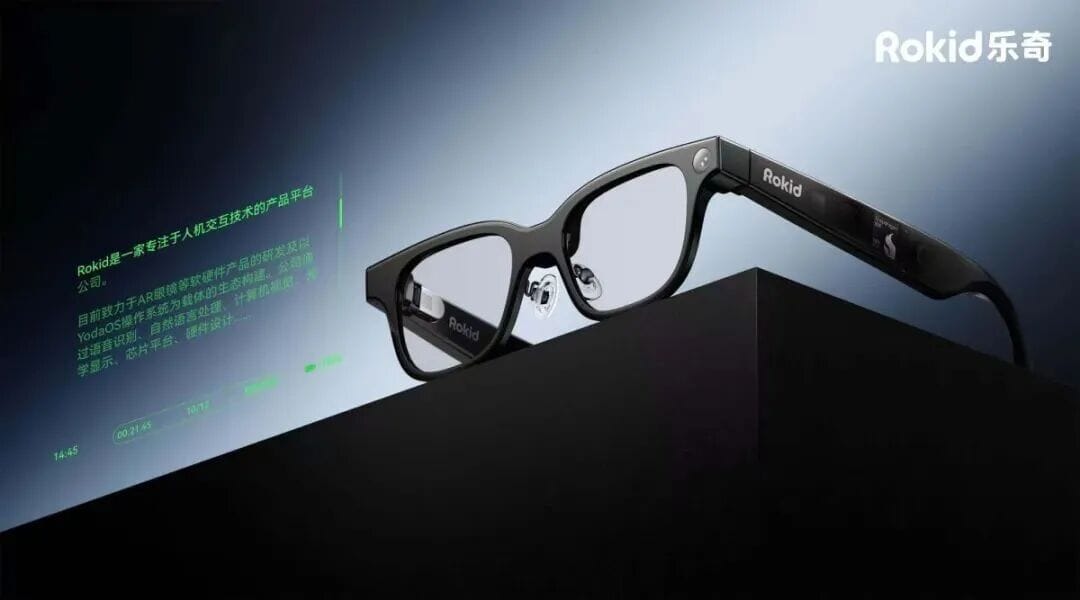
Cai Guoxiang: Rokid Glasses have all the functions that relevant smart glasses should have, plus additional display capabilities. In appearance, they're closest to ordinary glasses while maintaining the lightest weight at only 49 grams.
Other companies launching products with cameras and displays this year are either very heavy - seventy-plus grams or 100 grams - or have cameras in the middle, causing some usage discomfort and appearance significantly different from ordinary glasses.
I believe that under current technology and supply chain conditions, Rokid Glasses achieves the best, most balanced product.
Beluga Lab: Rokid's AI glasses weigh only 49 grams - was this a goal set in advance by Misa (Zhu Mingming)?
Cai Guoxiang: Yes.
Beluga Lab: Why 49 grams?
Cai Guoxiang: Because the best-selling smart glasses previously were Meta's Ray-Ban model, which weighed exactly 49 grams and sold very well.
This objectively set some industry standards. These glasses, at only 49 grams, sold millions of units, proving this weight has relatively high user acceptance. So everyone can follow this benchmark.
Cameras are definitely necessary, because before Meta Ray-Ban came out, many people had made glasses with waveguide displays but no cameras. Meta Ray-Ban proved cameras are important - the most discussed and shared feature in user communities is photography. Cameras are almost essential overseas.
So when designing Rokid AI glasses, having both cameras and displays was challenging. There were multiple solutions - putting cameras and optical engines on the temples, or placing optical engines on the lens tops and cameras on the middle frame. These would make the glasses' appearance less attractive.
We used a cleverer approach - placing cameras on the right side frame of the lenses, with optical engines stacked inside the middle frame, using a one-to-two method to output video signals to both sides. The optical engine position isn't visible from the outside and doesn't affect frame aesthetics.
03 Big Companies' Advantages Are Also Their Weaknesses
Beluga Lab: Rokid AI glasses sold about 250,000 units in three months from release to pre-order, right? Some people think you didn't actually sell that many?
Cai Guoxiang: It's not calculated from the release. We released on November 18th last year. The real viral breakthrough was February 18th this year, when our founder Misa wore Rokid Glasses and used the teleprompter feature during a speech. Calculating three months after going viral, we received 200,000 units in individual user pre-orders and channel distributor contract orders. Now it's actually exceeded 300,000 units.
Honestly, most of these orders come from industry channel distributors, mainly traditional eyewear stores. We've now partnered with many eyewear brands, including Baodao Eyewear, Baoli Eyewear, Wu Liangcai, Mao Yuanchang, and other chain brands.
Beluga Lab: What level does this order volume represent?
Cai Guoxiang: Previously, all cumulative orders for waveguide glasses in the domestic industry might be at this level.
Beluga Lab: How do you verify this pre-order volume in distributor agreements?
Cai Guoxiang: This requires collective discussion. After last year's launch event, we released F-codes for about a month. F-codes were for the earliest users, who also gave us lots of feedback through their experiences, co-creating the product. When selling F-codes, we didn't push extensively - we sold thousands in one month when we weren't yet viral.
After Chinese New Year, we went viral. Many people asked where to buy, but the product wasn't yet on sale and F-codes had ended. So we pre-sold on many e-commerce platforms where users could pay deposits. So far, these users have pre-ordered tens of thousands of units.
This actually gave many channel distributors confidence. After going viral in February, Rokid-related videos had billions of views across all networks, generating the industry's historically highest attention and buzz. You can check WeChat Index to see this very clearly. Let me open it now to show you - I haven't checked for several days.
WeChat Index is relatively low now. The highest in July was over 25 million, now it's over 5 million. Even at over 5 million, we still have the industry's highest index - dozens or hundreds of times higher than others. When we went viral on February 18th, Rokid's WeChat Index reached nearly 100 million.
Beluga Lab: This year, not only did Rokid sell well, but Xiaomi's sales were also quite good. They reportedly sold 70,000 units in the first week, finishing stock prepared for three months in just over twenty days.
Cai Guoxiang: (Laughs) Right, this is great news - good for the entire industry, boosting industry confidence.
Beluga Lab: Does Xiaomi affect you?
Cai Guoxiang: Looking at both sides, currently benefits outweigh drawbacks. Xiaomi's launch and sales prove the market is large and users have strong payment willingness, giving confidence to the entire industry. In other words, Xiaomi completed user education and market popularization that many startups like us might not accomplish despite great effort. From this perspective, we should thank Xiaomi.
Currently, our AI glasses have very significant differences from Xiaomi's glasses. Xiaomi's glasses don't have waveguide displays, while our product has waveguide displays where you can see screens. Xiaomi's are called pure AI glasses, ours are AI+AR glasses. From product differentiation, they're not the same category. Although both are called smart glasses, having displays versus not having displays makes a big difference.
Beluga Lab: Why?
Cai Guoxiang: From product capability perspective, having displays is stronger because some scenarios require displays. For example, our most viral teleprompter function this year - without displays, it's unusable, and we probably wouldn't have gone viral. Also, when phones receive messages, there are message notifications that can't be seen on smart glasses without displays.
Some functions, if they have displays, greatly improve product user experience. For example, translation - when communicating face-to-face with foreigners, translated content projects in front of your eyes as Chinese. Without displays, you can only listen to voice, which reduces experience. Including navigation - just voice directions are definitely not as clear as displaying route maps, making it easier to get lost.
So products with displays have broader application scenarios and better user experience. We believe both from product capability and positioning perspectives, we're higher than Xiaomi. Of course, our price is also slightly higher.
I believe Xiaomi will definitely make smart glasses with displays later. We predict that all future smart glasses will default to having displays, just like phones now default to having cameras. Displays will definitely be essential for future smart glasses.
Beluga Lab: Alibaba Quark launched AI glasses with displays, and Xiaomi might launch displays later. When everyone's product functions become similar, will there be pressure?
Cai Guoxiang: Our current product still leads for some time. During this window, we need to run fast enough. As mentioned before, we have 300,000 unit orders. When officially launching September 1st, more people will get this product, driving more user usage, promoting user scale and influence, making brand awareness bigger. So the question is: how do we compete against similar products?
Actually, there are just two points, no secrets. First is product experience refinement - not big product functions, but details, including whether appearance design is more beautiful, comfortable, and fashionable, plus hardware R&D on making it smaller and more compact inside, affecting heat dissipation, power consumption, etc.
The other is branding. Objectively speaking, going viral this year had lucky elements. But luck won't always exist - we need to work hard maintaining communication and buzz later, letting more people see the Rokid brand. Only by truly building the brand do you have real capital to compete against giants. Only with good product details and branding can you possibly survive competition.
Beluga Lab: So you also feel that while Rokid currently has good product capabilities short-term, long-term facing giants' influx will bring great pressure.
Cai Guoxiang: Right, exactly. Otherwise, when brands haven't risen and products don't have big differences, everyone usually fights price wars, right? Startups definitely don't have advantages because big companies have money for subsidies.
Beluga Lab: Xiaomi's smart research director recently mentioned in an interview that he thinks two types of companies have the most opportunities in the future. One type has phone and wearable ecosystems like Xiaomi or Huawei. Another type has national-level apps and top large models like internet companies Tencent and ByteDance. He didn't mention startups and even suggested investor friends not easily invest in startups in this field.
Cai Guoxiang: From probability perspective, what he said isn't wrong.
But investors definitely won't listen to him. Investors have different types, some prefer high risks because high risk means high returns.
What I want to say is that during new industry or industrial upgrade transformations, startups always emerge victorious - every single time. Tech revolutions aren't always won by old companies - each generation of products has new startups emerging. Looking at startup tracks, aren't we looking at those running in front? We certainly have such expectations and confidence in ourselves.
Beluga Lab: So you need to ensure you keep running in front.
Cai Guoxiang: Actually, I think large model companies won't necessarily do this. Alibaba Tongyi (Labs) didn't, Quark did. Within Alibaba, I don't know how they position this product internally - will they treat it as strategically important as large models? Certainly not now, maybe in the future.
Of course other big companies are also doing this, including many big companies you mentioned like Tencent. What hardware has Tencent made? Tencent focuses more on software, achieving social ecosystems through software products to change the world - you don't necessarily need hardware, right? So even if big companies have technology and resources, they won't necessarily choose to enter this track.
Another point: whether large model companies or big companies, once they enter themselves, they fall into a dilemma. For example, Xiaomi or other companies - Xiaomi has its own large model, so glasses must support Xiaomi's large model. Can they include DeepSeek, Doubao, Zhipu, or Alibaba Tongyi large models? Their advantage is simultaneously their weakness.
So what are we startup companies? We leverage our own advantages. Compared to big companies, we're not completely disadvantaged - we definitely have advantages.
Beluga Lab: How do you view Quark's AI glasses? Are you optimistic about them?
Cai Guoxiang: It's hard to say optimistic or not, because the product just launched.
Alibaba has always had a dilemma - where does its traffic come from? The most important thing for e-commerce is users. This is why Alibaba always wanted to do social - making Laiwang (the earliest product competing with WeChat) - because the most active user behavior is social, while e-commerce only comes when buying things, not otherwise. So Alibaba always worries about whether it can control traffic itself rather than directing it from elsewhere.
Where are user traffic's primary entrances? Phone hardware is a primary entrance. Years ago, Alibaba made Cloud OS and cloud phones, which weren't successful. They even acquired a phone manufacturer, later made Tmall Genie. Actually, Alibaba has been continuously exploring user primary entrances.
Phones are entrances, smart speakers were once entrances, now it's smart glasses. Alibaba doing this shows everyone recognizes that smart glasses will be the next interactive computing terminal - a new entrance. Combined with AI, this entrance brings greater disruption.
Unlike today's phones displaying all apps, taking Rokid glasses as an example, when users pay or navigate, they invoke Leqi. From hardware to human-machine interaction inside, smart assistant entrances are also in glasses, with all third-party services hidden behind smart assistants.
In the future AI era, you'll find apps no longer exist. So this AI assistant or voice interactive agent becomes a unified entrance, helping you execute and call various services. Future entrances become more concentrated and unified - this is scary. Future AI operating systems might have large models become operating systems.
If big companies don't do this, they'll be very passive in the future.
Beluga Lab: Apple is also making AI glasses. In coming years, which big company would you be more worried about?
Cai Guoxiang: Actually, we don't worry about any of them, because worrying is useless. They'll enter if they want to - it doesn't depend on our worrying. The key is: after they enter, what are our advantages? Just find your own advantages.
Because worrying about whether others will come isn't determined by your worrying - why worry uselessly?
Beluga Lab: Long-term, won't you worry about them becoming bigger leaders and eating up market share?
Cai Guoxiang: Today's phone industry is already a very stable endgame. Apple phones target high-end markets. If they also make such glasses, pricing will most likely be higher. For us, just find our own market positioning and target users.
Big companies definitely have weaknesses. As long as you find their weaknesses and attack them, there are definitely opportunities. Xiaomi has another weakness besides the small models mentioned above - Xiaomi covers all categories: home appliances, phones, and cars. It's hard to make users feel it's the most professional at making smart glasses. Rokid's brand only makes smart glasses, like DJI only makes drones.
In smart glasses, our years of hardware system R&D accumulation and product detail experience lead any big company, at least short-term. Users think your experience is better, your product is superior, and you specialize in this - higher recognition, equating smart glasses with Rokid brand. Xiaomi can't do this.
04 Can Smart Glasses Replace Phones?
Beluga Lab: How many companies do you think will survive in smart glasses?
Cai Guoxiang: I think there might be nearly 50 in the future.
Beluga Lab: Why?
Cai Guoxiang: Glasses have a natural attribute - they're naturally worn on everyone's face, with decorative properties. This means everyone has many personalized demands for glasses - fitting each person's age, gender, face shape, and styling temperament. So future smart glasses product forms will far exceed phones and smart speakers. Phones are one per person, at most two, right? Glasses might be more than one pair - two or three pairs, because I need to match different clothes and occasions.
Smart glasses are similarly more personalized and diversified - multiple glasses per person. This is a future trend we can see. My rough judgment: currently, domestic phone brands don't exceed one hand's count. In future smart glasses, the market's final endgame might be ten times today's phone situation.
That is, after the chaos of so-called "hundred glasses war" passes, the market will finally stabilize with possibly not just four or five smart glasses brands, but forty to fifty. Some specialize in children's glasses, elderly glasses, special population glasses, some specialize in party glasses, sports glasses, cycling glasses. So in the future, if you go deep enough in a vertical field, you might be number one.
Beluga Lab: Everyone says smart glasses will replace phones, becoming future terminals. Why?
Cai Guoxiang: First, to this day, no other wearable smart device can surpass glasses in replacing phones as personal terminals. We haven't seen this yet.
Current talk of smart glasses replacing phones is a process. Like Rokid Glasses connects to phones via Bluetooth, with our app installed on phones. When using various functions, it communicates with phones via Bluetooth, still computing locally through phones. Today, it's used as a phone accessory.
Now it partially replaces phone usage time. When I need translation or navigation, I don't need to open Gaode or Alipay on my phone - it's on my glasses, with smart glasses and phones working together. We believe this situation will last at least 3 years, or 3-5 years.
Later, various technologies on glasses will iterate and upgrade, gaining computing power approaching phones. They'll have larger local battery capacity - battery volume won't increase, but density will be higher. Display effects will improve. Now there are color waveguide displays, but technology levels aren't enough - display screens are small, resolution only 480P, and prices are expensive.
Then smart glasses won't just be phone accessories - they'll replace phones. For example, I can go out without phones and still pay, navigate, socialize, and shop - everything can be completed on them.
Such products now have prototypes. Last year Meta released a concept machine Meta Orion - an independent device not paired with phones. Display effects have large screens with 70-degree field of view, 720P resolution - much clearer than 480P. Computing power is strong, supporting spatial 3D and gesture recognition. But it has huge problems: appearance is obviously rough, weight is heavy at over 100 grams, and most critically - too expensive.
Beluga Lab: You mentioned future markets reaching billion-level scale. How did you get this data?
Cai Guoxiang: Just yesterday (mid-August), Meituan's entire management team came to exchange with us. I told them this prediction - in five years, smart glasses globally have opportunities to reach 100 million users. All lightweight smart glasses, whether with or without displays, globally have opportunities to reach 100 million.
In ten years, global cumulative users have opportunities to reach 1 billion. When reaching 1 billion scale, they can already compete with phones.
Global myopia users number 2.6 billion, with 700 million domestically - China is the largest myopic population country. Even halving China's 700 million people gives 300 million. Domestically, 300 million users have natural acceptance of such products.
In five years, I'm talking about global 100 million, not domestic data. I don't think this prediction is optimistic or overly aggressive - it might be conservative.
Beluga Lab: When do you think AI glasses' next iPhone moment will be?
Cai Guoxiang: Current AI glasses are still equivalent to phones' feature phone era. Smart glasses' next iPhone moment, I think, will emerge in 3-5 years. All the previously mentioned impossible triangles will improve to become high-resolution large field-of-view, color waveguide displays, lighter weight, more fashionable and compact appearance, stronger computing power, longer battery life - allowing you to want to wear them all day and use them independently from phones. That I believe is true AR glasses.
Beluga Lab: If comparing smart glasses to phones, which company do you think Rokid is most like?
Cai Guoxiang: Actually, I think Rokid is more like DJI. Many companies have tried making drones but can't beat DJI.
In the future, when talking about smart glasses, we hope that just like people think of DJI as the first brand for drones, the first thing people think of is Rokid and Leqi.