
Shangwei New Material Debuts 0.8-Meter Humanoid Robot to Target Consumer Market
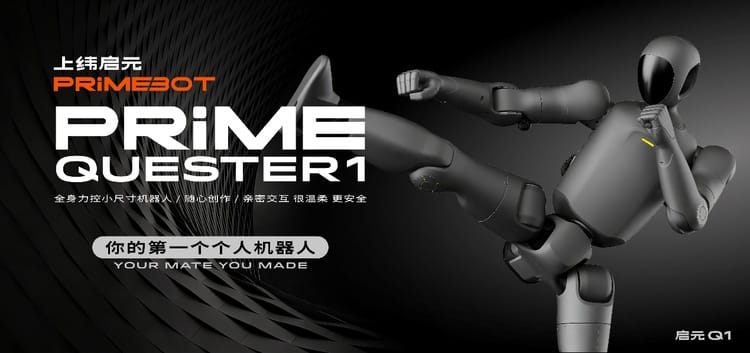
Shangwei New Material has officially entered the personal robotics sector with the launch of the "Qiyuan Q1," the world's first small-scale humanoid robot featuring full-body force control. Standing at just 0.8 meters tall, the device was unveiled by Chairman Peng Zhihui, known in the tech community as "Zhihuijun," marking a significant strategic pivot for the company under the new "Shangwei Qiyuan" brand.
The launch represents a shift from industrial applications toward the nascent personal robot economy. By condensing laboratory-grade capabilities into a backpack-sized form factor, Shangwei aims to lower the barrier to entry for advanced robotics. The company explicitly positioned the Q1 as a consumer-grade product designed to be owned, operated, and customized by individuals, rather than restricted to institutional research facilities.
Technologically, the Q1 distinguishes itself through the miniaturization of proprietary actuation systems. Shangwei claims to have overcome industry-standard engineering bottlenecks by compressing Quasi-Direct Drive (QDD) joints to a size smaller than an egg while maintaining high dynamic response and force control. This breakthrough addresses the "sim-to-real" gap, allowing complex motion strategies trained in virtual environments to be accurately replicated in the physical world with reduced hardware risks.
The introduction of the Q1 is expected to accelerate the commercialization of embodied intelligence in 2025. By targeting three distinct segments—academic researchers, hobbyist developers, and households—Shangwei is attempting to build an early ecosystem around its hardware. The company’s strategy relies on open-source architecture and modular design to foster user-generated content and rapid software iteration, potentially setting a new standard for the personal robotics market.
Strategic Entry into the Personal Robot Race
The unveiling of the Q1 serves as a formal declaration of Shangwei New Material’s expansion into the consumer technology space. The newly established "Shangwei Qiyuan" brand is focused exclusively on personal robots, operating on the philosophy that technological progress must be experiential rather than merely observational.
Peng Zhihui emphasized that the Q1 is designed to bridge the gap between high-end robotics and distinct user groups, including researchers, "geek" creators, and families. By creating a robot that combines high mobility with intelligent interaction in a compact frame, the company intends to provide the first tangible entry point for the mass market into the world of humanoid robotics.
Engineering Miniaturization and Durability
The defining characteristic of the Q1 is its 0.8-meter stature, a deliberate design choice that diverges from the standard 1.7-meter commercial humanoids and 1.2-meter juvenile-sized models. The core engineering achievement lies in the successful scaling down of the actuation system. The company’s new QDD joints retain the power density and precision of full-sized counterparts but are housed in a significantly smaller volume.
This reduction in scale offers practical physical advantages. With a volume and weight approximately one-eighth that of a full-sized humanoid, the Q1 benefits from a naturally higher durability threshold. The "square-cube law" physics applicable to the smaller frame means the robot is more resistant to impact and falls ("nai shuai nai zha"), significantly lowering the cost of trial-and-error in development. This makes the unit highly suitable for aggressive testing of locomotion algorithms that typically carry high financial risks with larger machines.
A Three-Pronged Market Strategy
Shangwei has outlined a diversified application strategy for the Q1, targeting distinct value propositions for different user bases:
Portable Solutions for Researchers: For the academic and scientific community, the Q1 is pitched as a "portable laboratory" and a "graduation machine" for embodied intelligence studies. Its backpack-compatible size allows researchers to transport their experimental hardware easily, breaking the constraint of fixed laboratory environments. The robot supports full SDK and HDK access, enabling extensive hardware and software expansion.
Open Platform for Creators: Targeting the developer and enthusiast community, the Q1 functions as an open creative canvas. The robot’s external structure is open-source, supporting 3D-printed customization and modular head replacements. Furthermore, the integration of the "Zhiyuan Lingchuang" platform allows users to program actions, facial expressions, and behavioral logic using a zero-code interface, lowering the technical threshold for creating complex robotic behaviors.
Interactive Companion for Households: For the broader consumer market, the Q1 is positioned as an intelligent family companion. Utilizing the "Zhiyuan Lingxin" platform, the robot is capable of natural language interaction and educational tasks, such as English tutoring and knowledge retrieval. It employs soft impedance control technology to ensure physical interactions are gentle and safe, allowing it to function as a secure playmate or dance partner within a home environment.