
"Somewhat Underwhelming": Global Legacy Auto Retreats at Guangzhou Show While China’s AI Giants Dig In
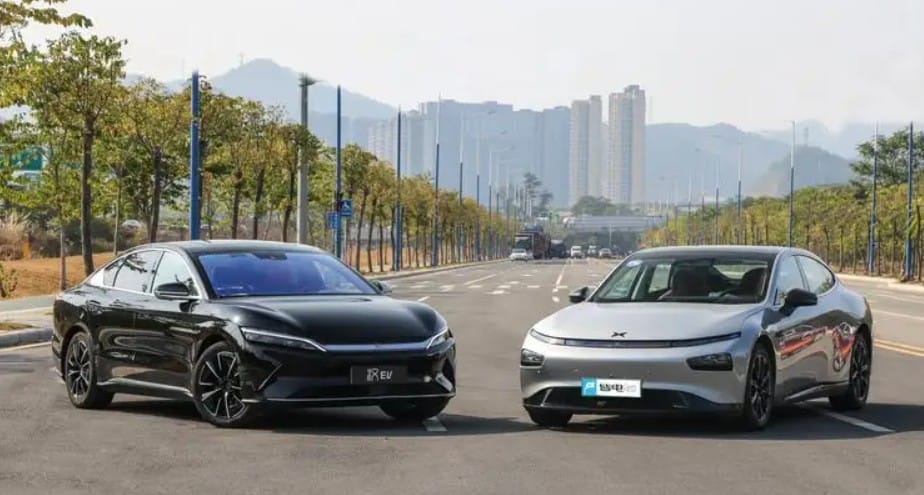
A quiet floor, a retreat of Western luxury, and an army of live-streamers—J.P. Morgan’s latest dispatch from the front lines of China’s EV war paints a picture of an industry holding its breath for 2026.
In a research note released on November 24, 2025, J.P. Morgan’s Head of APAC Auto Research, Nick Lai, offers a sobering assessment of the annual Guangzhou Auto Show. While the headline figures remain large by international standards, the vibe on the ground suggests a strategic pause. The frenetic pace of previous years has slowed, suggesting that global OEMs are "saving their bullets" for a potentially harsher 2026, while domestic leaders pivot aggressively toward AI and robotics.
For investors, the signal is clear: the broad tide isn't lifting all boats anymore. The smart money is moving toward selective technological dominance, specifically favoring XPeng and BYD, while legacy brands struggle to find their footing.
The Great Pullback
The most striking observation from the bank's team was the "conspicuous absence" of major international players. The report notes the show was "smaller/lower than previous shows," with key Western luxury and mass-market brands—including JLR, Porsche, and Hyundai—opting to sit this one out.
J.P. Morgan highlights the stark contrast to earlier events:
"Comparatively, Shanghai Auto Show earlier this year saw 163 new debuts and floor space was twice as large. We also noticed that several global brands chose not to participate... likely due to lack of near-term turnaround opportunity in China or cost-savings."
The strategy appears to be defensive. With J.P. Morgan forecasting retail passenger vehicle growth to be flat to down 5% once government subsidies expire, automakers are wary of overextending. As the analysts noted, "One potential strategic consideration is to ‘save the bullet’ for 2026 should underlying auto demand slow."
The Streaming Army and The Export Lifeline
If the traditional sales floor was quiet, the digital one was deafening. The report describes an "overwhelming number of live-streamers," noting that in many booths, "the number of live-streamers was 2-4 times that of the sales staff."
This marks a definitive shift in the consumption model. Young Chinese buyers have abandoned traditional auto media for direct engagement via social platforms. Simultaneously, the focus has shifted outward. The presence of numerous foreign dealers—speaking languages from Europe, Latin America, and the Middle East—underscores the critical role of exports. J.P. Morgan forecasts China’s total car exports will hit a record 6.6 million units in 2025.
The Rise of Huawei and The "Robot" Pivot
While legacy auto retreats, Huawei Technologies cemented its status as the inescapable operating system of the Chinese auto industry. The bank notes a significant shift: it’s not just domestic partners anymore. Global giants are now bowing to the reality that to sell in China, you need Chinese tech.
"We have seen further selected foreign brands partnering with Huawei in order to offer competitive connectivity solutions targeting young Chinese buyers - e.g. Audi and Toyota."
However, the real technological alpha, according to the report, lies in robotics. In a "disappointing" turnout where most expected humanoid robots to be commonplace, XPeng stood alone.
XPeng showcased its "IRON" humanoid robot, positioning itself as a dual-threat player in mobility and AI. J.P. Morgan remains structurally bullish on the stock, seeing "over 100% potential upside in the next 1-2 years." The bank points to a critical catalyst: the supply of XPeng’s proprietary Turing chip to Volkswagen’s new BEV models starting in Q1 2026.
Models to Watch
Despite the somber mood, the report identified several key product launches that will dictate market share in 2026:
- Leapmotor: The bank highlighted the Lafa5, a compact electric sedan priced aggressively between RMB 105,800 and 131,800 yuan (US14,600–14,600–18,170). Along with the new D19 flagship SUV, these launches underpin a forecast for near 60% volume growth.
- XPeng: The X9 EREV made waves with a total range of 1,602 km, directly targeting "range anxiety." Priced from RMB 309,800 yuan (US$42,730), it is a direct play for the family MPV segment.
- Geely Automobile: Debuted the Galaxy V900, a high-end MPV aimed at competing with BYD's Denza, supporting a projection of 3.4 million unit sales for FY26.
- Mercedes-Benz: In a bid to stop the bleeding, the new CLA BEV abandons the previous "EQ" branding design language. With pricing starting at RMB 249,000 yuan (US$34,340), it represents a final attempt to price competitively without the massive 25-30% discounts that plagued previous models.
The Bottom Line
The Guangzhou show confirms the bifurcation of the market. The era of easy growth in China is over. We are entering a phase of consolidation where "Old Auto" tries to survive via cost-cutting and Huawei partnerships, while the "New Auto" leaders like XPeng and BYD leverage AI silicon and robotics to redefine the valuation multiples. As J.P. Morgan concludes, for those not innovating at the speed of light, 2026 looks like a long, cold winter.