
StepFun Secures $7 Billion in Largest Chinese AI Funding Round, Marking New Era in Physical AI
StepFun has closed a 50 billion yuan ($7 billion) Series B+ funding round, setting a new record for the largest single financing in China's large language model sector over the past 12 months. The deal signals a decisive shift in China's AI landscape as capital consolidates around proven winners and the industry pivots from pure model development to commercialization through physical devices. The financing attracted an unusually diverse investor base spanning state-backed funds, insurance capital, and leading venture firms, while the company simultaneously appointed AI veteran Yin Qi as chairman to spearhead its terminal-focused strategy.
The funding round drew participation from Shanghai Guotou Pioneer Fund, China Life Equity, Pudong Venture Capital, Xuhui Capital, Wuxi Liangxi Fund, Xiamen C&D Corporation, and Huaqin Technology, alongside follow-on investments from existing backers including Tencent, Qiming Venture Partners, and 5Y Capital. The capital infusion comes as China's AI sector faces mounting pressure to demonstrate sustainable business models, with 2025 witnessing just 22 investments totaling 9.4 billion yuan in the model layer—a sharp decline from 2024 levels.
StepFun's ability to command such significant capital reflects growing investor conviction that the race for AI supremacy has narrowed to a handful of contenders. The company, founded in Shanghai in 2023, has released over 30 models and positioned itself as a leader in multimodal AI, earning the industry moniker "multimodal rollout king." The financing validates its strategic bet on "AI+Terminal," a departure from the API-selling and project-delivery models that have struggled to achieve scale.
The appointment of Yin Qi marks a strategic inflection point for the company. As chairman of Qianli Technology and founder of Megvii Technology, one of China's "AI Four Dragons," Yin brings battle-tested experience navigating AI cycles from 1.0 to 2.0. His involvement in StepFun's strategic planning since its early days now formalizes into executive leadership, forming what the company calls a "1+3 golden team" alongside CEO Jiang Daxin, Chief Scientist Zhang Xiangyu, and CTO Zhu Yibo.
Investor Composition Signals Market Maturation
The financing structure reveals a fundamental shift in how China's AI sector attracts capital. Unlike previous mega-rounds dominated either by dollar funds or regional state-owned enterprises, StepFun's investor roster balances government-backed institutions, insurance capital, industrial investors, and market-driven venture firms—a composition that suggests deepening confidence in the company's commercial trajectory.
China Life Equity's participation carries particular weight. As the private equity arm of China Life Insurance, the country's largest state-owned insurer, its involvement represents a rare endorsement from long-term institutional capital known for stringent risk assessment. Insurance capital typically demands clear paths to profitability and sustainable cash flows, criteria that have eliminated most AI startups from consideration.
Xiamen C&D Corporation's investment marks the state-owned conglomerate's first foray into large language models, reflecting intensifying competition among regional governments to anchor AI capabilities within their jurisdictions. The company's controlling shareholder, Xiamen C&D Inc., brings extensive industrial networks that could facilitate StepFun's expansion into new verticals.
Huaqin Technology's strategic investment aligns directly with StepFun's terminal-focused roadmap. The nearly 100 billion yuan market-cap ODM manufacturer supplies OPPO and VIVO while producing tablets, laptops, wearables, and automotive electronics—product categories where StepFun aims to embed its models. The partnership positions StepFun to scale across virtually every category of consumer smart devices.
The continued participation of Tencent, Qiming Venture Partners, and 5Y Capital—all following their money with additional capital—signals sustained conviction from sophisticated investors who have tracked the company's progress closely. For many of these institutions, StepFun represents their sole or primary bet in the foundation model space, concentrating firepower behind a single horse rather than spreading investments across multiple contenders.
Technical Architecture Targets Hardware Efficiency
StepFun has built what it describes as China's most comprehensive foundation model portfolio, releasing over 30 models in less than three years. The company's "1+2" architecture centers on Step 3, its third-generation large language base model, flanked by two strategic directions: native multimodal capabilities spanning text, voice, and image, and cloud-edge integration that enables models to operate across devices.
Step 3 represents the company's first full-scale, natively multimodal reasoning model, designed from inception to maximize inference efficiency across diverse hardware platforms. According to the company's analysis, Step 3 achieves inference decoding efficiency up to 300% higher than DeepSeek-R1 on domestic chips, while maintaining compatibility across all chip architectures—a critical advantage as China accelerates semiconductor self-sufficiency.
The model's architecture prioritizes system and hardware characteristics during design phases, enabling high-performance inference on widely deployed platforms. This approach contrasts with models optimized primarily for benchmark performance, which often struggle when deployed on resource-constrained devices or non-standard hardware configurations.
StepFun distinguishes itself through heavy investment in AI infrastructure, treating its infra team as co-equal with algorithm development. The company employs one of China's few technical leaders with multiple experiences building and managing single clusters exceeding 10,000 GPUs, a capability that has become table stakes as training runs scale exponentially.
The multimodal portfolio extends beyond language to vision, audio, 3D imaging, and music generation. StepFun has pursued native multimodal integration and unified understanding-generation architectures since inception, betting that AI assistants will require comprehensive sensory capabilities to operate effectively in physical environments.
In November 2025, StepFun launched its Step GUI series, including a 4 billion parameter edge model that became the industry's first genuinely deployable on-device GUI model for smartphones. The release enabled any handset to function as an AI phone without requiring cloud connectivity for basic operations, while cloud-based models provide enhanced experiences for complex tasks.
Physical AI Strategy Targets Terminal Dominance
StepFun's commercial strategy diverges sharply from prevailing monetization approaches in China's AI sector. Rather than pursuing customized B2B delivery projects vulnerable to open-source competition, API sales subject to price wars from tech giants, or consumer subscriptions where internet platforms hold structural advantages, the company targets physical terminals as the primary value-capture mechanism.
The strategy aligns with Nvidia CEO Jensen Huang's proclamation that physical AI—artificial intelligence capable of understanding natural laws and interacting with the physical world—represents the next wave of industry evolution. At CES 2026, Huang devoted 90 minutes to declaring that physical AI's "ChatGPT moment" approaches, echoing computer scientist Yann LeCun's argument that AI must integrate sensory data with text, images, and sound to operate effectively in physical environments.
StepFun frames its approach as "AI+Terminal," positioning foundation models as intelligence substrates while automobiles and smartphones serve as the highest-penetration, highest-frequency physical entry points. According to IDC projections, China's smart terminal market will exceed 900 million unit shipments in 2026, representing a massive addressable market as demographic dividends transform into "AI dividends."
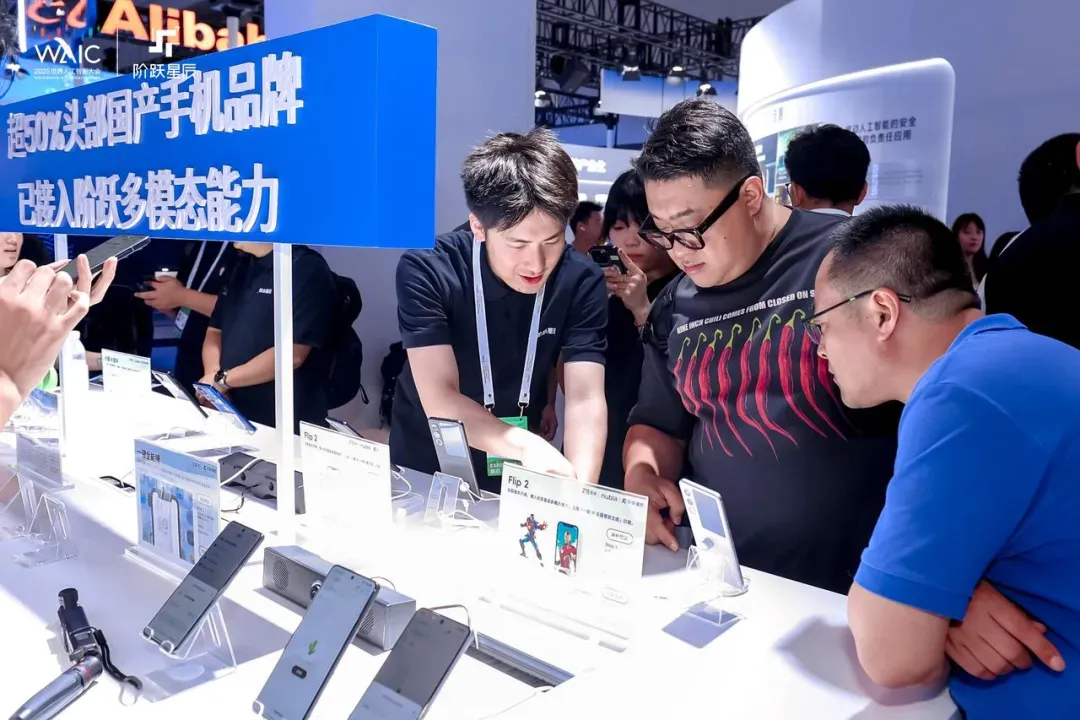
The company has already established dominant positions in key terminal categories. In smartphones, 60% of leading Chinese handset brands have entered deep partnerships with StepFun, including OPPO, Honor, and ZTE, with models installed on over 42 million devices serving nearly 20 million daily users. In automotive, StepFun collaborated with Geely Auto Group and Qianli Technology to develop next-generation intelligent cabin AgentOS, which debuted in the Geely Galaxy M9. The model sold nearly 40,000 units in its first three months and has entered overseas markets, with StepFun projecting its models will be installed in over one million vehicles in 2026.
Performance metrics demonstrate accelerating traction. Through year-end 2025, StepFun's terminal Agent API call volume grew nearly 170% for three consecutive quarters. Over the full year, open platform API calls surged nearly 20-fold while active users increased fivefold—growth rates that validate product-market fit in high-volume deployment scenarios.
Leadership Team Combines Strategic and Technical Depth
The "1+3 golden team" structure addresses the multidimensional requirements of foundation model competition, which demands simultaneous excellence in strategic vision, algorithmic innovation, systems engineering, data understanding, and commercial execution—a combination rarely found in single teams.
Yin Qi brings proven capability navigating technology cycles and scaling AI businesses. As a member of Tsinghua University's inaugural "Yao Class" for computer science, he founded Megvii Technology, successfully steering the company through AI 1.0 to 2.0 transitions. His current role as chairman of Qianli Technology, which focuses on AI+automotive applications, creates strategic synergies with StepFun's terminal roadmap and strengthens the company's automotive value proposition.
CEO Jiang Daxin previously served as Corporate Vice President at Microsoft and Chief Scientist of Microsoft Asia Internet Engineering Institute, where he expanded Bing search services to over 200 countries and regions. His experience scaling global infrastructure and managing complex engineering organizations provides operational foundations for StepFun's international ambitions.
Chief Scientist Zhang Xiangyu, a post-1990s AI researcher, co-authored the landmark ResNet (Residual Network) paper that revolutionized deep learning architectures. His presence signals StepFun's commitment to advancing fundamental research alongside commercial deployment.
CTO Zhu Yibo's career spans Microsoft Research, ByteDance as AI Infra lead, and Google Cloud as GPU product technical lead. He ranks among China's few technologists with multiple experiences building and managing single clusters exceeding 10,000 GPUs—expertise that proves critical as training runs demand ever-larger computational resources.
The team composition reflects StepFun's conviction that foundation model leadership requires eliminating weak links across strategy, algorithms, systems, and commercialization—a "no shortcomings" philosophy that distinguishes the company from competitors strong in isolated dimensions but vulnerable to execution gaps.
Funding Arrives as Sector Consolidates Around Winners
The financing closes as China's large language model sector undergoes stark bifurcation. After a period when capital flowed liberally to dozens of startups, investors have grown markedly selective, concentrating resources on companies demonstrating clear commercial momentum. In 2025, only three model companies secured single-round financing exceeding 1 billion yuan: MiniMax and Zhipu AI, both of which completed IPOs, and Moonshot AI, which announced funding on the final day of the year.
The shift reflects growing recognition that foundation models have entered a "slow elimination" phase where survival requires self-sustaining revenue rather than continuous fundraising. MiniMax and Zhipu AI's public market debuts, both achieving valuations exceeding 100 billion yuan, validated that investors reward demonstrated ability to convert technological capabilities into paying customers.
StepFun's financing success amid this selective environment underscores its position within what investors increasingly describe as the "Big Four" foundation model companies—a cohort that has separated from the broader pack through a combination of technical leadership, commercial traction, and strategic clarity. The capital provides extended runway to execute its terminal strategy while competitors face mounting pressure to demonstrate viability.
The diverse investor composition also provides strategic advantages beyond capital. State-backed funds bring policy alignment and regional government relationships; insurance capital signals institutional confidence in long-term sustainability; industrial investors like Huaqin Technology enable vertical integration; and venture firms contribute operational expertise and network effects. This multi-stakeholder structure positions StepFun to navigate China's complex regulatory environment while accelerating commercial deployment.
The company's trajectory from founding in 2023 to super-unicorn status in just over two years compresses timelines that historically required a decade or more. As China's AI sector matures from experimental phase to industrial deployment, StepFun's financing marks a definitive moment when capital, technology, and market demand converge around companies positioned to capture value from AI's integration into billions of physical devices.