
The AI Car Race in China: Who Gets to Define the Next Generation of Smart Vehicles?
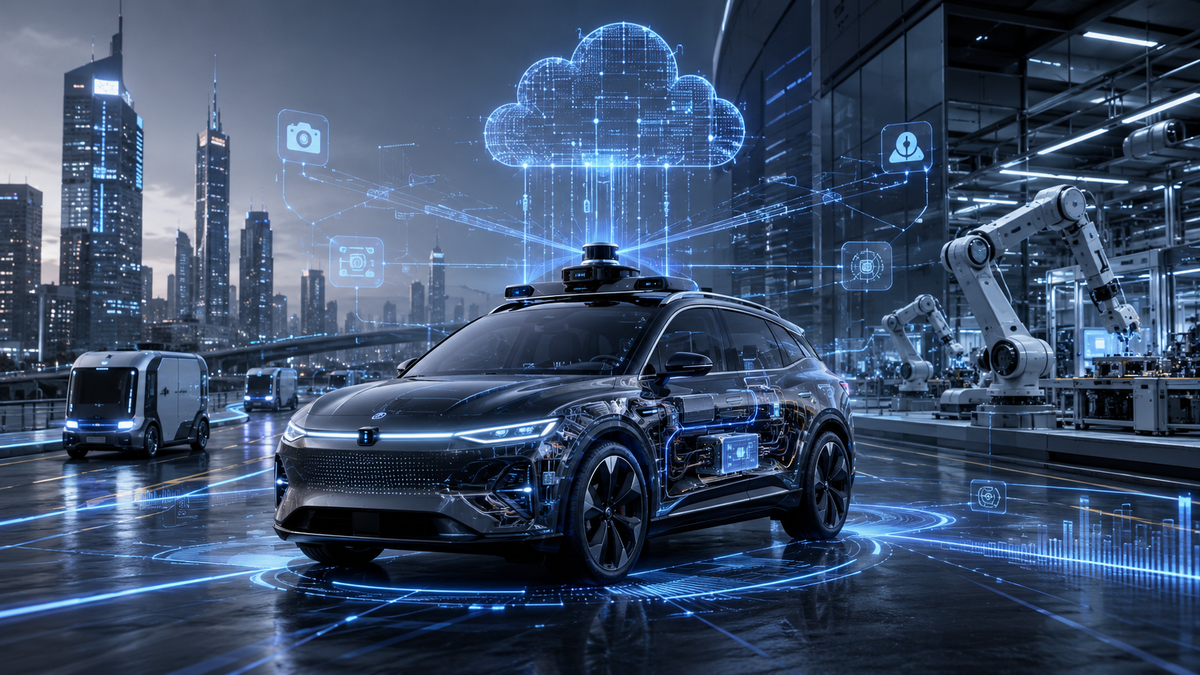
China's automakers and autonomous driving companies are racing to rebrand around "Physical AI" — but a stubborn trust gap between industry ambition and actual user behavior may determine who survives the transition.
What Is the "AI Car" Debate Actually About?
The term "AI car" has become one of the most overused phrases in China's automotive industry. But beneath the marketing noise lies a genuinely consequential structural question: is a car with AI features the same thing as an AI-native vehicle?
The distinction matters enormously — for product strategy, for valuation, and for long-term competitive positioning.
In the earlier phase of China's smart car boom (roughly 2020–2024), intelligence was measured in hardware terms: chip compute capacity, sensor counts, and average miles between driver interventions. By 2025–2026, that framework has been largely abandoned. The new benchmark is whether a vehicle can serve as what the industry calls a "Physical AI entry point" — a platform through which artificial intelligence interacts with and acts upon the real world.
This reframing is not purely semantic. It represents a fundamental shift in how companies justify their valuations, recruit talent, and compete for partnerships.
Why Is This Happening Now?
Several converging forces have accelerated the redefinition:
1. Large language models have entered the vehicle. Over 30 in-car LLMs were deployed across Chinese vehicle models in the past year alone. Companies including BYD, Xpeng, and Li Auto have each released proprietary full-domain vehicle models that attempt to unify the cockpit, driving assistance, and vehicle-road coordination under a single AI architecture.
2. The autonomous driving industry has hit a valuation ceiling. Pure-play autonomous driving companies face a structural problem: their addressable market, however large, is bounded by the automotive sector. Rebranding as "Physical AI" companies — capable of deploying the same foundational model across passenger vehicles, delivery robots, freight trucks, and eventually humanoid robots — dramatically expands the theoretical market and the investment narrative.
3. Nvidia's public framing provided the vocabulary. After Nvidia CEO Jensen Huang spotlighted "Physical AI" as a defining technology trend in early 2026, virtually every major Chinese autonomous driving firm adopted the terminology. The 2026 World Artificial Intelligence Conference (WAIC) in Shanghai formalized this shift, with embodied intelligence featured as a co-equal track alongside computing infrastructure for the first time.
4. China's market has made intelligence a baseline requirement, not a premium. McKinsey's 2026 China Automotive Consumer Insights report found that 69% of respondents now consider urban Navigate on Autopilot (NOA) a standard feature. According to China's Ministry of Industry and Information Technology, over 70% of new passenger vehicles sold in 2026 include combined driving assistance systems, with urban NOA penetration exceeding 30%.
How Does the Industry Actually Work Right Now?
China's smart vehicle ecosystem has fractured into at least three distinct strategic camps:
New Energy Vehicle Startups: AI as Corporate Identity
Companies like NIO, Xpeng, and Li Auto have elevated AI from a product feature to a company-defining mission. NIO founder William Li stated in June 2026 that every car company must now become an AI company. Li Auto's founder Li Xiang argued that 2026 represents the "last boarding window" for becoming an AI-tier company, predicting that globally, fewer than three companies will successfully build foundational models, chips, operating systems, and embodied intelligence simultaneously. Xpeng has formally repositioned itself as "a global embodied intelligence company."
Traditional Domestic Brands: AI as Integration Tool
BYD, Geely, and Changan are pursuing what might be called the "whole-vehicle intelligence" approach — using AI to connect and optimize existing domains (driving, cockpit, powertrain) rather than rebuilding around AI from scratch. BYD's "Xuanji" architecture and Geely's "universal vehicle brain" follow this logic. The risk is clear: if the ultimate value of AI in vehicles accrues to software ecosystems rather than hardware platforms, traditional manufacturers may find themselves locked into the role of hardware assemblers — a dynamic that has already played out in smartphones.
Changan's leadership has been unusually candid about this anxiety. The company has committed approximately RMB 3 billion to computing infrastructure in 2026 alone, with one executive warning that without this investment, Changan risks becoming "just a shell manufacturer." The company has also registered a robotics subsidiary and articulated a "one brain, multiple bodies" strategy — exploring whether the same foundational model that drives a car can also control a robot.
International Brands: Cautious Globally, Aggressive in China
BMW has reduced L3 development priority globally while launching a "360-degree full-chain AI strategy" specifically for China. Mercedes-Benz has shelved L3 development globally while maintaining its China partnership with Momenta. Volkswagen's "In China, For China" strategy has produced co-developed models with Xpeng. The divergence reflects a structural reality: in China, AI capability has shifted from a differentiator to a market entry requirement.
Who Are the Key Players in the Supply Chain?
The most strategically significant development may be occurring not among automakers but among their technology suppliers.
Momenta listed on the Hong Kong Stock Exchange in July 2026 with a first-day market capitalization exceeding HKD 70 billion, positioning itself as the "first Physical AI public company." It holds approximately 65% of China's third-party urban NOA supplier market and plans to deploy a single world model across passenger vehicles, delivery vehicles, freight trucks, and robotaxis.
WeRide has deployed its Physical AI cognitive model WIIT, which replaces pixel-based perception with "physical fact modeling," and is operating fully driverless robotaxi services across four cities domestically and internationally.
Zelos Technology has become the first company globally to achieve mass production of an L4 map-free autonomous solution, compressing deployment cycles to a single day.
Zhuoyu Technology has released a native multimodal foundation model targeting zero-data cross-domain transfer — the ability to deploy across vehicle types and use cases without retraining. If achievable at scale, this would solve one of the industry's core commercialization bottlenecks.
Volcano Engine, ByteDance's cloud and AI services arm, reports that vehicles equipped with its Doubao large model have exceeded 7 million units. The company has released an agentic AI architecture for vehicles that attempts to unify vehicle control, navigation, and driving functions through a single AI layer.
What Is the Core Tension Holding the Industry Back?
Despite billions in investment and genuine technical progress, a fundamental disconnect persists between industry ambition and user reality.
The usage gap is stark. East Asia Securities survey data shows that only 31% of vehicle owners regularly use urban NOA features. Twenty percent explicitly say they are "afraid to use" the system. More than 70% rarely or never activate it. Hardware adoption is surging; behavioral adoption is not.
The performance gap is equally significant. WeRide CEO Han Xu has noted that Tesla drivers in California use autonomous driving features for over 98% of their mileage, while the strongest domestic Chinese systems achieve approximately 30–40%. Huawei's intelligent driving product line president has publicly criticized widespread "promotional inflation" in the industry, noting that many systems claiming "high-level autonomous driving" have mean-time-between-interventions of only hundreds to thousands of kilometers, while the genuine industry threshold should be hundreds of thousands of kilometers without safety incidents.
The architectural gap is structural. Cockpit AI and driving AI currently operate on different technical rhythms: driving systems require inference at 10–48 Hz, while cockpit interaction systems need only 1–2 Hz. Running both on unified hardware is technically inefficient. Volcano Engine's Volcano VP Yang Liwei has argued that pursuing cockpit-driving integration on a single chip is not the right near-term goal — a candid admission that true "AI-native architecture" remains a future state, not a present reality.
Tsinghua University professor Li Shengbo has identified a deeper methodological problem: current AI training paradigms for autonomous vehicles are largely adapted from visual and language models, which process "information." Physical AI must instead model causal physical relationships — cause precedes effect, state prediction cannot rely on future information. The industry, he argues, is applying information-processing methods to physical problems. This is not an engineering gap that can be closed with more compute; it requires a different approach to training.
Can Autonomous Driving Experience Transfer to Embodied Intelligence?
This question has become one of the most actively contested in China's technology sector, and the answer has significant implications for capital allocation.
Over the past two years, approximately 40 senior executives and technical leads from China's autonomous driving sector have moved into embodied intelligence (humanoid and industrial robotics). Some embodied intelligence companies have gone so far as to specify "no autonomous driving background preferred" in job postings for world model researchers — a signal that the skills may not transfer as cleanly as the narrative suggests.
The technical analysis from practitioners suggests a nuanced picture:
- What transfers: Data-driven methodology, engineering-to-production pipelines, large-scale data collection and labeling infrastructure, and the organizational capability to deploy complex AI systems in regulated environments.
- What does not transfer directly: Autonomous driving operates in a relatively structured environment with continuous, low-dimensional action spaces (steering, throttle, braking). Embodied intelligence requires managing discrete, high-dimensional action spaces (joint movements, grasping orientations) in unstructured environments. The task complexity is fundamentally different.
PIA Automation general manager Hu Shuang offered a blunt assessment: despite AI systems that can write code and pass professional exams, and robots that can dance and perform acrobatics, not a single robot in the world can independently operate a full shift on a real factory floor.
The commercialization constraint is equally important. Zhuoyu CEO Shen Shaojie has noted that end-to-end autonomous driving solutions achieve approximately 70% general capability out of the box, reaching roughly 90% with limited fine-tuning for passenger vehicles. But every additional vehicle category (freight, robotaxi, delivery) requires expensive separate adaptation. The "Physical AI entry point" narrative depends on the ability to enter multiple scenarios at low marginal cost — and that capability does not yet exist at scale.
What Are the Key Variables Going Forward?
Compute requirements will escalate significantly. Industry engineers estimate that AI-native L3 autonomous driving currently requires approximately 2,000 TOPS of onboard compute. Future requirements may reach 6,000 TOPS or higher. Companies selecting compute platforms today are making bets that will shape their capabilities for five or more years.
L4 commercialization timelines are compressing. Xpeng chairman He Xiaopeng, who two years ago expressed skepticism about L4 ever reaching mass deployment, now expects L4 and potentially L5 to achieve commercial scale within three to five years, with the experiential gap between high-level autonomous driving and standard L2 systems expanding to a factor of 10 to 1,000.
Profitability timelines remain extended. Momenta founder Cao Xudong has indicated the company targets profitability in 2028, with plans to invest a portion of those profits into consumer-facing embodied intelligence. This timeline illustrates the gap between the current capital narrative and the actual business cycle.
The trust problem is the most immediate constraint. Multiple industry executives have converged on the same conclusion: the companies that will define the next decade of AI vehicles are not necessarily those with the best technology benchmarks, but those that first establish genuine user trust. QCraft has argued that explicit safety commitments — companies willing to accept liability for system failures — will do more to build user trust than any technical specification.
What Does This Mean for the Long Term?
The "AI car" transition in China is real, but it is unfolding on a longer timeline and with more structural friction than the current industry narrative suggests.
Three structural realities will shape the outcome:
First, the Physical AI narrative is simultaneously accurate and premature. Autonomous vehicles are genuinely the most advanced deployed embodied AI systems in the world. But the leap from "best current embodied AI" to "universal Physical AI platform" requires solving cross-domain generalization at low cost — a problem that remains unsolved.
Second, the competitive moat is shifting from hardware to data and trust. Companies that accumulate real-world operational data at scale, and that convert that data into systems users actually engage with, will have advantages that are difficult to replicate. The 65% NOA market share held by Momenta, and Tesla's 98% autopilot engagement rate in California, illustrate what genuine data-trust flywheel dynamics look like.
Third, the international-domestic divergence in China will intensify. Foreign automakers are increasingly dependent on Chinese technology partners to remain competitive in China's market, while applying more conservative strategies globally. This creates an unusual dynamic where China's smart vehicle ecosystem is simultaneously the world's most advanced deployment environment and a largely self-contained competitive arena.
The companies that emerge as long-term winners will likely be those that solve the trust problem first — not by marketing more aggressively, but by building systems that users choose to engage with, at scale, in real conditions.
Related Coverage:
Li Auto Spins Off Chip Unit, Signaling Shift From Carmaker to Full-Stack AI Hardware Contender