
Tsinghua Unveils Ultra-Flexible AI Chip That Bends 40,000 Times, Costs Just 2 Cents
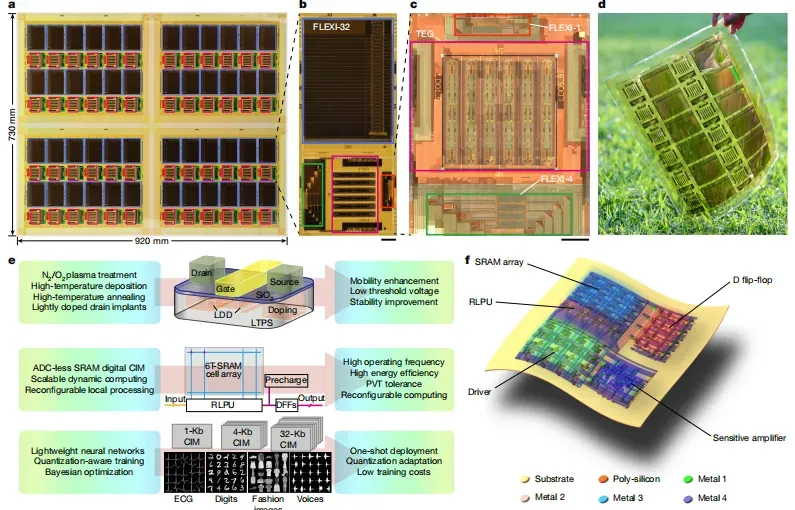
A research team at Tsinghua University has developed an ultra-thin, bendable AI chip that can withstand over 40,000 folds while maintaining full computational capability, marking a significant advance in flexible electronics that could transform wearable health monitoring and soft robotics. The chip, detailed in a study published in Nature, costs as little as $0.016 to produce and achieves over 99% accuracy in cardiac arrhythmia detection.
The chip, named FLEXI and led by Professor Ren Tianling's team, measures approximately 25 micrometers thick—thinner than a human hair—and can be sewn into clothing, attached to skin, or implanted in medical devices. It demonstrated a 92.1% yield rate in production and maintained stable performance after exposure to temperatures ranging from -40°C to 80°C, high humidity, and prolonged light exposure over six months.
The breakthrough represents the first implementation of in-memory computing architecture on a flexible platform specifically designed for AI and neural network applications. The chip successfully completed 10 billion multiplication operations without a single error, achieving clock frequencies exceeding 10 MHz—more than ten times faster than previous flexible chip designs.
FLEXI's ultra-low production cost stems from optimized manufacturing processes that leverage low-temperature polysilicon printed on flexible plastic substrates, similar to newspaper printing. The estimated $0.016 unit cost reflects mass production economics, including materials, deposition, lithography, and amortized equipment expenses, according to lead author Dr. Yan Anzhi.
In-Memory Computing Architecture Eliminates Data Transfer Bottleneck
The chip employs a fundamentally different approach from conventional processors by integrating computational units directly within memory storage. Traditional chips shuttle data between separate processing units (CPUs) and memory banks, consuming significant energy and time. FLEXI's in-memory computing architecture performs calculations where data resides, dramatically reducing power consumption and latency.
"To truly empower flexible devices with intelligence, we must introduce high-efficiency architectures like in-memory computing," Yan explained. "Traditional CPU energy efficiency and computing power cannot support neural network tasks, while digital in-memory structures provide both high parallel computing capability and robustness suitable for mechanically variable environments."
The team optimized three layers simultaneously: material processing, circuit design, and AI algorithms. They developed lightweight neural network models that can be programmed into the chip in a single deployment, eliminating repeated read-write operations and substantially improving efficiency. This one-time deployment strategy allows entire neural networks to run completely within the chip's internal memory, avoiding frequent external data exchanges.
Medical Validation Demonstrates Clinical-Grade Performance
The research team validated FLEXI's capabilities through multi-signal health monitoring applications. The chip processes heart rate, respiration, body temperature, and skin humidity data through onboard neural network inference. In cardiac monitoring tests, it identified arrhythmia signatures within single heartbeats with 99.2% accuracy. The system also classified human activities—sitting, walking, running, or experiencing stress—with over 97.4% accuracy.
These results were achieved on chips with merely 1 kilobit of storage capacity, demonstrating the effectiveness of the team's model compression techniques. The researchers employed quantization-aware training methods to reduce model size while preserving accuracy, enabling complete neural networks to operate within severely constrained memory environments.
The chip's mechanical resilience proved equally impressive. Repeated bending to 180 degrees over 40,000 cycles caused no degradation in computational performance. This durability, combined with its thinness and flexibility, positions FLEXI as a viable foundation for next-generation wearable health devices that could provide continuous, intelligent monitoring without user discomfort.
Advanced Manufacturing Overcomes Flexible Electronics Limitations
Low-temperature polysilicon, while offering inferior semiconductor parameters compared to high-purity single-crystal silicon used in rigid chips, enabled the team to achieve industry-leading precision and energy efficiency within the flexible chip category. The breakthrough emerged from their CLCO strategy—cross-layer co-optimization spanning process, circuit, and algorithm domains.
At the process level, extensive experimentation and simulation revealed how film thickness and transistor parameters distribute during manufacturing, particularly for flexible CMOS processes refined through multiple iterations. At the circuit level, digital in-memory computing architecture proved more resistant to process variations and environmental changes than analog alternatives, while eliminating power-intensive analog-to-digital conversion modules.
Yan noted that their work fills a critical gap identified by Professor Kris Myny of KU Leuven, a prominent flexible electronics researcher, in a Nature commentary accompanying the publication. "Whether in frequency, energy efficiency, or energy-delay product, we significantly surpass previously reported flexible chips," Yan said. The team also became the first to conduct systematic mechanical and aging tests following industrial standards, establishing new evaluation paradigms for reliability assessment.
Applications Extend Beyond Wearables to Robotics and Neural Interfaces
Beyond health monitoring, the research team envisions FLEXI enabling advances in soft robotics, where the chip's large-area scalability could create electronic skins addressing current robots' limited close-range perception. Integration with infrared sensors could provide non-contact distance sensing and obstacle avoidance. The flexible material's ability to conform to biological tissue makes it particularly suitable for brain-computer interfaces and neural probe devices, enabling high-throughput neural signal acquisition with real-time front-end processing.
The chip's natural advantage on complex curved surfaces positions it for applications in rapidly developing deformable robots, supporting local motion control, environmental recognition, and potentially navigation and communication in micro aerial vehicles. Future development targets include integration into electronic skin, implantable neural probes, and voice interaction patches to make human-machine interaction more natural and efficient.
"Medical health is an important direction, but I believe it has great potential in flexible robotics," Yan said. The team's collaborative, cross-disciplinary research environment—where students from different specializations freely exchange ideas and form teams to tackle scientific challenges—proved instrumental in nurturing the innovation underlying FLEXI's development.
Professor Ren's approach of respecting objective scientific research laws and encouraging independent thinking through setbacks rather than reprimanding failures created an atmosphere where bold exploration could flourish, according to Yan. This open, pragmatic research culture enabled innovative concepts to take root and advance toward practical implementation.