
Unitree Breaks the Humanoid Robot Cost Barrier With RMB 29,900 R1
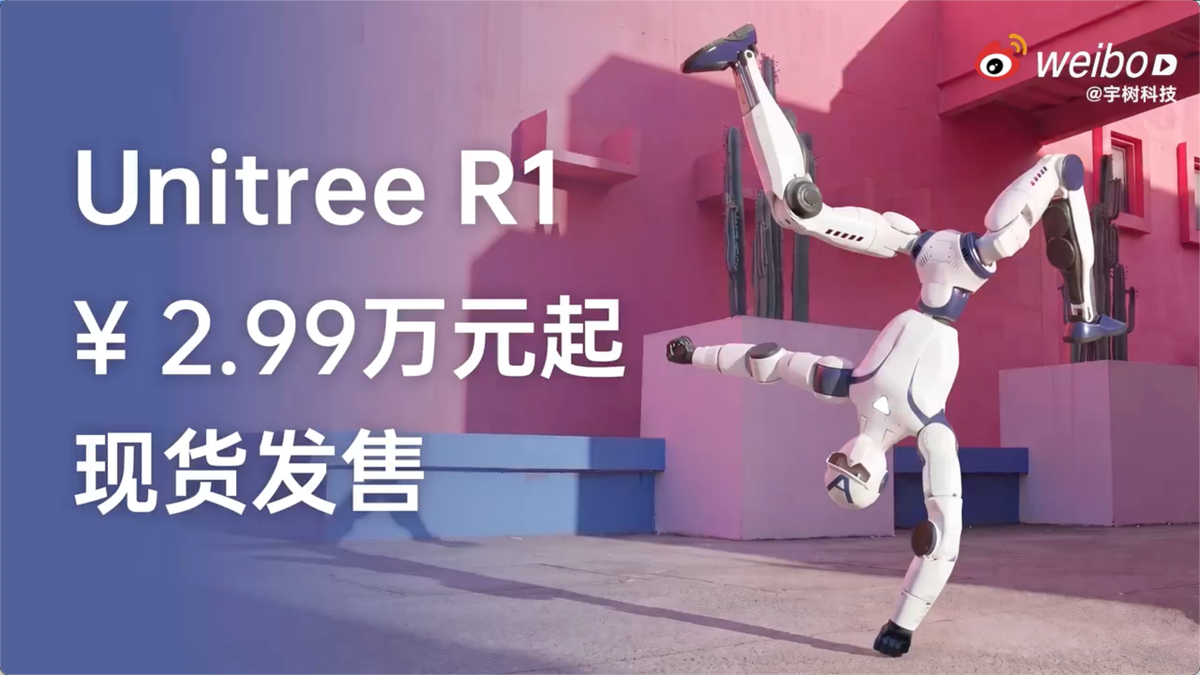
China's Unitree Science & Technology has done what most rivals said was impossible: it is selling a fully capable bipedal humanoid robot for RMB 29,900 (US$4,150)—in stock, no waitlist, ships today. The June 24 price cut on the Unitree R1 line is not a promotional stunt; it is the clearest evidence yet that vertically integrated domestic manufacturing has structurally broken the cost floor of embodied-AI hardware.
The entry-level R1 Air was repriced from RMB 39,900 to RMB 29,900—a 25% reduction—while the standard R1 retains its 26-degree-of-freedom architecture and dual-camera vision system. More consequential than the price tag, however, is the shift to immediate fulfillment. For two years the humanoid-robot playbook ran: flashy launch event → pre-order queue → 12-month wait → limited batch delivery. Unitree has scrapped that script entirely, signaling that its end-to-end supply chain—from raw actuators to boxed product—is now operating at consumer-electronics cadence.
Vertical Integration Drives Margins Higher Even as Prices Fall
The financial logic confounds conventional wisdom. According to Unitree's prospectus filings, the company's average humanoid-robot selling price collapsed from RMB 593,400 in 2023 to RMB 166,400 in 2025—a 72% decline in two years. Yet gross margin expanded from 44% to 60% over the same period. The R1's RMB 29,900 launch price implies the trajectory has not reversed.
The mechanism is vertical integration. Unitree self-manufactures its motors, harmonic reducers, encoders, controllers, and LiDAR modules; externally sourced components account for only 14%–18% of bill-of-materials cost, and the domestic-content ratio across core parts exceeds 90%. U.S. research firm SemiAnalysis, after tearing down Unitree's G1 model, estimated its bill-of-materials at US$8,976—implying a gross margin of roughly 67% at then-prevailing prices. At RMB 29,900, Unitree is almost certainly still profitable on hardware alone. Competitors who assemble from third-party actuators and reducers—components that together represent more than 70% of industry cost structures—cannot match that arithmetic without years of supply-chain restructuring.
Specs Position R1 as a Development Platform, Not a Toy
The R1 Air weighs 27 kilograms and carries 20 motorized joints, a monocular vision module, and 10-TOPS onboard AI compute. The standard R1 adds six degrees of freedom (26 total), binocular vision, articulated head and waist joints, and the ability to execute backflips, handstands, and incline traversal. Single-arm payload is 2 kg; end-effector repeatability is ±0.1 mm. All interfaces are open: buyers can rewrite firmware, deploy custom AI models, and integrate with mainstream robotics simulation platforms.
At RMB 29,900—less than three top-tier smartphones—the addressable buyer shifts from elite research labs to university robotics clubs, hardware startups, and advanced hobbyists. Every RMB 10,000 reduction in price historically expands the potential user pool by roughly an order of magnitude, a pattern established during the early smartphone era and now repeating in embodied AI.
Competitors Accelerate Toward the RMB 10,000 Threshold
Unitree's move is not isolated. Songyan Power has already listed its Bumi humanoid at RMB 9,998—below the symbolic RMB 10,000 barrier. Jiasu Jinhua's K1 series is also priced at RMB 29,900 in promotional configurations. The convergence of multiple vendors at or below RMB 30,000 in mid-2026 marks a structural inflection, not a temporary discount cycle. Once price anchors reset at this level, premium positioning becomes untenable without differentiated capability.
Unitree founder Wang Xingxing has publicly stated a long-term price target of RMB 3,000–4,000 per unit—roughly the cost of a mid-range Android handset. The company shipped more than 5,500 humanoid robots in 2025, the highest volume of any manufacturer globally. Industry analysts project global humanoid-robot output will exceed 100,000 units in 2026, making this year the de facto start of mass production.
Demand Structure Remains the Unresolved Variable
The supply-side story is compelling; the demand-side picture is more nuanced. China's per-capita disposable income stood at approximately RMB 43,000 in 2025, meaning an R1 Air represents roughly 70% of the average annual discretionary budget—still a considered purchase for most households. Current end-buyers are predominantly universities, corporate event organizers, and technology studios. True consumer adoption at scale requires either a further price reduction to the RMB 10,000 range or the emergence of killer applications beyond entertainment and education.
Industrial customers present a different calculus. Factory floors require precision, durability, and mean-time-between-failure guarantees that consumer-grade platforms have not yet demonstrated at production scale. The acrobatic capabilities that generate social-media traction—backflips, handstands—are largely irrelevant to assembly-line deployment. The gap between consumer excitement and industrial procurement cycles remains the sector's most significant near-term constraint.
What the iPhone Parallel Actually Means for Investors
The 2011 smartphone analogy is invoked frequently in Chinese tech media, and in this case it is structurally apt. In 2011, Android handset prices fell below US$200, carrier subsidies evaporated, and device volumes compounded at triple-digit rates for three consecutive years. The companies that survived were not those with the most impressive launch-event demos; they were the ones that had already internalized their supply chains. Unitree's 90%-plus domestic component ratio and demonstrably expanding gross margin suggest it has cleared that bar earlier than most observers expected.
For investors tracking the embodied-AI supply chain, the immediate read-through is to second-tier component makers—harmonic-drive manufacturers, MEMS sensor suppliers, and edge-AI chip designers—who will face accelerating volume demand if Unitree's fulfillment model proves replicable. The more cautious read is that a price war that benefits the vertically integrated leader tends to be structurally lethal for assemblers without proprietary manufacturing. That bifurcation is already visible in today's pricing data, and it is likely to widen through the remainder of 2026.
Related Coverage:
SemiAnalysis: Unitree Is Emerging as a Global Humanoid Robotics Leader