
Unitree Humanoid Robot Completes World's First Live Surgical Procedure
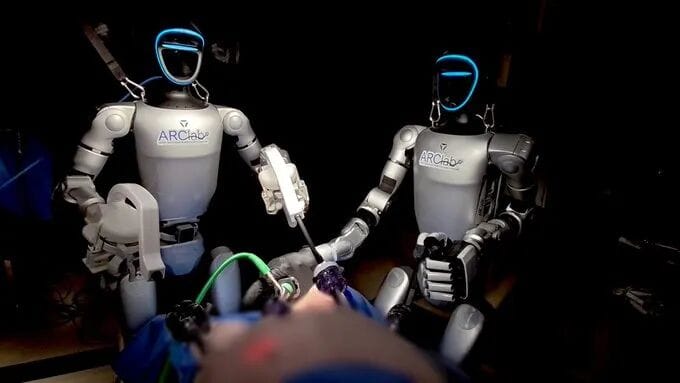
A humanoid robot developed by Chinese robotics company Unitree Robotics has successfully performed laparoscopic surgery on living animals, marking what researchers describe as the world's first instance of a humanoid robot completing a full standard minimally invasive surgical procedure on a live subject.
The study, published online in Nature under the title "In Vivo Feasibility Study of Humanoid Robots for Surgical Applications," used Unitree's G1 humanoid robot to carry out standard laparoscopic cholecystectomies — gallbladder removal surgeries — on two live pigs. The robot operated standard laparoscopic instruments designed for human surgeons and was controlled via teleoperation throughout both procedures.
Both surgeries were completed without requiring conversion to conventional laparoscopic or open surgery. The first procedure concluded without major complications. In the second, minor bile spillage and liver bed bleeding occurred but were resolved intraoperatively through suction and electrocautery. Efficiency also improved markedly between the two cases: active console operation time dropped from approximately 56 minutes to roughly 32 minutes, while the number of robot redeployments fell from eight to four.
The lead author of the paper is Liang Zekai, who completed his undergraduate studies at Huazhong University of Science and Technology in 2023, earned a master's degree from the University of California San Diego in 2025, and is currently a doctoral candidate at UCSD in the laboratory of Professor Michael C. Yip.
The research team framed the findings as an evidence-based assessment of both the capabilities and limitations of current humanoid robots in surgical settings. Key technical hurdles remain before any clinical deployment. The paper notes that multiple recalibrations were required during the procedures, significantly extending operation time compared with the da Vinci robotic surgical system. Sterilization also poses a challenge: commercially available humanoid robots currently lack components that can be autoclaved, meaning sterile gloves were used as a substitute — a measure the authors acknowledge falls short of the sterility standards required for human surgery.
The research team drew a historical parallel to temper those concerns, noting that the first robotic laparoscopic surgery took six hours to complete and now routinely takes around 30 minutes. They argue that similar improvements in humanoid surgical robotics are likely over time.
The findings arrive as interest in humanoid robots for medical applications intensifies. Earlier this year, Elon Musk predicted that his Optimus robot would surpass human surgeons in operative performance within three to four years, a timeline the Unitree study neither confirms nor refutes but places in sharper empirical context.
For investors tracking the humanoid robotics sector, the Nature publication represents a meaningful proof-of-concept milestone, demonstrating that general-purpose humanoid platforms — not purpose-built surgical systems — can execute complex medical procedures. Whether that translates into near-term commercial opportunity will depend on how quickly the industry resolves the sterilization, precision, and regulatory barriers the study identifies.
Related Coverage:
Unitree Clears China's Fastest STAR Market Review, Eyes RMB 4.2 Billion War Chest