
Unitree Puts 48% of IPO Proceeds Into AI as the Humanoid Robot Race Shifts to Cognition
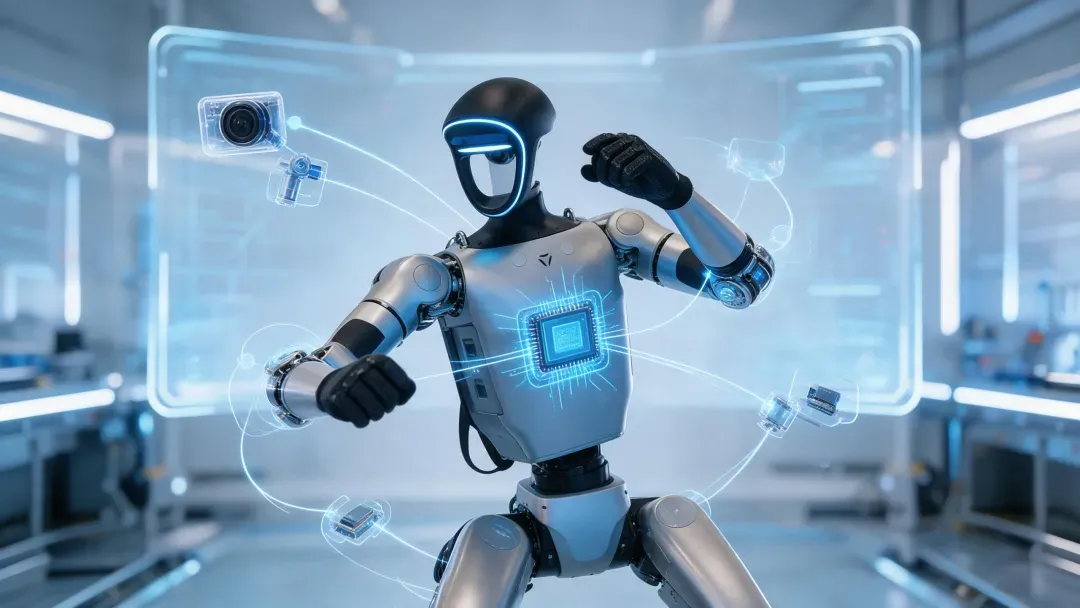
China's newly listed humanoid robot maker is redirecting nearly half its IPO proceeds into foundational AI cognition—a strategic admission that hardware alone can no longer sustain a competitive moat.
On the evening of September 7, 2026, Unitree Robotics released footage of two humanoid robots engaging in fully autonomous combat, relying entirely on its proprietary UnifoLM-X2-1.0 world-action model to perceive, predict, and execute strikes and evasions in real time—without pre-scripted routines or remote human control. The company described the result as validating "the foundational feasibility of large-scale deployment driven by world models." Markets responded with immediate attention, but the more consequential story lies in the capital allocation strategy underpinning the spectacle.
Unitree raised approximately RMB 4.202 billion (US$583 million) in its initial public offering, and 48.13%—exceeding RMB 2 billion (US$277 million)—is earmarked specifically for what the company terms "big brain" and "small brain" foundational technology. In total, 85% of IPO proceeds, or roughly RMB 3.6 billion (US$500 million), flows into R&D. The scale of that commitment signals not confidence, but urgency.
Shrinking Hardware Margins Force a Cognitive Pivot
The strategic logic is straightforward and unforgiving. Global humanoid robot shipments reached approximately 22,000 units in the first half of 2026, up nearly 300% year-on-year according to Counterpoint Research—a surge that has simultaneously commoditized the supply chain. Motors, reducers, and actuator systems that once differentiated early movers are now broadly accessible. Hardware windows, in the language of venture capital, are closing.
Unitree's own trajectory illustrates the risk. The company only began materially scaling "big brain" R&D investment in 2024, having spent prior years optimizing physical hardware and motion-control systems—the so-called "cerebellum." That sequencing has consequences: in the first half of 2026, AgiBot overtook Unitree to claim the top global shipment ranking, with Unitree falling to second place. UBTECH Robotics separately achieved four-digit quarterly delivery volumes. Unitree's once-commanding volume lead has been erased.
The RMB 2 billion cognitive investment is not incremental enhancement. It is a structural correction under time pressure.
Dual-Track AI Architecture Reflects Deliberate Risk Distribution
Unitree founder Wang Xingxing disclosed during the IPO roadshow that the company is pursuing parallel development across two distinct AI architectures: World Model Architecture (WMA), which emphasizes physical-world prediction and forward simulation, and Vision-Language-Action (VLA) models, which prioritize instruction comprehension and scene-conditioned execution. Unitree open-sourced UnifoLM-WMA-0 in September 2025 and UnifoLM-VLA-0 in January 2026. The September 7 demonstration deployed UnifoLM-X2-1.0, an advanced iteration of the WMA path.
Running both tracks simultaneously is a hedge against architectural uncertainty—neither WMA nor VLA has established clear dominance in embodied AI, and Unitree is unwilling to concentrate on one before the field resolves.
A notable capital alignment: DeepSeek, the AI research firm founded by Liang Wenfeng, invested over RMB 140 million (US$19.4 million) as a strategic placement investor in Unitree's IPO, subject to a 36-month lock-up. The relationship, however, is not one of AI dependency. DeepSeek's public research focus does not encompass multimodal or world-model development, meaning Unitree's cognitive build-out remains internally driven. DeepSeek's participation is better characterized as complementary resource alignment—borrowing credibility and ecosystem access, not outsourcing cognition.
Combat Demo Validates a Methodology, Not a Product
The September 7 footage carries genuine technical significance that deserves precise framing. In November 2025, Unitree staged a similar combat exhibition at the China International Import Expo—but that performance relied on pre-programmed motion libraries and remote operator intervention. It was choreography. The 2026 demonstration is categorically different: the model operates a closed-loop perception-prediction-planning-execution chain in real time, processing opponent position, velocity, and threat vector to select evasion angles and counter-attack timing autonomously.
The choice of combat as a test environment is analytically deliberate. High-dynamic adversarial scenarios impose maximum stress on every system component simultaneously: sensor latency, balance control, joint coordination, and decision throughput. Successfully running a world model under those conditions provides a stress-tested proof of concept that structured environments—automotive factory inspection, logistics handling, facility maintenance—should theoretically be more tractable.
Unitree has already deployed humanoid robots in automotive manufacturing facilities and is running internal factory tests. However, the company acknowledges that insufficient generalization capability has prevented broad rollout. The combat demo is, in part, a message to industrial customers and capital markets: the cognitive architecture is production-ready for controlled environments.
Three Structural Gaps Separate Demonstration from Deployment
Despite the technical milestone, three constraints materially limit near-term commercialization.
Generalization remains unproven in unstructured environments. The combat arena is a controlled, low-variable setting. Factory floors, warehouses, and domestic spaces introduce unpredictable human behavior, irregular surfaces, and novel object configurations that current models have not encountered at scale. The industry's persistent failure mode—robots that excel in exhibition halls but struggle with routine manipulation tasks—has not been resolved by a single combat demonstration.
On-device compute constraints impose hard limits on model deployment. Running a world-action model at the inference speeds required for real-time physical interaction demands substantial processing resources. Production hardware operates under strict power and thermal budgets. The gap between demonstration-grade compute and mass-market unit economics remains a significant engineering problem, particularly as sustained operation introduces thermal throttling that degrades algorithmic stability.
Safety and fault-tolerance frameworks are immature. Autonomous decision-making in physical proximity to humans requires certified safety envelopes, emergency interrupt protocols, and validated failure modes. Combat scenarios tolerate falls and collisions by design. Industrial and domestic co-working environments do not. Neither Unitree nor the broader industry has produced standardized safety architecture for autonomous humanoid deployment, and regulatory frameworks in China and major export markets remain nascent.
Competitive Pressure Intensifies as Automotive and Tech Giants Enter
Unitree's post-IPO challenge extends beyond catching up on AI cognition. The competitive landscape has structurally shifted. Major automotive manufacturers and large-cap technology companies have committed capital and engineering resources to humanoid robotics, bringing supply chain leverage, proprietary large model infrastructure, and established enterprise sales channels. Future differentiation will require integrating hardware, embodied AI, and vertical application expertise simultaneously—a multidimensional competition that favors well-capitalized incumbents.
Unitree's existing advantages—vertically integrated actuator and drive systems, a large installed base of research and educational customers providing stable cash flow and real-world motion data, and the cost efficiency that has driven humanoid unit prices down from hundreds of thousands of renminbi—remain durable but insufficient as standalone moats. Revenue concentration in the research and education segment, where margins are structural and volume is bounded, limits the financial runway for the scale of R&D the company is now committing to.
The valuation implied by Unitree's IPO pricing incorporates expectations of industrial-scale deployment that the current business model does not yet support. Any deceleration in technology iteration or commercialization timeline will apply direct pressure on that premium.
Impact Assessment
For investors, Unitree's RMB 2 billion cognitive investment represents a necessary but not sufficient condition for sustaining competitive relevance. The dual-track AI architecture is strategically sound; execution risk is high. The DeepSeek strategic placement provides ecosystem optionality without creating dependency.
For the humanoid robotics supply chain, the UnifoLM-X2-1.0 demonstration signals that domestic Chinese manufacturers are transitioning from hardware-differentiated to software-differentiated competition—a shift that will accelerate consolidation among pure-hardware component suppliers and expand demand for inference-optimized edge chips.
For the broader industry, the demonstration establishes a new baseline for what constitutes a credible world-model proof of concept. The benchmark has moved from "robot can walk" to "robot can autonomously navigate adversarial dynamic interaction." The next benchmark will be: robot can sustain that capability reliably, safely, and economically at production scale.
That benchmark has not yet been met by any market participant.
Related Coverage:
Unitree’s Falling Floor Is Becoming a Ceiling for China’s Robot Startups