
Unitree Robotics Q3 Revenue Jumps 69.93%, but Margin Squeeze Signals a Critical Inflection Point
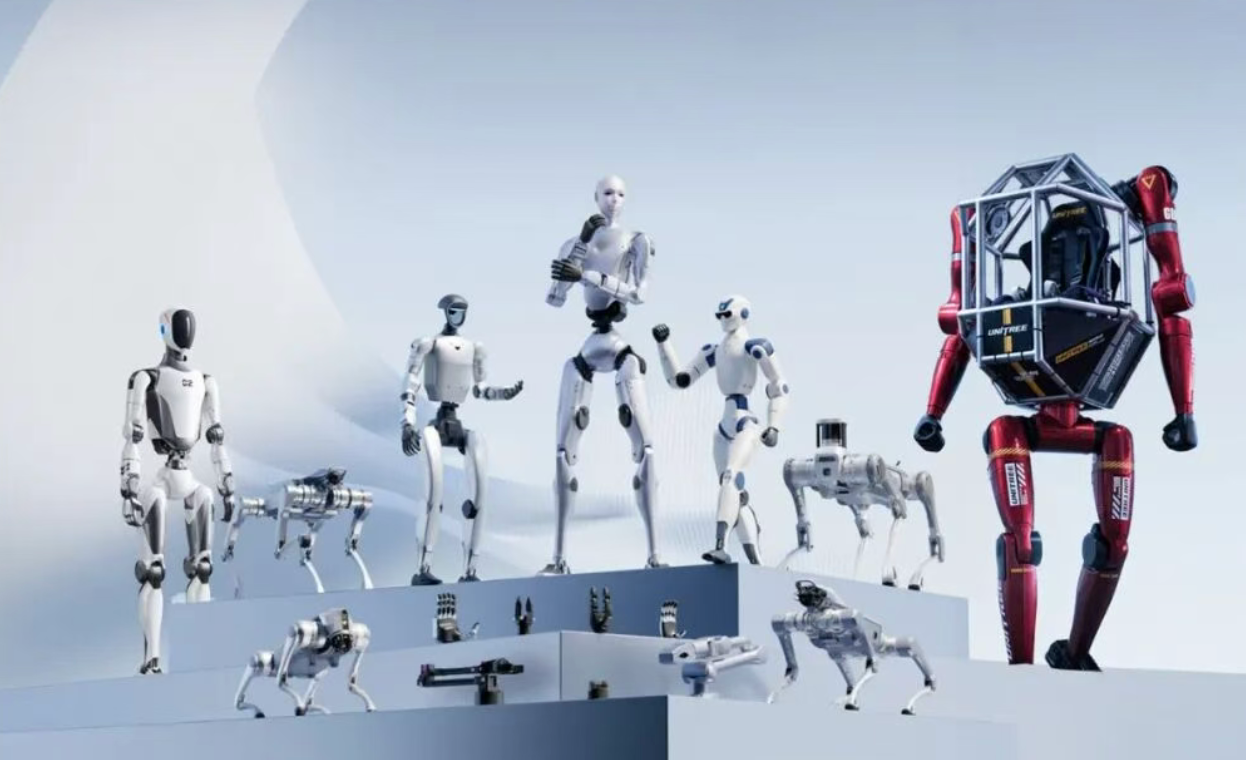
The humanoid robot darling of China's A-share market delivered blockbuster nine-month results, yet a sharp Q3 profit decline and a 465x valuation multiple are forcing investors to confront a fundamental question: how much of this story is priced in?
Unitree Robotics, China's most closely watched humanoid robot pure-play since its August 2026 STAR Market debut, reported January-September revenue of RMB 1.817 billion (US$252 million), up 55.71% year-on-year, with net profit attributable to shareholders surging 270.54% to RMB 387 million (US$53.8 million). The results, the company's first quarterly disclosure since listing, landed on October 28 as the broader A-share robot sector staged another broad-based rally, with multiple names hitting the daily 10% limit-up ceiling.
Yet beneath the headline growth, a more complicated picture is emerging. Unitree's stock climbed 8.74% to RMB 695.9 on the day, briefly piercing RMB 700 intraday—a rebound of more than 70% from its recent trough—even as the company's own filing carried an embedded warning: its trailing price-to-earnings ratio stood at 465.22x as of October 26, versus a sector average of 38.54x.
Q3 Margin Compression Exposes the Cost of Scaling Intelligence
Strip away the favorable year-on-year base effects that flattered the nine-month headline—specifically, a one-time, large-value share-based compensation charge booked in the prior-year period—and the underlying earnings trajectory looks considerably more strained. On a like-for-like basis, nine-month non-recurring net profit fell 18.78% to RMB 349 million (US$48.5 million).
The third quarter alone crystallizes the tension. Revenue for the July-September period reached RMB 665 million (US$92.4 million), advancing 69.93% year-on-year—an acceleration in top-line momentum. But attributable net profit contracted 17.37% to RMB 113 million (US$15.7 million), and non-recurring net profit fell 17.42%. The divergence is a textbook case of revenue growth outpacing margin expansion, a pattern that typically signals one of two things in high-growth technology hardware: either a deliberate investment cycle, or structural cost pressure that has yet to surface fully.
In Unitree's case, the evidence points heavily toward the former. Q3 research and development expenditure reached RMB 127 million (US$17.6 million), a 249.58% year-on-year surge, representing 19.10% of quarterly revenue. For the nine-month period, cumulative R&D spending hit RMB 263 million (US$36.5 million)—already exceeding the company's full-year 2025 R&D outlay of approximately RMB 145 million, and up 191.48% year-on-year. As a share of revenue, R&D intensity climbed to 14.47%, a 6.74-percentage-point increase from the same period last year.
For context, Unitree's R&D-to-revenue ratio was 17.83% in 2024 before compressing sharply to 8.53% in 2025 as revenue scaled. The renewed spike toward the high-teens suggests management has made a deliberate choice to reinvest scale gains directly into next-generation capability development, rather than allowing margins to expand organically.
Embodied AI Investment Redefines Unitree's Long-Term Positioning
The destination of that R&D capital matters as much as its magnitude. Unitree disclosed that the increase is driven primarily by embodied large model research, computing infrastructure, team expansion, and new product development—a spending profile that mirrors the capex patterns of software-era AI companies more than traditional robotics hardware manufacturers.
Speaking at the 2026 World Physical AI Conference held in Hangzhou on October 22, Unitree founder, chairman, and CEO Wang Xingxing outlined a timeline and a candid assessment of where the technology stands. He projected that physical AI could achieve key breakthroughs within one to two years in an optimistic scenario, or two to three years under a more conservative one.
Wang's remarks were notable for their specificity about current limitations. He acknowledged that while existing large language models already demonstrate strong capabilities in robot planning and navigation, the critical alignment problem between model inputs/outputs and real-world robot actuation remains unsolved. Operational precision and task success rates in physical interaction scenarios—grasping, manipulation, unstructured environment navigation—are still materially below commercial deployment thresholds.
The company is exploring what amounts to an AI-driven R&D loop: systems that autonomously retrieve technical literature, generate code, run simulation training, and iterate on algorithms based on evaluation outputs—effectively seeking to reduce the human engineering labor embedded in each development cycle. If successful, this approach could structurally lower the marginal cost of capability improvement over time, a critical variable for any investor attempting to model Unitree's long-run economics.
Production Capacity Constraints Surface as Demand Accelerates
Even as the software architecture evolves, physical manufacturing constraints are sharpening. Wang previously disclosed that Unitree currently produces tens of thousands of robots and hundreds of thousands of joint motors and modules annually. He characterized existing capacity as insufficient to meet demand if humanoid robots achieve meaningful penetration into factory, retail, and household environments at scale.
The demand signal from industry data is real, though the composition of that demand merits scrutiny. According to IDC figures published in September 2026, global humanoid robot shipments for the first half of 2026 approached 25,000 units, representing 432.1% year-on-year growth. However, three application categories—scientific research and education, performance and exhibition, and government data collection—collectively accounted for 69% of total shipments. Industrial manufacturing, retail, and logistics, the segments that would drive volume and margin at scale, remain in continuous validation phases.
This concentration of demand in relatively captive, lower-volume applications is a structural constraint that the entire humanoid robot industry—not just Unitree—must navigate. The path from demonstration-grade deployment to factory-floor reliability at commercially viable unit economics has historically proven longer and more capital-intensive than initial market projections suggest.
Sequoia China Partnership Signals an Ecosystem Play Beyond Hardware
On the same day it released its quarterly results, Unitree announced a strategic co-investment initiative with Sequoia Capital China, branded the "Shanyu · Chuangji Plan." The program targets early-stage startups across embodied intelligence, robot applications, and upstream and downstream enabling technologies.
The strategic logic is straightforward: Unitree contributes engineering capability, hardware access, and product validation infrastructure; Sequoia China contributes deal flow, capital, and portfolio network effects. Participating startups would receive support spanning technical R&D, product commercialization, and fundraising. Financial terms and investment scale have not been disclosed.
The announcement is analytically significant beyond its immediate funding implications. By co-anchoring an ecosystem investment vehicle, Unitree is explicitly positioning itself not merely as a hardware manufacturer but as a platform company seeking to capture value across the embodied AI stack. This strategic posture—building a captive supplier and application developer ecosystem—mirrors playbooks deployed by industrial technology incumbents ranging from Fanuc (FANUC Corporation) in traditional robotics to NVIDIA Corporation in AI computing infrastructure.
Valuation Premium Leaves Minimal Margin for Error
Unitree itself issued a stock trading abnormal volatility announcement on October 27, disclosing the 465.22x trailing P/E ratio and explicitly flagging that the humanoid robot industry remains in the early stages of commercialization, with material uncertainties across technology maturity, downstream market demand, and supply chain readiness.
A 465x earnings multiple on a company generating RMB 113 million in Q3 net profit—while that profit is simultaneously declining year-on-year—is a valuation that prices in decades of flawless execution. It also prices in the resolution of precisely the technical limitations Wang himself publicly acknowledged: the alignment problem, the precision gap, and the capacity constraint.
For institutional investors, the near-term read is straightforward. The nine-month revenue growth trajectory of 55.71% is structurally sound and likely to continue as robot shipment volumes expand. The R&D investment surge, while margin-dilutive in the short term, is the correct strategic response to a technology race in which capability differentiation will determine long-term pricing power. The Sequoia China partnership adds an optionality layer that is difficult to quantify but directionally positive.
What remains unresolved—and what the Q3 results crystallize—is the gap between the pace of commercial scaling and the valuation multiple already assigned to that scaling. In a sector where 69% of current demand comes from demonstration-adjacent use cases, and where the CEO himself places transformative application breakthroughs one to three years out, the stock's current price is a bet on a future that remains, by management's own admission, under active construction.
Related Coverage:
Unitree Robotics' 466x Valuation Demands a Model Breakthrough It Has Yet to Prove
Unitree Bets on Scale to Win Embodied AI Race, Accelerates “ChatGPT Moment”