
Unitree Bets on Scale to Win Embodied AI Race, Accelerates “ChatGPT Moment”
Unitree's Wang Xingxing Compresses Embodied AI Inflection to 12–24 Months, Betting Mass Manufacturing Over Model Supremacy
The founder of Unitree Robotics, the world's most prolific humanoid robot manufacturer by unit volume, declared on October 22 that the industry's defining inflection point is now 12 to 24 months away — a forecast he compressed by roughly half in just two months — framing mass hardware production, not AI model development, as the decisive competitive variable.
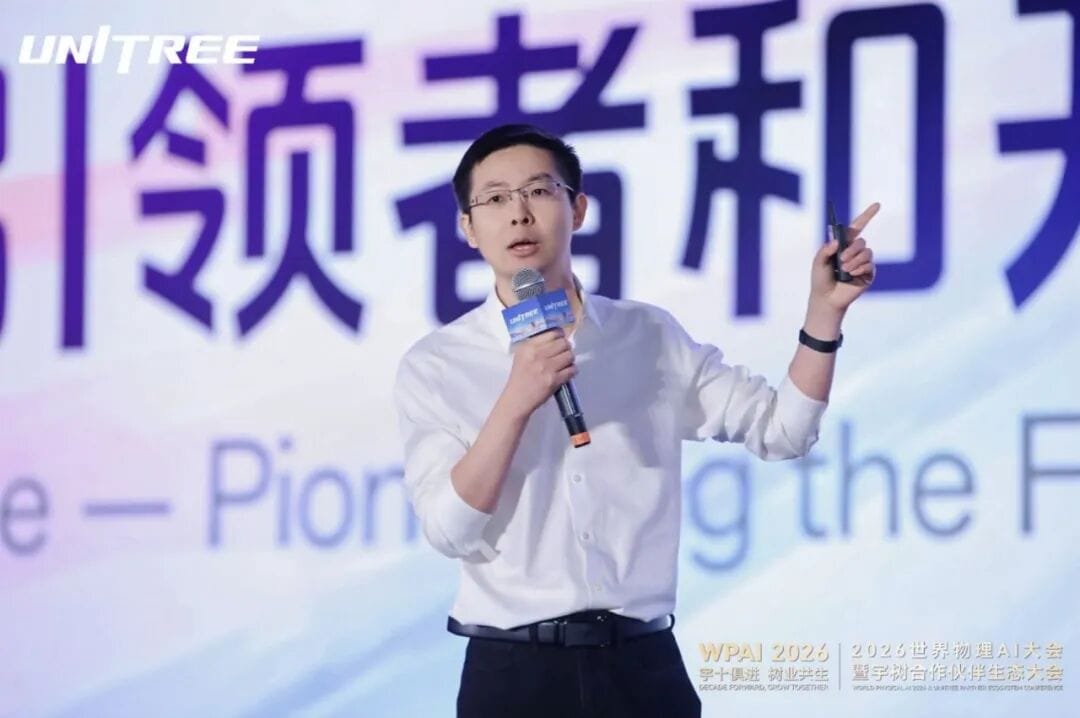
Wang Xingxing delivered that revised timeline at the World Physical AI Conference, hosted by Unitree at the Hangzhou International Expo Center on the company's tenth anniversary. The event, which drew a floor density of robots that likely exceeded human attendees, served as the launch platform for the World Physical AI Competition, backed by a prize pool of tens of millions of renminbi (equivalent to several million U.S. dollars at the RMB 7.2 reference rate), positioning the contest as the most significant developer recruitment effort in Chinese robotics since DJI's RoboMaster program.
Shrinking Timelines Signal a Strategic Inflection, Not Just Optimism
Wang's public forecast trajectory is the most telling data point from the conference. At the World Robot Conference in August 2026, he placed the embodied AI "ChatGPT moment" at two to three years in the optimistic scenario, five to ten years in the conservative case. By October, standing at his own company's event, the range had collapsed to one to two years, with three years as the outer bound. He went further, stating that autonomous household task completion — instructing an untrained Unitree robot to tidy an unfamiliar room — could arrive "as early as next year."
At the Shanghai Industrial Expo ten days prior, Wang had already framed this as a self-correction, describing insufficient belief in AI as "the biggest mistake of the past decade." He told attendees that whatever conviction they had in AI five or ten years ago, "multiply it by ten and it's still not enough." The velocity of that retraction, from cautious hardware engineer to the conference's most aggressive AI advocate, is not incidental — it reflects a calculated repositioning of Unitree's entire product and partnership strategy.
Hardware Moat Strengthens as AI Brain Commoditizes
Wang's commercial logic, stated plainly across several segments of his 36-minute address, runs as follows: if frontier AI reasoning will be supplied by OpenAI, Google, or equivalent hyperscalers at declining marginal cost, then the competitive advantage in embodied AI migrates entirely to the physical layer — who can manufacture the most reliable, lowest-cost robot body at the greatest scale.
That framing directly advantages Unitree. The company's G1 humanoid, launched in May 2024, has accumulated cumulative production of approximately 10,000 to 20,000 units, which Wang described as the highest single-model shipment volume for any humanoid robot globally. On October 21, one day before the conference, Unitree released footage of the H2-X "Kung Fu Legend Guardian," demonstrating a kick capable of denting a car door, bare-hand vehicle lifting, a four-meter platform back-flip, and an extended battery runtime of approximately eight hours, up from roughly three hours on the H2.
Wang was explicit that current output — tens of thousands of complete robots and hundreds of thousands of joint motors annually — is "nowhere near enough." Genuine mass adoption, in his framework, requires annual production of at least ten million units. He referenced compute clusters, chip capacity, and raw material supply chains as parallel bottlenecks requiring resolution.
GPT-6 Demo Reframes the Partnership Model
The most technically specific moment of the presentation was a live demonstration connecting GPT-6 to a Unitree robot with zero task-specific training. The robot successfully washed a paintbrush, changed paint colors, and executed precise moves on a Go board. Wang's interpretation was deliberate: planning and navigation are "largely solved problems"; the remaining gap is alignment between multimodal model outputs and real-world actuator and sensor tolerances — an engineering problem he characterized as "solvable quickly."
Notably, Wang did not position Unitree's own models as the primary AI engine. He acknowledged that competing directly with leading multimodal foundation model companies is "not realistic for a company of our age," signaling a hybrid strategy combining proprietary model development with external partnerships across domestic and international AI providers. Unitree's internal model effort centers on a self-evolution loop: AI retrieves research papers, writes control code, trains in simulation, tests on physical hardware, and feeds scored outcomes back into the training pipeline. Wang argued this loop compounds in value as base models improve externally.
Exhibition Floor Maps the Gap Between Showcase and Scale
The conference floor offered a less linear picture of near-term deployment. While robots demonstrated kendama juggling, diabolo spinning, and Go-board play — one kendama operator was a Japanese-language development team — the dominant commercial application visible across exhibitors remained navigation, entertainment, and guided tours. Robots dressed as pandas, dinosaurs, and lion-dance figures outnumbered units in industrial configurations.
Meaningful operational deployments were present but concentrated in a narrow band of use cases. One exhibitor deploying quadruped robots for nighttime security patrols in residential compounds told Geek Park that laser-lidar-equipped units are already replacing human guards on overnight shifts, with human operators available for remote takeover in emergencies. The same platform, fitted with suppression equipment, has been tested for firefighting. Yijing Technology demonstrated quadrupeds with articulated human-face overlays, with the company's team lead citing acceptance gains in elder care and reception contexts despite acknowledged uncanny valley effects.
Unitree's education division presented a packaged offering — hardware, software, and curriculum — designed to supply complete robotics laboratory infrastructure to schools, a pipeline that would simultaneously expand the developer base and extend the company's brand into institutional procurement channels.
Tenth Year Stakes: From Motor Supplier to Platform Architect
Wang closed with a personal chronology beginning in 2009, when as a first-year university student he built a bipedal humanoid and wrote a paper arguing that neural network capability scales with model size — using the comparative brain mass of humans versus chickens and pigs as his evidence. He traced the line through AlphaGo in 2016 and ChatGPT in late 2022, the latter directly triggering Unitree's formal entry into humanoid robotics in 2023.
The narrative arc was plainly constructed, but the underlying strategic bet it encodes is concrete: Unitree is no longer positioning itself as a robotics hardware company that uses AI. It is positioning itself as the manufacturing infrastructure layer of a coming AI-physical world — the company that supplies the body while the hyperscalers supply the brain. Whether the one-to-two-year timeline holds or compresses further, the logic of that positioning becomes more valuable with every foundation model release cycle.
Related Coverage:
Unitree Unveils H2-X Humanoid With 8-Hour Battery Life
Unitree Rallies 20% in Two Days as China Policy Boosts Humanoid Demand