
Unitree Robotics, Sequoia China Launch Joint Fund as Embodied AI Makers Pivot to Venture Capital
China's humanoid robot manufacturers are rapidly transforming into industrial venture capitalists, with Unitree Robotics and Sequoia China jointly launching an early-stage investment program that signals a structural shift in how the country's hard-tech ecosystem is being built and financed.
The initiative, dubbed "Shanyu Venture Creation Plan" and announced October 28, 2026, formalizes a partnership that began when Sequoia China wrote a RMB 15 million (US$2.08 million) Pre-A check for a then-unknown Wang Xingxing in 2019 — a bet that has since delivered one of China's most closely watched robotics listings. The announcement arrived as Unitree's stock closed at RMB 695.9 per share on the same day, valuing the company at RMB 281.5 billion (US$39.1 billion), a rebound of more than 70% from its October 16 trough.
The move lands at a pivotal moment: first-half 2026 saw a cooling in embodied AI venture funding as generalist VC and PE firms grew more cautious, creating a vacuum that industrial players are now moving aggressively to fill.
Sequoia Doubles Down as Strategic Partner, Not Just Shareholder
Sequoia China's Managing Director Li Yannan framed the collaboration as a "dual guarantee" — Unitree contributing frontline engineering knowledge and supply-chain access, Sequoia providing full-cycle capital support and post-investment services. The structure is designed to address the single biggest bottleneck for early embodied AI teams: not seed money, but access to manufacturing know-how, real deployment scenarios, and validated component supply chains.
The fund's five operating principles — technical sector expertise, early detection, fast decision-making, founder-first evaluation, and minimal operational interference — deliberately position it as a "co-pilot, not a driver," in the words of the program's own documentation.
Critically, neither party has disclosed the fund's total size, capital contribution structure, investment vehicle, or formal governance mechanism. At this stage, the program functions more as a structured deal-sourcing framework than a closed-end fund. That ambiguity has not dampened market interest.
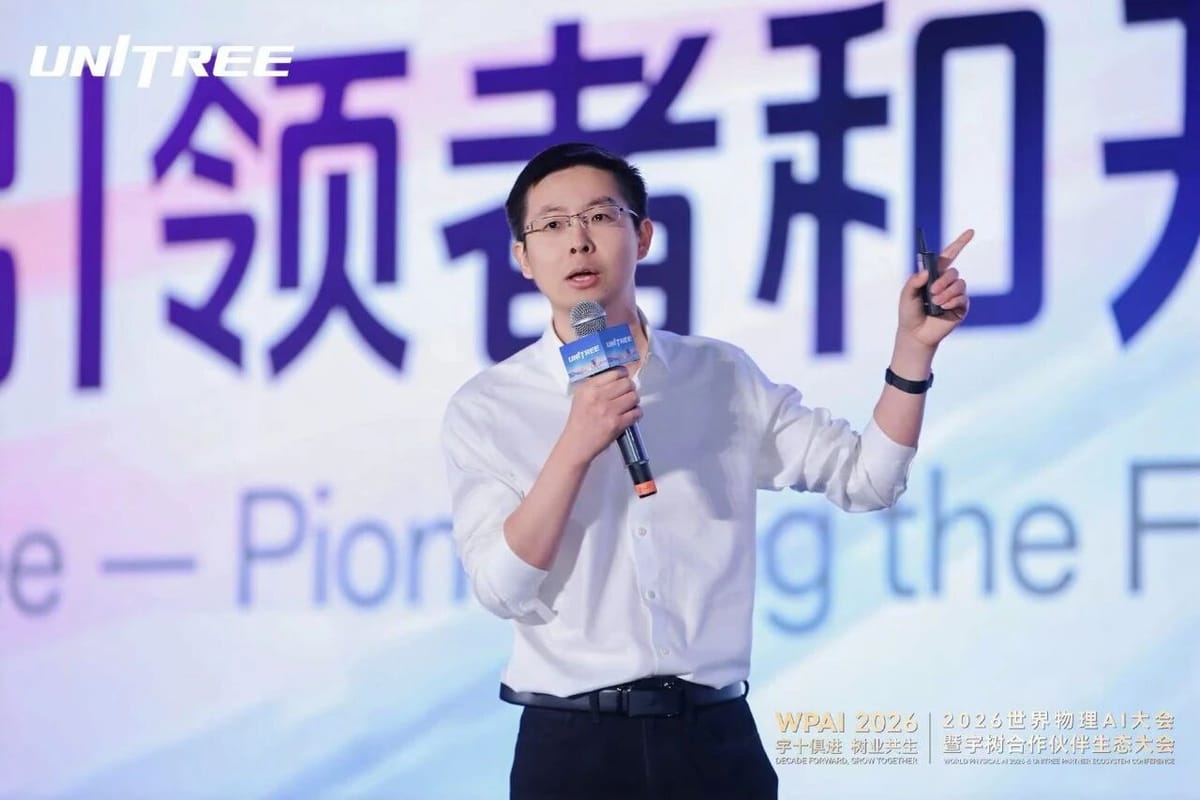
Wang Xingxing signaled his intent a month earlier. In mid-September 2026, Unitree unveiled the standalone "Yuchuang Plan", targeting startups across robot application solutions, data and simulation platforms, core components, embodied AI algorithms, and global distribution channels. Speaking at the World Physical AI Summit, Wang disclosed that the program had already attracted more than 200 project submissions within its first month of operation, with a stated five-year target of incubating more than 200 high-quality ecosystem companies. The trajectory is unambiguous: Unitree is no longer solely a robot vendor — it is building a platform.
Embodied AI Manufacturers Collectively Pivot Toward CVC
Unitree is the latest but not the first. A pattern of hardware-native corporate venture capital is crystallizing across China's embodied AI sector.
Zhiyuan Robotics launched its "Venture A Plan" in 2024 — China's first embodied AI-focused startup acceleration program. By April 2026, founder and CEO Deng Taihua reported that Zhiyuan had invested in more than 20 companies over the preceding 18 months, with average annualized valuation growth of 17x across the portfolio. That figure has since doubled. Zhiyuan's direct investments now span the majority of the embodied AI supply chain. In November 2025, Hillhouse Capital and Zhiyuan jointly established "Lingzhi Xinchuang", an early-stage fund managed by Zhuhai Hillhouse and focused on investing small and early across embodied AI — a structure that mirrors Hillhouse's role as Zhiyuan's seed-round lead investor.
Xinghaitu, in June 2026, partnered with Cathay Capital to announce the "Xingtu Plan", committing a combined RMB 1 billion (US$138.9 million) over five years to back 100 early-stage embodied AI projects covering components, data, algorithms, and application scenarios. In a notable deal, Xinghaitu also appeared on the cap table of Current Robotics, a humanoid intelligence company that disclosed its financing round to this publication.
Zibian Technology has taken equity positions in Juxie Intelligent and Moxian Technology, targeting integrated joint actuators/harmonic reducers and flexible tactile sensors respectively, while co-investing in Kaiwang Data alongside Zhiyuan and Mifeng Technology to anchor the robotics data supply chain.
Galaxy General Robotics has invested in Lanyue Powerand Yixing Robotics , and co-founded Bo-Yin Hechuang with Boyuan Capital to develop dexterous robots for industrial assembly and quality inspection — a more measured, scenario-specific approach.
Zhipingsquare and Zhujidong Technology are also actively deploying capital externally.
Most consequentially, DeepSeek has entered the arena. Two investments have recently surfaced: the startup of Tencent former scientist Hu Han and the venture of embodied AI researcher Yu Tao, both active in the embodied intelligence space. Sources familiar with the matter told this publication that DeepSeek's completed and planned investments in embodied AI extend well beyond these two disclosed deals, and that following the addition of Yan Wentao to the team, DeepSeek's primary-market activity is expected to intensify materially.
Industrial Capital Addresses What Venture Capital Cannot
The structural logic driving this wave is straightforward: early-stage embodied AI teams face a tripartite bottleneck — supply chain access, mass-production experience, and verified real-world deployment scenarios. These are precisely the assets that first-generation robot manufacturers accumulated through years of costly engineering iteration. Financial capital solves "zero to one." Industrial capital solves "one to one hundred."
The consensus within China's investment community is that sector-leading manufacturers bring a natural and durable advantage over generalist VCs: the ability to generate industrial synergies for portfolio companies that no amount of capital alone can replicate.
The historical parallel is instructive. Two decades ago, China's internet giants began establishing corporate venture arms — Tencent Investments, Alibaba's strategic investment unit— initially as ecosystem defense mechanisms, later as structurally dominant forces reshaping entire sectors. The current embodied AI CVC wave follows the same template, substituting manufacturing hardware leaders for internet platform incumbents.
The past decade's dominant narrative was that venture capital built China's robotics champions. The next decade's narrative, now being drafted in real time, may well be that China's robotics champions are building the next generation of everything else.
Related Coverage:
Unitree Robotics Q3 Revenue Jumps 69.93%, but Margin Squeeze Signals a Critical Inflection Point
Unitree Robotics' 466x Valuation Demands a Model Breakthrough It Has Yet to Prove