
Unitree Sets an 80% Benchmark for Humanoid Robots as IPO Valuation Faces Reality Check
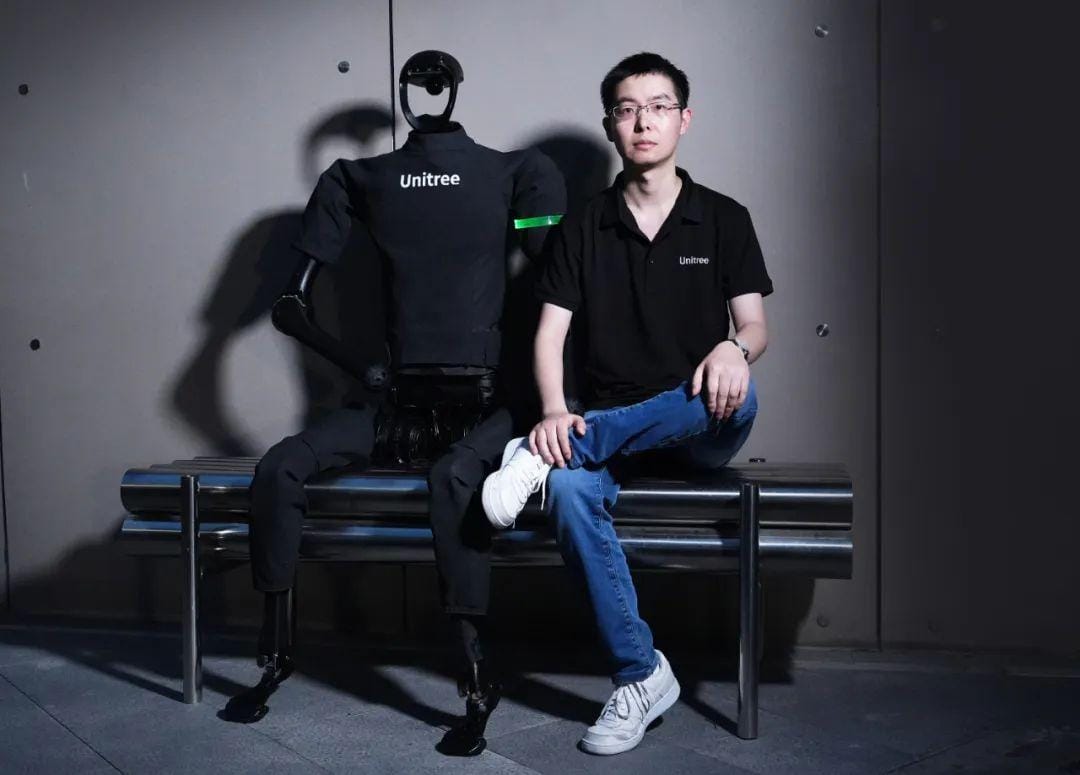
Wang Xinxing's first public address since listing defines the precise inflection point for general-purpose humanoid robots, even as markets deliver a sobering reality check on Day 2 of trading.
Unitree Robotics, China's newly listed "first humanoid robot stock" on the STAR Market, saw its shares give back nearly 15% on August 20 — one session after a staggering 460% debut-day surge — as founder Wang Xinxing used the 2026 World Robot Conference in Beijing to lay out a frank and technically specific roadmap for when embodied AI will finally deliver on its commercial promise.
The juxtaposition was stark: while Wang spoke of a two-to-three-year path to a sector-defining breakthrough, the market was already stress-testing whether the IPO premium had run ahead of that timeline. By mid-morning, Unitree's shares had fallen as much as 17% intraday to RMB 720.02 (approximately US$100.00) per share, pushing its total market capitalization below RMB 300 billion (US$41.7 billion), after touching a peak of RMB 1,100 per share on listing day.
Wang Defines the Inflection Point — and Exposes the Gap
In his first public remarks since the IPO, Wang delivered what amounted to an unusually candid engineering briefing rather than a promotional pitch. His central thesis: the industry's "ChatGPT moment" will arrive when a general-purpose humanoid robot can autonomously complete approximately 80% of everyday household tasks in unfamiliar environments — without prior customization or calibration — responding solely to natural language or text instructions.
"Fast, maybe two to three years. Slow, five to ten years," Wang said at the conference.
The 80% threshold is analytically significant. It implies a robot that is commercially deployable without site-specific engineering, which is the current cost barrier preventing mass-market adoption in home-service and light-industrial segments. Wang's framing effectively converts a fuzzy technological aspiration into a measurable product specification — one that investors and enterprise buyers can track.
Generalization Failure Remains the Core Technical Bottleneck
Wang was equally direct about what stands between today's hardware and that benchmark. He identified two compounding failure modes that current global AI-robotics models have not solved.
First, environmental brittleness: most AI models, after sufficient data collection and task-specific training in fixed scenarios, can approach a near-100% success rate within that controlled setting. But a change in object type or even a minor environmental variation causes task success rates to collapse sharply. This is the generalization problem that has plagued robotics for decades and that large language models, ironically, do not face in the same way.
Second, and more technically nuanced, cumulative input-output misalignment: Wang drew a direct contrast between language models and physical AI systems. In a language model, inputs and outputs are digital encodings confined to vector space — the process is reversible and essentially lossless. In a robot, every actuation cycle introduces physical deviation and energy loss. These errors accumulate across a task sequence, and the model currently lacks the real-time tactile feedback correction to compensate in the final centimeters or millimeters of a manipulation task — the precise moment when assembly or object-handling tasks most commonly fail.
Wang characterized this misalignment between AI model outputs and real-world physical constraints as the "single largest bottleneck" globally, but expressed confidence it is solvable within the current technology generation.
Self-Evolving Robot Models Signal a Strategic R&D Pivot
To close that gap, Unitree is pursuing what Wang described as a self-evolving physical AI architecture — a closed-loop system designed to reduce dependence on labor-intensive manual data curation, which he identified as a significant drag on current development velocity.
The system's logic: use frontier large language models as the reasoning core, define proprietary rule sets, experience frameworks, and constraint tools, then instruct the LLM to autonomously retrieve and synthesize the latest academic papers, leading research outputs, and high-quality open-source solutions to auto-generate robot control code. Evaluation of outputs is split between automated model-based assessment and human review.
Wang's key insight is a flywheel dynamic: as foundation model capabilities improve month-over-month and year-over-year through third-party iteration (OpenAI, Anthropic, domestic Chinese models), the self-evolution loop's own ceiling rises in lockstep — without proportional increases in Unitree's internal R&D spend. Simultaneously, as more physical robots are deployed, the volume and diversity of real-world test data feeding back into the loop expands, compounding the training advantage.
This architecture, if it functions as described, addresses a structural cost problem that has made robot AI development disproportionately expensive compared to pure software AI: the need for massive real-world data collection using physical hardware.
IPO Volatility Reflects Valuation Tension, Not Fundamental Doubt
The Day 2 selloff warrants context. A 460% first-day gain — Unitree's listing-day performance — is almost invariably followed by profit-taking, particularly in China's STAR Market where retail participation is high and institutional lock-up periods create asymmetric selling pressure in the near term. A 15% pullback from that base does not, by itself, indicate a reassessment of Unitree's long-term thesis.
However, the gap between Wang's "two-to-three-year" optimistic scenario and the "five-to-ten-year" conservative scenario is commercially material. At a sub-RMB 300 billion market cap, the stock is pricing in a scenario closer to the optimistic end of that range. Any evidence that generalization benchmarks are progressing more slowly than expected — or that a well-capitalized competitor, whether Boston Dynamics, Figure AI, or a Chinese peer such as UBTECH Robotics — closes the gap, would put that premium under sustained pressure.
Wang's 80% household task-completion metric now serves as the most precise public benchmark against which Unitree's progress can be measured. That specificity is a double-edged sword: it builds credibility with institutional investors who demand measurable milestones, but it also creates an explicit accountability standard that the market will not ignore.
Related Coverage:
Unitree Robotics IPO: What China's First Humanoid Robot Stock Tells Us About the Industry