
Xiaomi's Xring O1 Tops 1 Million Shipments as In-House Chip Push Expands to EVs
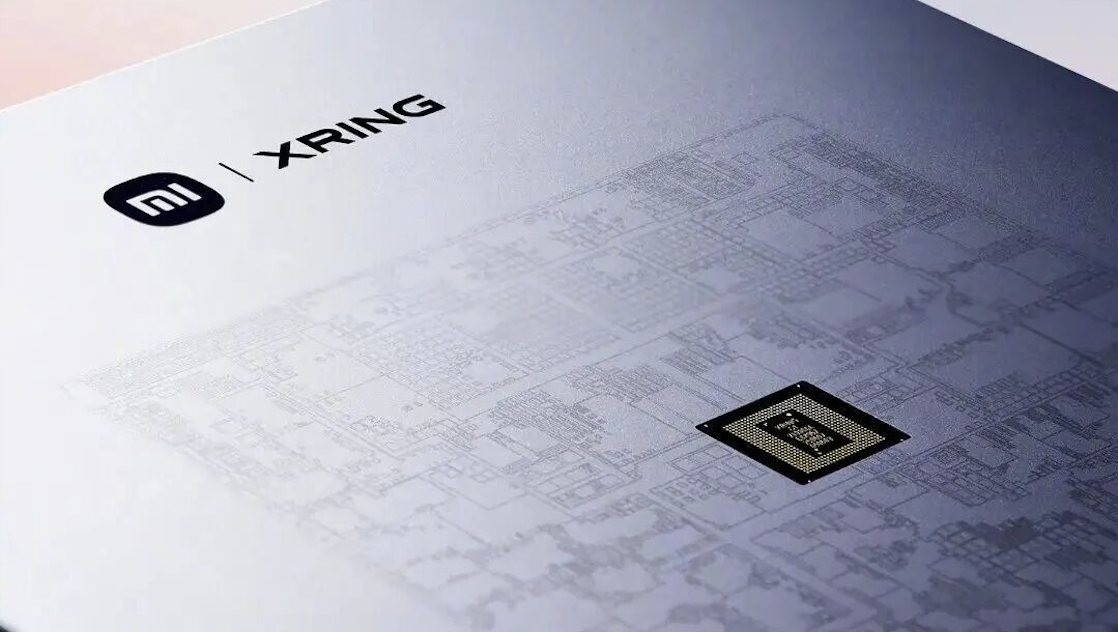
Xiaomi has crossed a critical inflection point in its decade-long semiconductor push: its proprietary Xring O1 processor has shipped more than one million units, with a structurally redesigned successor now cleared from tape-out and set to debut as early as September 2026.
President Lu Weibing disclosed the one-million-unit milestone during the company's second-quarter earnings call on Aug. 18, pairing the announcement with a forward signal that a new-generation Xring chip is "coming soon." The disclosure, buried inside a broader financial briefing, carries outsized strategic weight: it marks the first time a Chinese handset maker has validated a 3-nanometer in-house SoC at commercial scale — and now plans to extend that silicon into its electric vehicle lineup.
Supply-chain sources cited by Jiwei.com separately confirmed that the next-generation chip — referenced in Xiaomi's code repository as Xring O3 — completed tape-out at end-2025 and achieved first-light activation on the same day, a yield indicator that engineers treat as a proxy for design maturity. The chip has since entered terminal device integration, according to the same sourcing.
Eleven Years of Iteration Produce a Commercially Viable Node
Xiaomi's chip ambitions date to 2014, when the company quietly initiated an in-house SoC program. The first public output — the Surge S1, unveiled in 2017 — stalled on baseband integration and trailed market-leading silicon on performance benchmarks, forcing the team to pivot toward sub-system chips covering fast-charging, imaging, and battery management for six years.
The reset came in 2021, when Chairman Lei Jun authorized a full recommitment to flagship-grade SoC development. The renewed program consumed RMB 13.5 billion (approximately US$1.88 billion) over four years and deployed a 2,500-person engineering team before producing the Xring O1, which debuted at Xiaomi's 15th-anniversary event in May 2025.
The Xring O1 is manufactured on TSMC's second-generation 3nm process node, packing 19 billion transistors into a 109-square-millimeter die. Benchmark data show a single-core score of 3,008 and a multi-core score of 9,509 under Geekbench protocols. More competitively, Xiaomi claims GPU power draw runs 35% below Apple's A18 Pro at equivalent frame rates, with sustained gaming temperatures tracking approximately 3°C cooler than comparable flagship devices.
That positions Xring O1 within a narrow club. By process node, the only other companies shipping 3nm mobile SoCs in volume are Apple with its A-series, Samsung with Exynos, and Huawei with Kirin — making Xiaomi the fourth globally and the first domestic Chinese vendor to reach this node in a shipping consumer device. Qualcomm and MediaTek remain on 4nm and 5nm nodes for their current flagship lines.
One Million Units Validates Economics, Not Just Engineering
The commercial significance of the one-million-unit threshold is primarily financial. Xiaomi has publicly estimated that each generation of 3nm SoC development requires approximately US$1 billion in non-recurring engineering costs. At one million units, per-device amortization of that R&D burden exceeds US$1,000 — a figure that alone would surpass the retail price of the Xiaomi 15S Pro, which starts at RMB 4,999 (approximately US$694) after government trade-in subsidies.
The milestone therefore signals three things simultaneously: manufacturing yields at TSMC are stable enough for sustained supply; one year of real-world deployment across one million devices has not produced systemic reliability failures; and the economics of iteration — rather than one-off development — are now plausible. Lu Weibing framed this directly on the earnings call: "Xring O1 is only the starting point; in the future we will very likely release upgraded versions annually."
The Xring O1 is currently deployed across three SKUs: the Xiaomi 15S Pro at RMB 4,999, the Xiaomi Pad 7 Ultra at RMB 5,699, and the Xiaomi Pad 7S Pro at RMB 2,798 (approximately US$694, US$791, and US$389, respectively).
Xring O3 Signals Architectural Break, Not Incremental Refresh
Code-repository analysis cited by supply-chain media indicates that the Xring O3 is not an iterative revision of the O1 but a ground-up architectural redesign — a distinction that matters for competitive positioning. Leaked clock-frequency data suggest the prime core will reach 4.05GHz, a meaningful step up from the O1's configuration. The 3nm process node is expected to be retained.
The chip's first commercial vehicle is widely reported to be the Xiaomi MIX Fold 5, internally codenamed "Q18" or "lhasa," a wide-format foldable flagship. The device is expected to bundle Xring O3 with HyperOS and Xiaomi's MiMo large language model in a single hardware-software stack — a vertical integration play that mirrors the architecture Apple has pursued with its own silicon-OS pairing.
Lu Weibing has publicly denied that the chip carries the "O3" designation, though he has not offered an alternative name ahead of an official announcement.
Automotive Expansion Reshapes the Total Addressable Market
The most consequential disclosure may be the one that received the least earnings-call airtime. On Aug. 20, Lei Jun publicly confirmed that Xring chips will be deployed across Xiaomi's automotive product line going forward — a statement that fundamentally alters the chip program's return-on-investment calculus.
Xiaomi's EV unit, which launched the SU7 sedan in 2024, has been scaling production through 2025 and 2026. Integrating proprietary silicon into vehicles extends the addressable volume base for Xring beyond smartphones and tablets, potentially improving per-unit R&D amortization and enabling tighter hardware-software integration across Xiaomi's device ecosystem.
The move also insulates Xiaomi from a specific category of geopolitical supply-chain risk. Automotive-grade chip procurement has become a pressure point for Chinese EV makers navigating U.S. export controls, and vertical integration — however partial — provides a degree of strategic buffer that fabless competitors relying entirely on third-party suppliers cannot replicate.
Competitive Context: Domestic Semiconductor Race Intensifies
Xiaomi's progress arrives against a backdrop of accelerating domestic chip investment in China. The Chinese government has directed substantial capital into semiconductor self-sufficiency through its "Big Fund" vehicles, and major handset and EV brands are under implicit pressure to reduce dependence on foreign silicon.
Huawei's HiSilicon remains the most advanced domestic SoC designer by cumulative investment and IP depth, though U.S. export restrictions have constrained its access to leading-edge foundry capacity. Xiaomi, by contrast, retains access to TSMC's advanced nodes — a structural advantage that may narrow if geopolitical conditions shift but currently enables competitive parity with global peers on process technology.
Lei Jun acknowledged the gap with Apple's silicon directly: "We are genuinely behind Apple's chips — Apple is the global leader, and we should not expect to immediately outperform them. But as long as we have started catching up, we are on the path to winning."
The September product cycle will provide the first hard data point on whether that trajectory is holding.
Related Coverage: