
WeRide Reports Revenue Surge as Robotaxi Fleet Hits 2,800 Vehicles
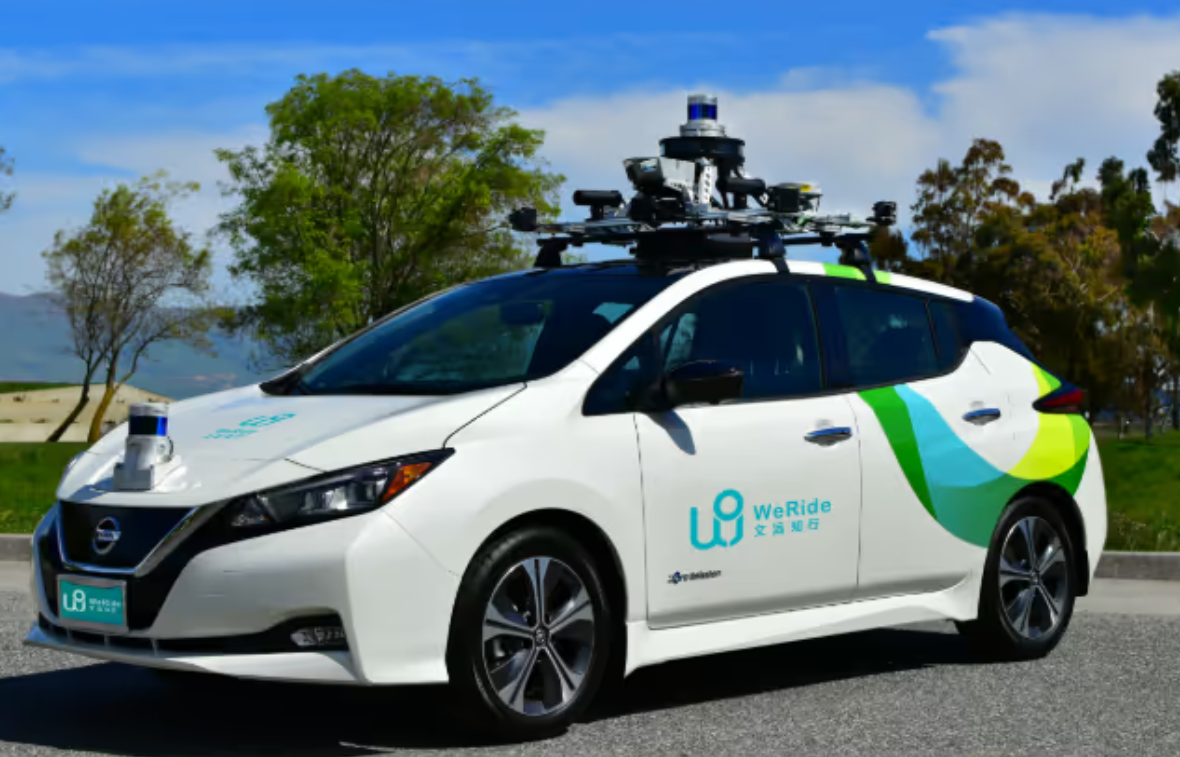
Chinese autonomous vehicle operator WeRide posted RMB 114 million (US$15.8 million) in Q1 2026 revenue, marking its fourth consecutive quarter above RMB 100 million as registered Robotaxi users doubled year-over-year.
WeRide Technologies Inc., the Guangzhou-based autonomous driving company operating across eight countries, reported Q1 2026 revenue climbed 58% from a year earlier while gross margin held at 35%. The results cap a fiscal 2025 where full-year revenue reached RMB 690 million (US$95.8 million), up 90% annually, signaling China's AV sector is transitioning from pilot programs to commercially viable operations at scale.
The company's global autonomous fleet now stands at approximately 2,800 vehicles, including roughly 1,300 Robotaxis—nearly 1,000 of which operate in China alone. Daily average orders per vehicle exceeded 17 in Q1, surging to 28 during peak periods, as registered Chinese users reached twice 2025 Q1 levels.
Fleet Expansion Drives Revenue Concentration
Product revenue—primarily Robotaxi fares—jumped 116% year-over-year to RMB 94 million in Q1 2026, reinforcing autonomous ride-hailing as WeRide's fastest-growing segment. By comparison, Robotaxi revenue accounted for RMB 16.1 million in Q1 2025, or 22.3% of total sales. Full-year 2025 Robotaxi revenue reached RMB 150 million while user base expanded over 900%.
Service coverage widened materially over the past year. In Guangzhou, WeRide extended operations from Huangpu District into core Tianhe areas. Abu Dhabi service now blankets approximately 70% of the emirate's central zones, while Dubai achieved fully driverless commercial operations. Singapore opened public Robotaxi access in 2025.
CFO and International Head Li Xuan noted fleet scalability hinges less on autonomous software maturity than operational complexity—pickup zone optimization, in-cabin interface design, platform integration, and incident response protocols all directly impact unit economics. "This capability requires prolonged real-world iteration," Li explained during the earnings call.
If year-end targets hold, WeRide's Abu Dhabi fleet could reach 400–500 vehicles, matching vehicle density levels Alphabet's Waymo maintains in San Francisco. Domestically, the company plans to launch Robotaxi service in one additional first-tier Chinese city this year, targeting full-domain coverage in at least one metropolis by 2027.
Cost Structure Signals Profitability Inflection
WeRide sustained gross margins above 30% for five consecutive quarters—a rarity among autonomous vehicle operators still absorbing sensor costs, cloud computing expenses, and safety driver wages. Q1 2026 gross profit of RMB 39.6 million rose 56% annually, while Q4 2025 gross profit climbed 74.1% year-over-year.
The margin resilience stems partly from diversified revenue streams. Beyond Robotaxi, WeRide's L2 ADAS business secured nearly 30 vehicle model contracts with automakers including GAC Aion and Chery, leveraging its WRD 3.0 end-to-end perception system. The technology achieved unprecedented four consecutive wins at China's Intelligent Driving Competition, validating what CEO Tony Han describes as a step-change in training efficiency.
WeRide's GENESIS world model—a simulation platform supporting L2++ through L4 configurations—boosts extreme scenario data efficiency by several thousand-fold while cutting data collection and labeling costs roughly 75%, according to company disclosures. Hardware partnerships with NVIDIA, Qualcomm, and domestic chipmaker CoreDrive enable multi-platform deployment scalability.
A five-year agreement with Lenovo Vehicle Computing targets deployment of 200,000 L4 vehicles through 2030. Internationally, WeRide collaborates with Uber in Dubai for driverless operations and Grab in Singapore for market expansion, accelerating overseas validation loops.
Global License Portfolio Supports 'Flywheel' Strategy
WeRide holds autonomous vehicle permits across eight countries, the broadest regulatory footprint among global AV operators. CEO Han introduced the "L4 qualification race" concept, arguing new entrants must operate 100+ driverless Robotaxis publicly for six months without major incidents before competitive positioning becomes relevant.
Abu Dhabi serves as WeRide's international blueprint. Five years into local operations, service spans 70% of core urban areas. The company opened multiple new cities in 2025 alone, compressing market entry timelines through operational playbook replication.
At current scale, previously fragmented data coalesces into city-level road network models, enabling long-tail scenario coverage and urban-scale dispatch algorithms that form genuine operational moats. Learnings transfer laterally to other L4 verticals, creating cross-business synergies.
CEO Han projects the 2026 operating fleet will reach 2,600 Robotaxis, with multiple cities deploying thousand-vehicle fleets within three to five years—some approaching 10,000-unit concentrations. Sustained cash flow from operations finances fleet expansion, which in turn generates scenario data and operational efficiency gains that improve margins, attracting incremental capital and market share in a self-reinforcing cycle.
The Q1 results underscore China's autonomous vehicle industry pivot from technology validation to operational execution. As profitability thresholds come into view and international deployments accelerate, companies demonstrating sustained revenue growth and margin discipline—rather than pure R&D prowess—are emerging as sector leaders.
Related Coverage:
WeRide Sees Public Offering Oversubscribed More Than 50 Times in Hong Kong Listing
WeRide Signals Commercial Breakout with 210% Robotaxi Surge and $100 Million Buyback