
While The West Burns Cash On Flying Car Hype, China Is Already Building The Fleet
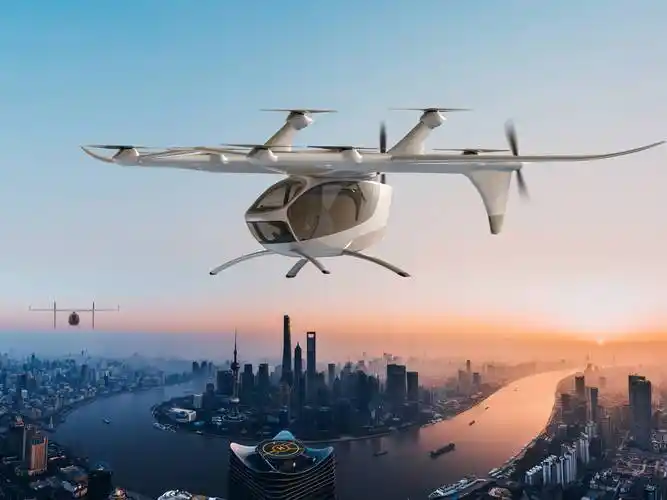
A sweeping "deep dive" into the electric vertical takeoff and landing (eVTOL) aircraft market, released on September 19, 2025, by analysts at J.P. Morgan, paints a starkly divided picture of the much-hyped "flying car" industry. While the report highlights a potential global market swelling to over $200 billion by 2040, a closer reading reveals a critical divergence: as Western firms navigate a capital-intensive, pre-revenue landscape fraught with regulatory delays, their Chinese counterparts are already achieving certification, profitability, and mass-market pre-orders.
For investors betting on the future of urban air mobility, the report is a crucial reality check. The race for the skies is not just about futuristic prototypes; it’s about a pragmatic path to commercialization, and right now, China appears to be building an insurmountable lead.
The Trillion-Dollar Dream Meets Reality
Wall Street has long been enamored with the promise of eVTOLs, and J.P. Morgan’s report echoes this, sizing the potential market with eye-watering figures. Analysts believe a confluence of factors is setting the stage for explosive growth.
"Total addressable market for passenger eVTOLs will reach 100bn globally(≈33−50k units assuming each costs US2-3mn) by 2040E, driven by accelerating regulatory frameworks, public investment in low-altitude infrastructure, and growing demand for zero-emission transport alternatives."
However, the report also injects a healthy dose of skepticism, cautioning that the initial euphoria is fading. The once-touted "$1 trillion TAM" is being aggressively revised downward as the industry collides with real-world constraints.
"We believe the total addressable market opportunity will continue to decline from 1T+ expectations 3−4 years ago, closer to 100-300B... The $1 trillion TAM cited several years ago at the top of the eVTOL hype cycle is likely to keep declining as we think the realistic constraints of real-world operating conditions...could limit the missions where it makes sense to use eVTOL."
China's Pragmatic Leap: Certification, Production, and Profits
While the West grapples with deflating hype, China is executing. The report puts a spotlight on two key players that are moving far beyond the prototype stage.
EHang is singled out for its unprecedented regulatory achievements and early profitability—a status its Western peers can only dream of. The company has uniquely secured the full suite of certifications from the Civil Aviation Administration of China (CAAC), giving it a green light for commercial operations that others lack.
"EHang holds AC+TC+PC+OC (CAAC) certificates in China, uniquely positioned to scale from prototypes to a commercial model... a clear path to breakeven, with (non-GAAP) net profit breakeven already achieved in FY24A and net profit set to grow at a 307% CAGR in FY25-27E."
Simultaneously, EV giant XPeng, through its subsidiary XPeng AeroHT, is commercializing a different vision: a modular flying car for individual users. Its "Land Aircraft Carrier" is not just a concept; it has a price tag, a production timeline, and thousands of pre-orders.
"Priced under RMB 2 million yuan (US 280,000), it has over 3,000 pre−orders, with mass production targeted for 2026...AeroHT aligns with China′s booming eVTOL market, projected to be worth RMB 50 billion yuan approximately US$ 6.9 billion by 2030, positioning XPeng as a leader in dual-mode mobility."
The West's Cash-Burning Hopefuls Face Headwinds
In stark contrast, the report details an American and European landscape defined by heavy spending, persistent losses, and an uncertain regulatory timeline. U.S. frontrunners Joby Aviation and Archer Aviation are lauded for their technical progress but remain mired in the pre-revenue phase.
On Archer Aviation, the analysis notes:
"The company remains pre-revenue, with ongoing operating losses typical of early-stage aerospace ventures. The eVTOL sector faces regulatory and operational hurdles, and Archer’s ability to achieve certification and scale commercial operations will be critical to its financial trajectory."
Joby Aviation, despite its leadership, is similarly positioned, with its valuation reflecting future hope rather than current business fundamentals. The recent bankruptcies of European pioneers Lilium and Volocopter (the latter now acquired by China’s Wanfeng Group) serve as a grim reminder of the sector’s brutal economics.
The report lays bare a fundamental chasm: China is leveraging state-backed regulatory speed and a massive domestic market to build a commercially viable industry today. Meanwhile, the West remains locked in a capital-intensive R&D cycle, selling a future vision that is proving increasingly expensive and distant. For those watching the future of transportation unfold, the flight path seems clear, and it's being charted in Beijing, not Silicon Valley.