
Xiaomi Auto Unveils Enhanced HAD Driving Assistance System with Reinforcement Learning
Xiaomi Auto officially launched its "Xiaomi HAD Enhanced Version" driving assistance system at the Guangzhou Auto Show on November 21, marking a significant technological advancement in the company's automotive capabilities.
The upgrade represents the first deployment of reinforcement learning combined with world model training methods, following the initial 10-million-clip end-to-end version introduced with the Xiaomi YU7 in June 2025. The system delivers improvements across three core areas: longitudinal acceleration and deceleration control, lateral lane changes, and intersection navigation, with rollout to vehicles scheduled via HyperOS 1.11 over-the-air updates after the auto show.
The enhancement shifts Xiaomi's driving assistance technology from a data-driven approach to a cognition-driven framework. The previous system relied on imitation learning from professional driver data, limiting its ability to address edge cases due to constraints in real-world sample coverage. The new architecture leverages Xiaomi's proprietary 4D digital asset library to generate high-fidelity virtual scenarios, enabling the model to autonomously explore optimal driving strategies through reward-and-penalty mechanisms without depending on randomized real-world data.
The system's world model has gained international academic recognition. Xiaomi's ViSE algorithm won first place at the ICCV 2025 autonomous driving simulation challenge, with related research accepted at the NeurIPS conference. The technology replicates road conditions and simulates various weather and lighting scenarios while supporting parallel training and dynamic strategy adjustment.
Practical improvements include precise prediction of vehicle cut-ins with smoother deceleration, professional-grade lane change execution, and enhanced navigation interpretation at complex intersections. The system demonstrates stronger performance in scenarios including roundabouts and main-auxiliary road transitions, with intersection passage rates improving by over 40 percent. Emergency response time reaches 0.5 seconds.
The HyperOS 1.11 update also introduces Emergency Steering Assist, along with low-speed front and rear collision prevention systems, establishing a more comprehensive collision avoidance framework. The system adapts to individual driving styles and features optimized sensor algorithms for nighttime and heavy rain conditions, supported by three-tier human-machine interaction alerts.
The technology is trained on tens of millions of driving scenarios nationwide with doubled data quality, utilizing Xiaomi's proprietary XLA large model for integrated perception, decision-making, and control. Continuous upgrades will be delivered through over-the-air updates.
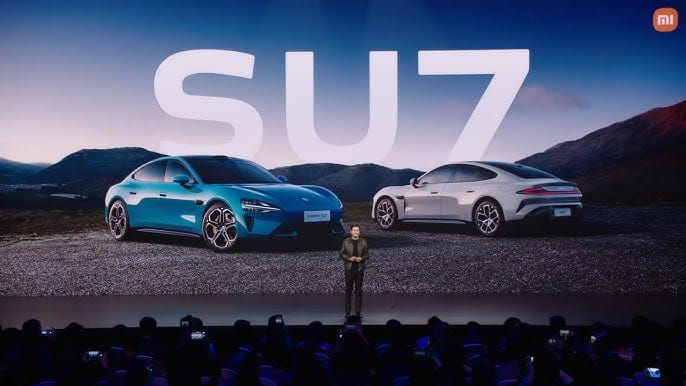
Xiaomi Auto has demonstrated strong commercial performance. The SU7 has led the over-RMB 200,000 ($27,800) sedan segment for the past 12 months, maintaining an 88.91 percent residual value rate after one year among pure electric vehicles. The YU7 topped the multi-powertrain SUV sales chart in October. Since the SU7's debut in March 2024, Xiaomi reached 500,000 vehicle production in 602 days, setting a global record. The company expects to exceed its 2025 annual delivery target of 350,000 units this week.