
XPeng GX Demand Surge Validates Premium Ambitions, but Profitability Delayed to 2028
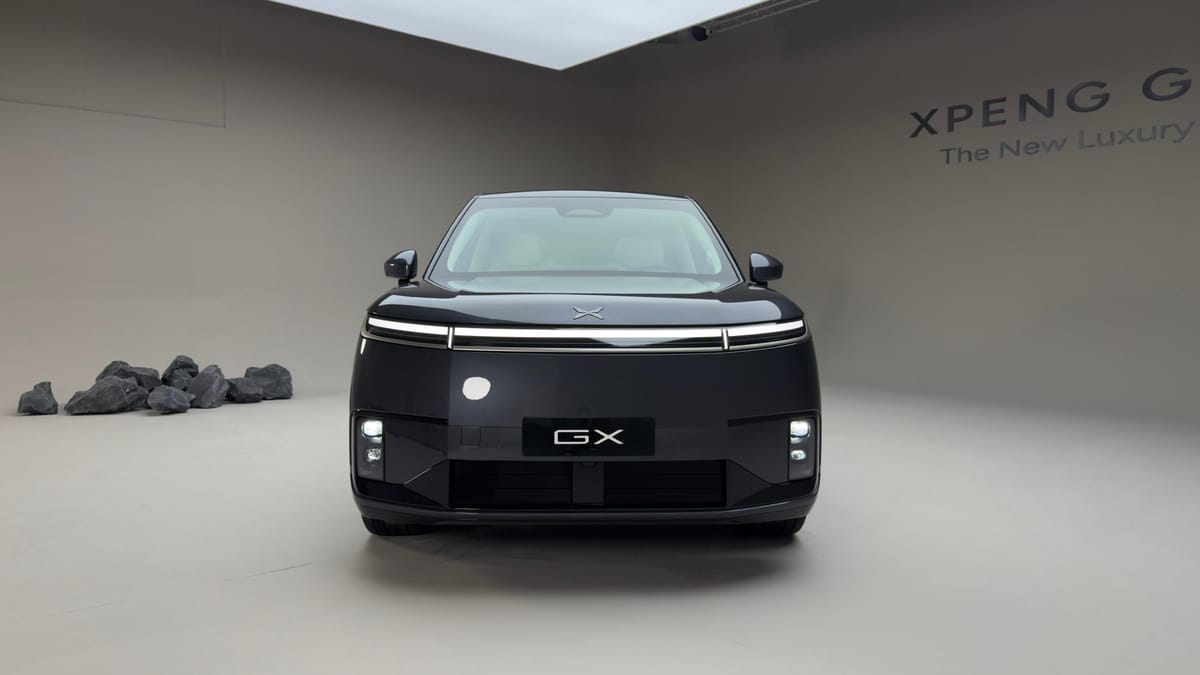
Morgan Stanley maintains Overweight on XPeng with HK$96 price target as flagship GX SUV demand exceeds expectations, overseas monthly run rate hits 6,000 units, and robotaxi commercialization targets crystallize — yet the bank trims 2026-28 volume forecasts by 4-6% and pushes net profit break-even to 2028.
The GX launch has done what multiple prior model cycles failed to achieve for XPeng: deliver credible evidence that Chinese consumers will pay a premium for the brand. But translating that demand signal into sustained earnings remains a multi-year execution test, and Morgan Stanley's revised estimates underscore just how expensive the transition will be.
In a research note dated June 2, 2026, Morgan Stanley Asia Limited analyst Tim Hsiao kept his Overweight rating and HK$96 price target on XPeng's Hong Kong-listed shares (9868.HK), implying 33.3% upside from the current share price of HK$72.00 — while simultaneously cutting 2026-28 unit volume forecasts by 4-6% to 442,000, 560,000, and 626,000 vehicles respectively. The revision reflects weaker year-to-date sales and softer demand for plug-in hybrid models, partially offsetting the GX momentum. The stock has traded between HK$57.55 and HK$110.80 over the past 52 weeks, and the H-share currently sits closer to the lower end of that band, creating what Morgan Stanley characterizes as an asymmetric entry point ahead of a catalyst-dense second half.
The market's initial read on the GX — launched May 20, 2026 — appears unambiguously positive. Management flagged that demand for the Ultra flagship trim has "materially exceeded expectations," a signal that carries particular weight given XPeng's historical inability to command premium pricing in the RMB 300,000-plus full-size six-seat SUV segment. Monthly segment sales exceed 50,000 units industry-wide, and Morgan Stanley argues that gaps among mainstream rivals remain wide enough for a well-configured entrant to capture meaningful share.
GX Unlocks Premium Positioning That Eluded Earlier Cycles
XPeng's brand equity problem has been well-documented: the company consistently attracted technically sophisticated buyers but struggled to convert product innovation into willingness-to-pay at higher price points. The GX Ultra data point suggests that equation may be shifting.
The strategic implications extend beyond a single model. Morgan Stanley frames the GX as a "proof point" that should invite investor re-engagement after a weak start to 2026. More importantly, the GX serves as the demand foundation for the next three product launches — the G9L and MONA L03/L05, both slated for 2H26 — all of which are positioned as global products. A successful premium brand transition domestically directly de-risks the overseas pricing strategy, where XPeng cannot rely on the cost subsidies and brand familiarity that underpin its China volumes.
Vehicle average selling price (ASP) is forecast to rise to RMB 176,588 in 2026 from RMB 165,398 in 2025, before moderating slightly to RMB 173,671-174,479 in 2027-28 as the volume mix shifts toward higher-unit MONA models. Gross margin on vehicles is projected to expand incrementally from 12.8% in 2025 to 13.6% by 2028, a trajectory that is modest but directionally significant given the competitive pricing pressure across China's EV market.
Overseas Expansion Builds Data Moat, Targets 10,000 Monthly Units by Q4
The overseas business is evolving from a margin-enhancing revenue stream into a strategic infrastructure play. XPeng's overseas monthly run rate reached 6,000 units in April 2026, driven primarily by the P7+, and management has set a target of 10,000 units per month by the fourth quarter of 2026. On an annualized basis, that trajectory implies approximately 120,000 units — a volume level that begins to matter for both revenue and fixed-cost absorption in the standalone international business.
Management now expects overseas sales to account for more than 20% of total volume starting in 2026, with full-year international deliveries more than doubling year-on-year. The G9L, MONA L03, and MONA L05 are all designated global products, providing a multi-model pipeline to sustain the ramp beyond a single hero vehicle.
The deeper strategic logic, however, lies in autonomous driving data. The planned rollout of VLA 2.0 — XPeng's next-generation vision-language-action model — alongside vehicles equipped with the proprietary Turing chip creates a data collection network outside China. For a company targeting commercial driverless robotaxi operations, international real-world driving data is not a nice-to-have; it is a prerequisite for regulatory credibility and model generalization. Morgan Stanley characterizes this as the foundation for "an early lead in building a data moat" — a long-term strategic advantage that does not appear in near-term financial models but could materially influence sum-of-the-parts valuation if the robotaxi timeline holds.
Robotaxi and Humanoid Timelines Crystallize, Shifting Narrative from Concept to Execution
XPeng's autonomous driving roadmap has sharpened considerably. The company has reiterated a supervised pilot robotaxi launch in 2H26, with a driverless operation target for 1H27 in China, followed by expansion into additional cities under a solutions-provider model. Morgan Stanley views this timeline as credible, supported by XPeng's vertically integrated AI chip and algorithm stack — the Turing chip — and platform synergies from its growing consumer EV fleet, which provides the training data volume necessary to validate the system.
The MONA model line is central to robotaxi economics. Higher MONA volumes reduce per-unit deployment costs, improving the unit economics of future commercial robotaxi operations. The overseas VLA 2.0 rollout adds an international data layer that could eventually support cross-border robotaxi commercialization, though that remains a 2027-2028 horizon story at earliest.
On humanoid robots, XPeng has reached key mass-production milestones and is targeting a monthly production run rate of approximately 1,000 units by year-end 2026. Morgan Stanley is careful to note that this volume "may not represent a meaningful financial contribution" in the near term, but frames it as a demonstration of AI and hardware integration capability beyond the EV core. The bull case sum-of-the-parts valuation assigns RMB 11 billion to the humanoid business at 10x 2028 price-to-sales, alongside RMB 14 billion for robotaxi (10x 2028 P/S) and RMB 35 billion for the Turing AI chip business (6x 2028 P/S) — together representing roughly 27% of the RMB 220 billion vehicle business valuation in the upside scenario.
Losses Widen Before Narrowing: The Cost of Building Three Businesses Simultaneously
The financial model reflects the tension between near-term investment and long-term optionality. Morgan Stanley now projects XPeng to remain loss-making through 2027, with net losses of RMB 3.6 billion (US$500 million) in 2026 and RMB 950 million (US$132 million) in 2027, before reaching net profit break-even in 2028 at RMB 194 million (US$27 million) in 2027, before reaching net profit break-even in 2028 at RMB 194 million (US$27 million). The 2026 net loss estimate is actually wider than the 2025 loss of RMB 1.17 billion, reflecting accelerating R&D spend — projected to reach 14.8% of revenue in 2026, up from 12.4% in 2025 — as XPeng simultaneously funds its Turing chip program, robotaxi deployment, and humanoid production scale-up.
Revenue is forecast at RMB 83.1 billion (US$11.5 billion) in 2026, rising to RMB 103.3 billion (US$14.3 billion) in 2027 and RMB 116.3 billion (US$16.2 billion) in 2028. Group gross margin is expected to hold at approximately 19.1-19.2% across the forecast period, suggesting the product mix improvement from GX and overseas premium sales is roughly offsetting competitive pricing pressure in the domestic mid-range segment.
The SG&A-to-revenue ratio is expected to be contained — declining from 12.0% in 2026 to 9.5% by 2028 — as domestic operating leverage kicks in. But this improvement is largely offset by rising overseas operational expenditure and non-auto initiative spending, meaning the consolidated P&L does not benefit from the full scale leverage that the domestic auto business alone would imply.
Free cash flow is projected at negative RMB 3.3 billion in 2026 before turning positive at RMB 3.4 billion in 2027 and RMB 9.8 billion in 2028, underpinned by working capital normalization and improving operating profitability in the core vehicle business. Cash and equivalents stood at RMB 38.3 billion at end-2025, providing approximately two years of runway at the projected 2026 cash burn rate without requiring external financing.
Valuation Reflects Execution Premium at Current Levels
Morgan Stanley's probability-weighted DCF methodology assigns 30%/50%/20% weightings to its bull, base, and bear scenarios. The firm's US$25 ADR price target (HK$96 for H-shares) implies 2.0x 2026E P/Sales, based on a 12.8% WACC, 1.6x beta, and 3% terminal growth rate. Technology service revenue from Volkswagen is expected to provide a long-term gross margin floor, adding a revenue quality component that many pure-play Chinese EV manufacturers lack.
The bull case of US$40 (HK$156) — implying 3.2x 2026 P/Sales — requires rapid PHEV sales ramp, accelerating humanoid and L4 robotaxi rollout, and meaningful operating leverage. Options market data as of June 1, 2026 assigned approximately 9.7% probability to XPeng's ADR exceeding US$25 over a 12-month horizon and near-zero probability of reaching the US$40 bull-case valuation, reflecting the market's current skepticism about execution velocity. The bear case of US$10 (HK$39) — implying 0.8x 2026 P/Sales — assumes a 20% volume decline and 3 percentage point gross margin contraction from intensified competition, a scenario the options market assigned approximately 24.9% probability.
The consensus mean price target of HK$97.59 sits marginally above Morgan Stanley's HK$96 target, with 90% of covering analysts rating the stock Overweight — an unusually high concentration of bullish sentiment that itself represents a risk if the 2H26 product cadence disappoints.
Related Coverage: