
XPeng Takes Humanoid Robots From Prototype to Production With an 80%-Automated Line
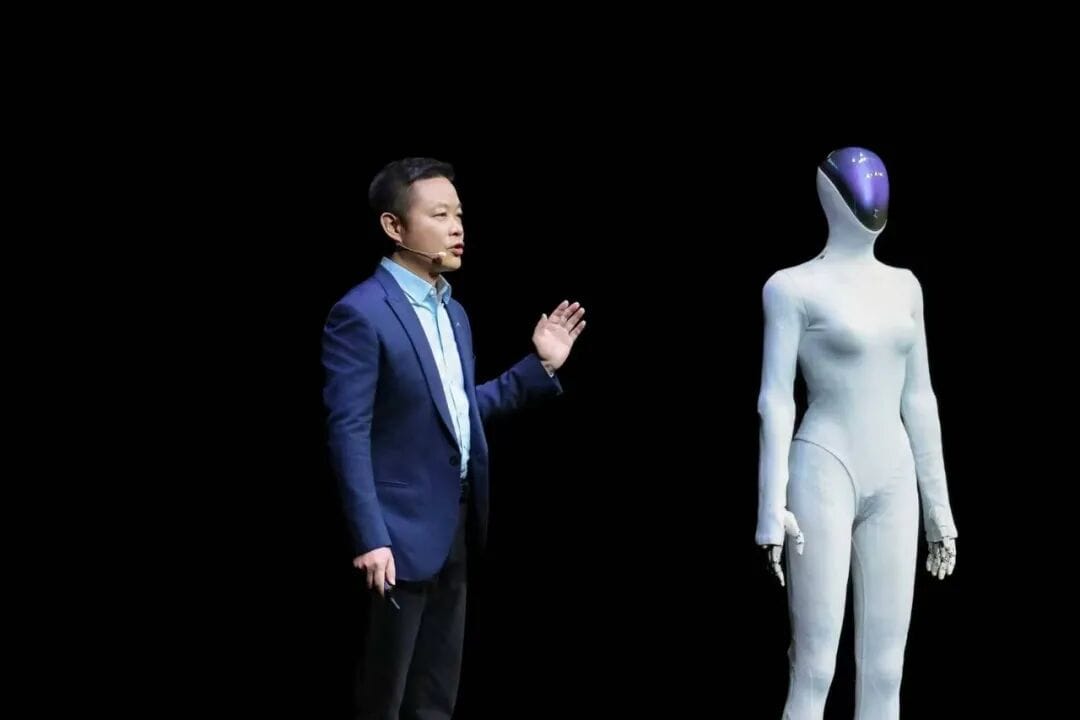
XPeng activated its dedicated humanoid robot production line on September 8, becoming the first Chinese automaker to complete a full "R&D-to-mass-production" cycle for a general-purpose humanoid robot — a milestone that shifts the industry's competitive axis from prototype showmanship to manufacturing scalability.
The launch ceremony in Guangzhou carried unmistakable symbolism: IRON, XPeng's flagship humanoid robot, walked autonomously off the production line as Chairman and CEO He Xiaopeng stepped forward to pin an employee badge on its chest. The gesture was theatrical, but the underlying numbers are what investors should watch. XPeng claims its new line achieves over 80% automation in core manufacturing processes — a benchmark borrowed directly from automotive-grade quality systems — and the company has set a firm deadline of end-2026 for scaled production, with commercial deliveries to China and overseas markets beginning in 2027.
The announcement arrives two weeks after XPeng's robotics unit closed a first-round equity financing exceeding US$900 million (RMB ~6.48 billion), valuing the standalone business at over US$6.3 billion (RMB ~45.4 billion). The round was led by IDG Capital, with participation from Gaorong Capital and strategic investments from Tencent and Alibaba — a capital structure that signals both financial depth and ecosystem alignment.
Automotive DNA Drives an 80% Automation Rate That Pure-Tech Rivals Struggle to Replicate
The production line's most defensible competitive advantage is not the robot itself, but the manufacturing infrastructure behind it. XPeng has transplanted its automotive-grade quality control architecture — precision tolerances, supply chain discipline, statistical process control — into a domain where most competitors still rely on manual assembly benches.
This matters because consistency, not peak performance, determines commercial viability at scale. Industry observers have long noted that humanoid robots from pure-software companies and traditional robotics firms suffer from low yield rates and assembly inconsistencies that inflate per-unit costs. XPeng's 80%-plus core-process automation rate directly attacks that cost structure. The company describes the line as designed for "high precision, high flexibility, and intelligent manufacturing," with explicit capacity for rapid volume scaling — language that echoes how XPeng's automotive plants are engineered for surge production.
The 110,000-square-meter Guangtang Science and Innovation City Embodied Intelligence Industrial Park in Guangzhou's Tianhe District, where XPeng signed a strategic framework agreement with local government in February 2026, will house the full-chain production base. Phase one infrastructure — high-specification robot factory floors, power stations, and ancillary facilities — is already under construction.
IRON's Hardware Stack Positions XPeng at the Top of a Crowded Specification Table
The production-ready IRON carries specifications that benchmark against the global field's upper tier. The platform features 76 full-body degrees of freedom, with 21 degrees of freedom per hand — enabling fine manipulation tasks including grasping, rotation, and load transfer across multi-scenario environments.
On the compute side, IRON runs three of XPeng's proprietary Turing AI chips, delivering 2,250 TOPS of effective on-device compute. XPeng states its physical AI model is deployed at the edge, allowing IRON to execute complex tasks autonomously without remote teleoperation — a critical differentiator for latency-sensitive industrial applications and a data-security advantage in enterprise deployments.
XPeng's self-developed hardware stack spans chips, controllers, motion modules, and dexterous hands, all integrated within a fully enclosed flexible lattice body structure designed to balance human-like aesthetics with contact safety. One notable specification revision: XPeng had previously highlighted all-solid-state batteries as a product feature at its 2025 Technology Day. Industry tracking by JiPian Lab reported on September 3 that the company has now confirmed a high-energy-density semi-solid (solid-liquid hybrid) pouch cell solution for mass production, with one supplier already designated, while additional battery vendors continue sample testing. The pivot reflects a pragmatic trade-off between energy density ambitions and the manufacturing readiness of solid-state technology at scale.
A Three-Phase Commercial Roadmap Reveals Where Revenue Actually Materializes
XPeng's go-to-market strategy is deliberately staged, prioritizing data accumulation over near-term revenue maximization — a pattern consistent with how the company scaled its ADAS capabilities through real-world driving data.
Phase 1 (end-2026): The first production batch will deploy within XPeng's own retail stores and campuses, handling repetitive, lower-risk tasks: customer service, facility inspection, materials handling, and basic logistics. These deployments serve a dual purpose — generating revenue from internal cost substitution while feeding real-world operational data back into model training alongside human demonstration data.
Phase 2 (2027): Formal commercial launch targeting China and international markets, with scope expanding to campus services, commercial complexes, enterprise back-office operations, and light industrial assistance. This phase opens external revenue channels.
Phase 3 (2028 and beyond): Cost reduction through manufacturing scale, penetration into family services, specialized operations, and precision industrial production — positioning robotics as XPeng's third major revenue pillar alongside smart EVs and Robotaxi services.
The roadmap is notable for what it omits: there are no stated revenue targets or volume commitments beyond the production ramp. This is consistent with an early-stage industrial rollout, but investors pricing the US$6.3 billion robotics valuation will need to monitor whether 2027 delivery volumes justify that figure.
Tencent and Alibaba's Strategic Stakes Signal Ecosystem Plays Beyond Financial Returns
The composition of IRON's financing round deserves scrutiny beyond headline valuation. IDG Capital's lead position is conventional venture capital. But Tencent and Alibaba's participation as strategic investors — two companies with competing cloud, enterprise software, and AI infrastructure businesses — suggests both are hedging against a scenario where physical AI becomes a distribution channel for their respective ecosystems.
For Alibaba, which operates Cainiao logistics and a vast e-commerce fulfillment network, humanoid robots capable of warehouse operations represent a direct operational asset. For Tencent, whose enterprise services division competes for corporate IT budgets, an investment in the hardware layer of physical AI provides optionality in a market where software and hardware are increasingly co-sold. Neither investment is purely financial; both create preferential access to a platform that could become infrastructure.
Industry Inflection Point, But Commercialization Risk Remains Underpriced
XPeng's production line activation is a genuine industry inflection — the first verifiable evidence that a Chinese company has industrialized general-purpose humanoid robot manufacturing to automotive quality standards. It sets a benchmark that competitors including Xiaomi, which has demonstrated its CyberOne and subsequent platforms, and international players such as Tesla's Optimus program, will need to match on manufacturing rather than specification grounds.
However, the gap between manufacturing readiness and commercial maturity is wide. IRON's acknowledged limitations — constrained battery endurance, incomplete adaptive capability in dynamic environments, unproven high-intensity operational stability, and ongoing AI generalization development — are shared across the global humanoid robot industry. High unit costs and a currently narrow set of commercially viable deployment scenarios remain the primary constraints on addressable market size.
The next 24 months will determine whether XPeng's manufacturing lead translates into a durable cost advantage or merely an early-mover position that better-capitalized competitors can close. The company has solved the production equation. The commercial equation — unit economics, customer acquisition, and recurring service revenue — remains open.
Related Coverage:
XPeng's He Xiaopeng Takes Robot CEO Role, Targets IRON Mass Production by End-2026