
China’s EV Upstarts Face a New Test: Who Can Afford the R&D Race?
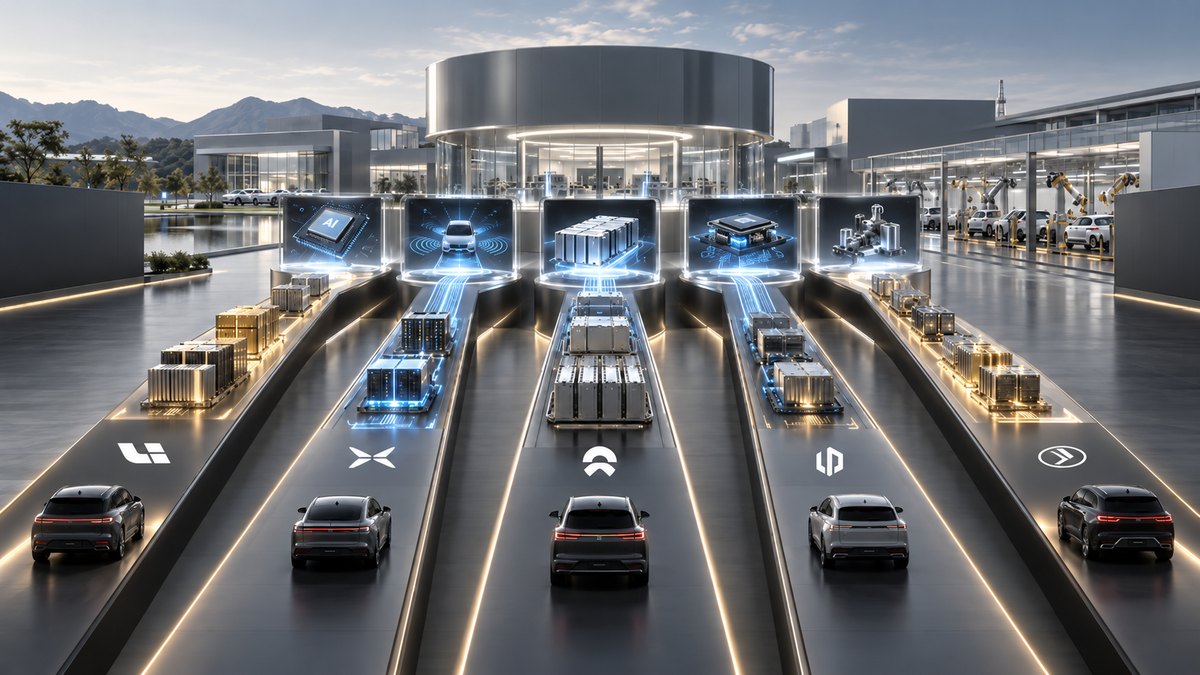
Cash reserves and development spending data from first-half 2026 filings expose stark divergences in financial durability and strategic focus among China's five leading new-energy vehicle challengers.
Li Auto sits atop the cash pile with RMB 87.5 billion (US$12.15 billion) in liquid reserves, yet that headline figure masks an 18.1% year-on-year decline — a warning signal for investors monitoring the company's ability to sustain its aggressive AI-chip ambitions. The semi-annual disclosures, compiled from filings released in early September 2026, lay bare a sector undergoing rapid financial stratification: two players are burning through reserves, two are accumulating, and one is actively restructuring its cost base.
Markets are increasingly scrutinizing not the size of these war chests, but their rate of depletion relative to R&D velocity — a metric that may prove more predictive of long-term competitiveness than quarterly delivery numbers alone.
Cash Positions Diverge, Signaling Unequal Staying Power
The five-way comparison reveals a clear hierarchy. Li Auto leads at RMB 87.5 billion (US$12.15 billion), followed by Seres Group at RMB 73.15 billion (US$10.16 billion), NIO at RMB 56.7 billion (US$7.88 billion), Xpeng at RMB 40.48 billion (US$5.62 billion), and Leapmotor at RMB 38.59 billion (US$5.36 billion).
The directional trends, however, tell a more nuanced story. NIO's reserves doubled year-on-year — the strongest absolute improvement in the cohort — likely reflecting the capital-raising activities and balance-sheet repair the company undertook through late 2025. Leapmotor posted 30.5% reserve growth, consistent with its narrowing losses and expanding Stellantis-backed international distribution. By contrast, Li Auto's 18.1% decline and Xpeng's 14.9% drop suggest both companies are accelerating cash deployment into product cycles and technology platforms faster than revenues are replenishing reserves.
Applying the "cash reserves ÷ annualized R&D" runway metric cited by Cui Dongshu, secretary-general of the China Passenger Car Association, the divergence becomes operationally significant. Companies with three-plus years of R&D runway and positive operating cash flow are compounding competitive advantages; those with sub-four-year buffers and negative operating cash flow face a structurally tighter window to achieve profitability before needing to return to capital markets.
Xpeng Outspends Peers on R&D Intensity, Li Auto Locks In AI Chip Strategy
On research and development expenditure — the more forward-looking metric — Xpeng claims the top position despite ranking fourth on cash reserves. The Guangzhou-based automaker spent RMB 5.82 billion (US$808 million) on R&D in the first half of 2026, representing the highest R&D-to-revenue ratio among the five peers. Chairman He Xiaopeng confirmed on the second-quarter earnings call that full-year 2026 R&D investment is projected to exceed RMB 10 billion (US$1.39 billion), with primary allocation toward next-generation vehicle platforms, autonomous driving, and physical AI — the company's term for embodied intelligence applications.
Li Auto's RMB 5.498 billion (US$764 million) in H1 R&D spending ranks second, with a 3.3% year-on-year increase that trails the cohort's growth pace. The slower headline growth obscures a sharp strategic pivot: CFO Li Tie disclosed that AI-related spending will account for approximately 50% of the projected RMB 12 billion (US$1.67 billion) full-year R&D budget. The company's self-developed 5nm automotive-grade chip, the Maho M100, has already shipped more than 50,000 units into production vehicles, with the Maho VLA large language model deployed concurrently — a rare instance of a Chinese automaker achieving simultaneous silicon and software vertical integration at scale.
NIO's RMB 4.03 billion (US$560 million) in H1 R&D spending came with a notable asterisk: second-quarter R&D costs fell 28.7% year-on-year to RMB 2.145 billion (US$298 million), which the company attributed to organizational restructuring, reduced headcount in R&D functions, and improved engineering efficiency. CFO Qu Yu guided analysts toward a Non-GAAP quarterly R&D baseline of approximately RMB 2.5 billion (US$347 million) for the remainder of 2026, with modest dynamic adjustments tied to project cadence — effectively signaling that NIO has structurally reset its cost base rather than merely deferred spending.
Seres reported RMB 3.734 billion (US$518 million) in expensed R&D (excluding capitalized development costs), with total R&D investment including capitalized items reaching RMB 7.007 billion (US$973 million) — a 34.8% year-on-year increase representing more than 12% of revenues. The Chongqing-based company, which produces the AITO series in partnership with Huawei, highlighted advances in 800V high-voltage architecture, full-vehicle safety redundancy systems, and AI engineering integration. Leapmotor's RMB 2.32 billion (US$322 million) grew 22.8%, supported by its self-developed core component strategy covering approximately 65% of vehicle bill-of-materials value.
Geely's Zeekr and Xiaomi Auto Broaden the Competitive Field
Two additional players warrant investor attention even though their financials are not directly comparable on a standalone basis.
Zeekr, the premium EV brand under Geely, delivered 178,000 vehicles in H1 2026 — a 97% year-on-year surge — generating revenues of approximately RMB 55 billion (US$7.64 billion), equivalent to 31.7% of Geely Group's total top line. Geely's consolidated R&D expenditure reached RMB 9.199 billion (US$1.28 billion) for the half-year, up 25.5%, though Zeekr's standalone R&D and cash figures are subsumed into group-level reporting.
Xiaomi, whose automotive ambitions have expanded rapidly since the SU7 launch in 2024, reported group-level R&D investment exceeding RMB 18.2 billion (US$2.53 billion) in H1 2026, with second-quarter spending of RMB 9.2 billion (US$1.28 billion) rising 18.9% year-on-year. Management has indicated the primary allocation targets AI foundation models, embodied intelligence, and automotive intelligence — a portfolio spanning its phone, AIoT, and vehicle businesses simultaneously, making automotive-specific R&D disaggregation difficult but the aggregate commitment unambiguous.
Effective R&D Conversion, Not Spending Volume, Determines Competitive Moats
The critical analytical question is not how much these companies are spending, but how efficiently that capital converts into products users value.
A white paper jointly published in 2026 by the China Association of Automobile Manufacturers and automotive R&D services firm Altair found that leading Chinese automakers have compressed vehicle development cycles from the traditional 36-to-48-month window to 18-to-24 months, with select firms approaching 12 months. This acceleration raises per-vehicle amortized R&D costs even as it shortens time-to-market — creating a structural premium on capital efficiency over raw spending.
Cui Dongshu identifies three metrics as the most reliable proxies for R&D effectiveness: commercialization conversion rate (the speed from patent filing to mass-production deployment); R&D density (per-vehicle R&D spend against per-employee output); and platform reuse ratio. His observation that some automakers achieve profitability on lower absolute R&D budgets while better-funded peers remain loss-making underscores that spending scale is a necessary but insufficient condition for competitive advantage.
The five technology domains Cui identifies as most directly translating into consumer-perceivable value — autonomous driving algorithms and data, battery and electric drivetrain technology, cockpit software and OTA capability, chassis and active safety, and proprietary chip development — map closely onto the stated investment priorities of Li Auto and Xpeng, and partially explain why those two companies command the highest market attention despite their contrasting cash trajectories.
For investors, the H1 2026 data crystallizes a bifurcating landscape: companies with expanding cash reserves, growing R&D intensity, and demonstrable hardware-software integration (Li Auto's chip deployment, Xpeng's ADAS architecture) are building durable moats; those managing through restructuring (NIO) or relying on partnership ecosystems (Seres-Huawei) face a narrower path to self-sustaining competitive differentiation. The next 18 months of product launches will determine whether current R&D allocations translate into the delivery volumes and margin structures necessary to justify their respective balance-sheet positions.
Related Coverage:
Li Auto Bets RMB 2.65 Billion on Battery Independence, Reshaping Its CATL Dependency
XPeng’s New VLA Pushes Its Physical AI Ambitions Beyond Cars