
XPeng’s $900M Robotics Raise Signals a New Phase in China’s Embodied AI Race
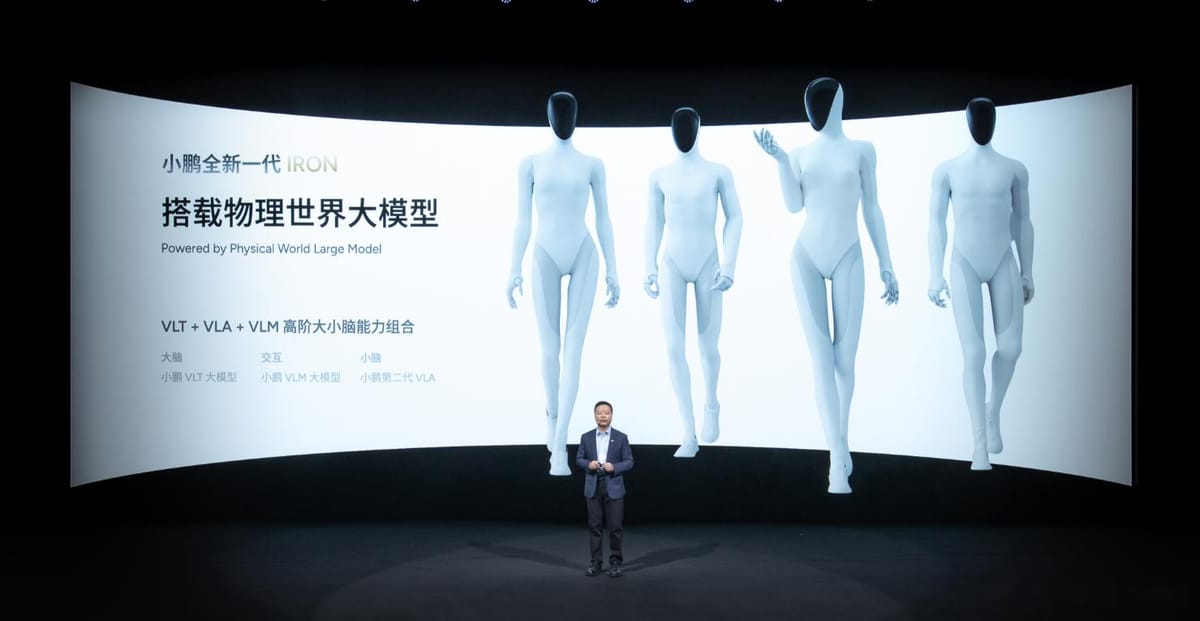
XPeng has completed a record-breaking fundraise for its humanoid robotics subsidiary, drawing simultaneous backing from China's two largest internet rivals and setting a new benchmark for private capital deployment in the country's embodied AI sector.
The robotics unit, operating under Dogotix closed its Series A at over $900 million (approximately RMB 6.1 billion), pushing its post-money valuation to $6.3 billion (approximately RMB 42.7 billion) — the highest ever recorded for a single private equity round in China's embodied intelligence industry. The announcement landed on August 24, the same day XPeng reported stronger-than-expected second-quarter automotive results, though the robotics deal rapidly dominated investor attention.
The financing structure is notable for both its scale and its strategic composition. IDG Capital led the round with Gaorong Capital as co-investor. More significantly, Tencent and Alibaba — fierce competitors across virtually every other domain of China's digital economy — participated as strategic investors in the same transaction. External investors contributed approximately $600 million in aggregate, with XPeng Group contributing $200 million from its own balance sheet. XPeng Chairman and CEO He Xiaopeng personally co-invested $80 million, while President Gu Hongdi committed an additional $20 million, bringing the management team's combined subscription to $100 million plus warrants.
Rival Tech Giants Converge on a Single Cap Table, Signaling Sector Urgency
The simultaneous presence of Tencent and Alibaba on the same capitalization table is structurally unusual and analytically telling. Both companies have historically maintained parallel — and often competing — investment portfolios across China's technology landscape. Their joint participation suggests that the strategic value of securing early positioning in embodied AI infrastructure now outweighs conventional competitive calculus.
Under the agreed terms, XPeng Group's ownership stake dilutes from 100% to approximately 73.80% assuming warrants remain unexercised, and to roughly 68.41% upon full warrant exercise — in either scenario, the parent retains absolute control. The robotics business will continue to be consolidated into XPeng's group financial statements, meaning its losses and eventual revenues will flow directly through the listed entity's P&L. IDG Capital holds approximately 4.72% post-close, while Alibaba, Tencent, and Gaorong each hold approximately 1.57%. An employee incentive pool accounts for 14.96% of the fully diluted cap table.
A Seven-Year IPO Redemption Clause Embeds Hard Accountability
Embedded within the shareholder agreement is a redemption mechanism that functions as a hard deadline: if Dogotix fails to complete a qualifying initial public offering within seven years of the closing date, investors may demand full redemption at the higher of principal plus 8% compound annual interest or 120% of principal. The clause is standard for late-stage Chinese tech deals but carries particular weight given the round's size.
He Xiaopeng's personal $80 million commitment — alongside Gu Hongdi's $20 million — alongside an additional warrant package priced at a $500 million aggregate exercise value (at $123.35 per share for up to 247 million shares) signals management's conviction that the seven-year window is achievable. The agreement also contains an 18-month non-compete obligation for senior executives following any departure or share transfer, a structural retention mechanism rarely disclosed with such specificity in Chinese robotics deals.
Mounting Losses Reflect a Deliberate Investment Cycle, Not Operational Distress
Dogotix's disclosed financials reveal a loss trajectory that is steep but consistent with a pre-revenue hardware scaling phase. The unit posted a net loss of RMB 87 million (approximately $12.1 million) in 2024, widening more than fourfold to RMB 369 million (approximately $51.3 million) in 2025. As of March 31, 2026, net liabilities stood at approximately RMB 447 million (approximately $62.1 million).
Critically, these losses are being absorbed by an automotive parent whose balance sheet is strengthening. XPeng Group reported Q2 2026 total revenue of RMB 19.74 billion (approximately $2.74 billion), up 51.5% quarter-on-quarter. Gross margin reached 20.7%, a 3.4 percentage-point improvement year-on-year. Net loss narrowed to RMB 1.34 billion ($186 million) from RMB 1.78 billion in Q1 2026, and cash and equivalents stood at RMB 40.48 billion ($5.62 billion) as of June 30. For Q3 2026, XPeng guided deliveries of 115,000–121,000 vehicles and revenue of RMB 21.7–23.4 billion — a trajectory that provides a durable funding runway for the robotics buildout.
He Xiaopeng has projected that humanoid robot gross margins will substantially exceed those of the automotive business, citing an industry pricing convention of 2.5x–3x bill-of-materials cost. If that margin structure holds at scale, Dogotix's contribution to group profitability could become material within the decade.
IRON's Technical Specifications Position XPeng Against Tesla Optimus on Multiple Vectors
The capital raise is anchored by a specific product: XPeng IRON, unveiled at the company's Technology Day in November 2025. IRON's hardware specifications are designed to differentiate on both dexterity and on-device intelligence. The robot features 76 degrees of freedom across its full body, with 21 degrees of freedom in a single hand — approximately 50% more than Tesla's (TSLA) Optimus platform by He Xiaopeng's own comparison. The chassis employs a full-body flexible lattice structure that is both compressible and extensible, with tunable physical properties derived purely from geometric configuration rather than material substitution.
On the compute side, IRON carries three Turing AI chips delivering 2,250 TOPS of effective on-device processing power, enabling autonomous task execution without remote teleoperation. XPeng claims this architecture ensures both low inference latency and data security — a specification increasingly relevant to enterprise and public-sector deployment contexts.
The entire hardware stack — AI chips, controllers, motion modules, and dexterous hands — is described as fully proprietary. He Xiaopeng has noted that over 85% of Dogotix's supply chain vendors overlap with XPeng's existing automotive supplier base, a structural cost advantage that is difficult for pure-play robotics startups to replicate quickly.
Data Flywheel Strategy Leverages Automotive Infrastructure for Robotic Training
Perhaps the most strategically durable element of XPeng's robotics thesis is its data architecture. According to He Xiaopeng, Dogotix's data collection, training pipelines, and overall data management systems are fully integrated with XPeng's automotive AI infrastructure — a shared stack that encompasses everything from sensor data ingestion to closed-loop model iteration.
This integration implies that as IRON units deploy in commercial settings, the demonstration and real-world interaction data they generate feeds directly into a training ecosystem already hardened by years of autonomous driving development. The company has published research on three world model components — X-World (future video generation), X-Foresight (multi-view scene and action prediction), and X-Cache (efficiency optimization) — that collectively underpin IRON's physical AI capabilities.
XPeng has also defined its initial commercial target markets under what He Xiaopeng describes as a "three-guide" framework: tour guide, shopping guide, and exhibition guide. Unlike Tesla's manufacturing-first deployment strategy for Optimus, XPeng is explicitly targeting high-footfall consumer-facing environments — retail stores, tourist attractions, hospitals, and its own dealership network — as the primary commercial launch venues. IRON is scheduled to enter mass production by end-2026, beginning with XPeng's own stores and campuses, with broader domestic and international market delivery commencing in 2027.
Competitive Context: China's Embodied AI Race Enters a Capital-Intensive Phase
XPeng's $900 million raise arrives as China's humanoid robotics sector undergoes rapid consolidation around well-capitalized platforms. Unitree Robotics, Agibot, and Fourier Intelligence have each raised significant rounds over the past 18 months, but none has matched the scale or strategic investor composition of this transaction. The $6.3 billion post-money valuation for a pre-revenue robotics unit — spun out of an EV manufacturer — reflects both the sector's speculative premium and the market's recognition that full-stack vertical integration, particularly in AI chips and supply chain, may prove to be a durable moat.
He Xiaopeng assumed direct operational control of the robotics business in June 2026 following the departure of the unit's previous head, Mi Liangchuan. His dual role as Group CEO and Dogotix CEO concentrates decision-making authority and accelerates the cross-pollination of automotive and robotics engineering resources — a governance structure that mirrors Elon Musk's hands-on management of Tesla's Optimus program.
Related Coverage:
XPeng's He Xiaopeng Takes Robot CEO Role, Targets IRON Mass Production by End-2026