
XREAL Files for HK IPO as AR Leader Faces Cash Crunch
XREAL, the world's largest augmented reality (AR) glasses manufacturer by shipment volume, filed for a Hong Kong initial public offering on April 1, signaling an urgent need for public capital as the spatial computing sector faces a severe cash squeeze.
Co-sponsored by CICC and Citi, the prospectus reveals that despite commanding a 27% global market share in 2025, the decade-old hardware maker is operating with a critically low cash buffer of just RMB 63.63 million (US$9.22 million) against accumulated shareholder losses of RMB 3.026 billion (US$438.55 million).
The filing marks a critical turning point for the Chinese AR pioneer, forcing a transition from venture-backed cash burn to rigorous financial discipline. Market analysts view the move as a necessary survival tactic rather than an expansionary triumph, as the broader smart glasses industry braces for intensifying price wars led by tech giants.
Despite completing 12 funding rounds totaling roughly RMB 2.3 billion (US$333.33 million) over the past decade—including a US$67.76 million Series D in January 2026 backed by Luxshare Precision and Pudong Innovating that valued the firm at US$833 million—the capital-intensive nature of AR hardware manufacturing continues to outpace revenue generation. Founder Xu Chi retains 27.98% of voting rights, steering a company backed by heavyweight investors including Sequoia China, Alibaba, and Hillhouse through an increasingly skeptical public market.
Stagnant Shipments Expose Sector Profitability Flaws
While the broader smart glasses market experienced a surge driven by Meta's Ray-Ban AI glasses, true AR hardware remains trapped in a low-volume, high-cost cycle. XREAL's shipment data reflects a stagnant trajectory over the past three years: 137,200 units in 2023, 124,900 in 2024, and 133,700 in 2025. Annual revenues have hovered between RMB 300 million and RMB 500 million, failing to scale at a pace that justifies the massive structural costs.
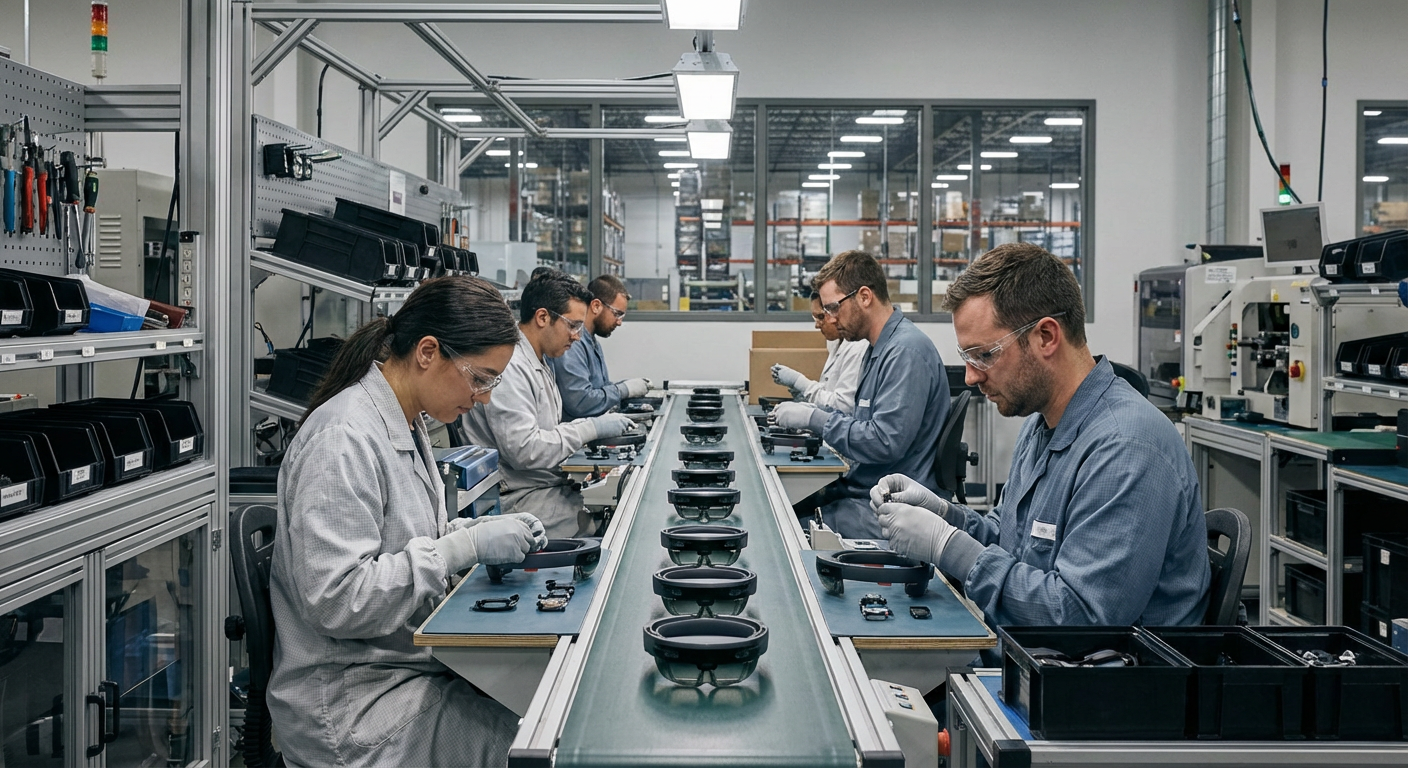
The profitability bottleneck stems directly from hardware complexity. Unlike standard AI glasses with a bill of materials (BOM) around US$150, binocular AR glasses incur hardware costs ranging from US$400 to US$1,000. XREAL has heavily subsidized its supply chain, utilizing previous funding to build proprietary AR optical module factories and develop edge co-processors. Consequently, the company recorded a net loss of RMB 456 million (US$66.08 million) in 2025, with adjusted net losses at RMB 250 million (US$36.23 million).
To mitigate losses, XREAL has pivoted toward a premium product strategy. Its flagship One series, priced near RMB 4,000 (US$579), accounted for 110,000 of the 133,700 total units shipped in 2025, proving that a high-ticket, immersive spatial entertainment approach can generate concentrated revenue, albeit within a niche demographic.
Aggressive Cost Cutting Anchors 2026 Product Strategy
Facing macroeconomic headwinds and aggressive capitalization from competitors like Viture—which secured a US$100 million Series C in February 2026—XREAL has systematically dismantled its high-burn marketing strategy. Sales and distribution expenses dropped sharply from RMB 210 million in 2023 to RMB 130 million in 2025. Simultaneously, gross margins improved from 18.8% to 35.2% over the same period, driving the operating expense ratio down from 137.6% to 82.7%.
However, R&D remains an immovable cost center, consuming RMB 183 million (US$26.52 million) in 2025 alone. This sustained investment is heavily tied to the company's 2026 product roadmap, which aims to break the industry's "impossible triangle" of maintaining a lightweight body, long battery life, and immersive display.
Looking ahead, XREAL's market viability hinges on strategic ecosystem partnerships. The 2026 lineup includes the ROG XREAL R1 tailored for gamers, a mass-market Project Helen, and notably, Project Aura—a next-generation flagship co-developed with Google based on the Android XR platform. Scheduled for late 2026, the Google collaboration represents XREAL's most significant bid to transition from a niche hardware vendor to a mainstream spatial computing platform, provided the IPO secures the runway needed to execute the launch.