
Baidu Robotaxi Halt Highlights Global Safety Standards Amid Scale Up
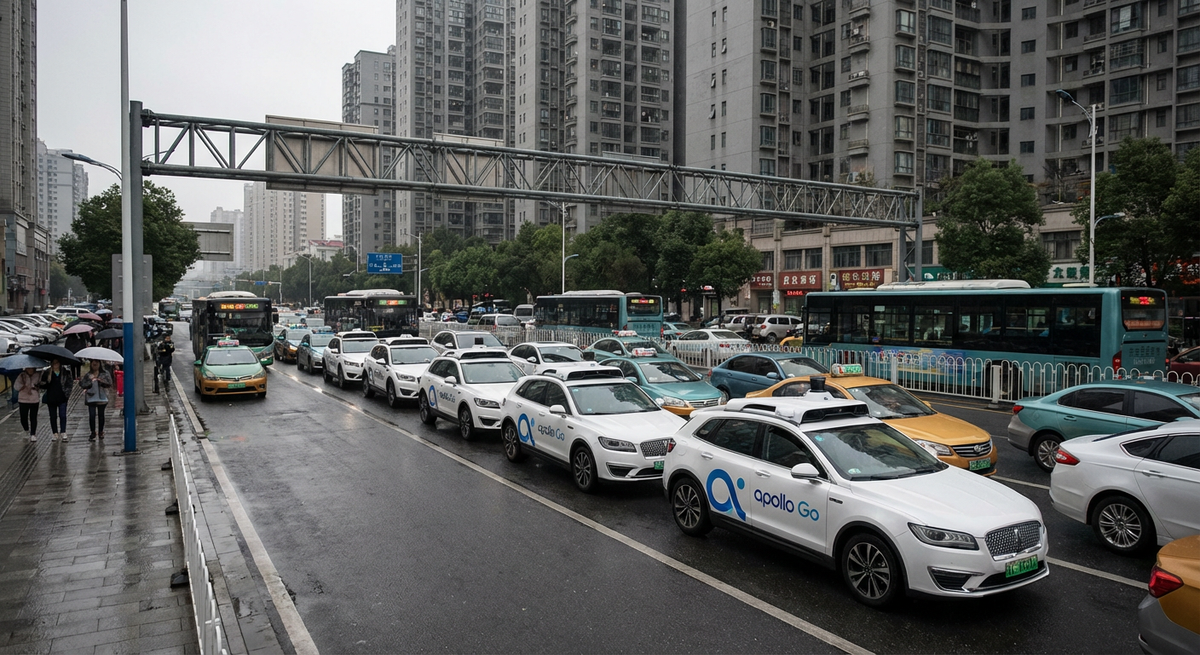
A sudden fleet-wide stall of Apollo Go autonomous vehicles in Wuhan exposes the rigid safety redundancies governing the robotaxi industry as it transitions from technological validation to commercial profitability in 2026.
The March 31 incident, which temporarily disrupted local traffic without causing injuries, triggered what engineers define as a Minimal Risk Condition (MRC). Local transport authorities quickly cleared the gridlock, but the event immediately drew scrutiny from investors assessing the operational resilience and safety logic of Level 4 autonomous driving networks.
Rather than a system failure, industry analysts identify the synchronized stop as a deliberate algorithmic safeguard. Under the ISO23793-1:2024 international standard, autonomous vehicles encountering perception anomalies or environmental uncertainties must execute longitudinal deceleration, prioritizing absolute safety over operational continuity.
Executing Safety Redundancies Across Fleets
Autonomous architecture relies on a tri-layered redundancy across perception, decision-making, and execution. When primary computing units encounter conflicting sensor data or sudden environmental shifts, the system defaults to its baseline code to halt the vehicle. This mirrors the fail-safe mechanisms utilized in commercial aviation autopilots for decades.
This rigid protocol aligns with global regulatory expectations. In December 2025, Alphabet Inc.'s Waymo experienced a similar mass-halt in San Francisco following a citywide power outage that disabled traffic lights. Unable to verify intersection safety within standard timeframes, the Waymo fleet triggered identical MRC protocols, a baseline requirement enforced by the California Department of Motor Vehicles (DMV).
Validating Commercial Viability Amid Urban Hurdles
The Wuhan incident occurs precisely as autonomous operators report shifting unit economics. With multiple firms achieving single-quarter profitability and positive per-vehicle margins this year, the market is aggressively targeting a valuation projected to surpass US$1 trillion within the decade.
Zhu Keli, Dean of the New Economy Research Institute at the China Information Industry Association, noted that this conservative exit strategy is essential for the sector's long-term deployment. "The strict adherence to a 'safety first' logic, while presenting as an operational anomaly, is foundational for public acceptance," Zhu stated.
As dual markets in the US and China push toward Artificial General Intelligence (AGI) through physical-world data collection, localized operational pauses serve as quantifiable stress tests. These events validate that commercial algorithms consistently prioritize loss prevention and risk mitigation over dispatch efficiency.