
Alibaba Earnings Outlook: AI and Cloud Growth in Focus as Profits Face Short-Term Squeeze
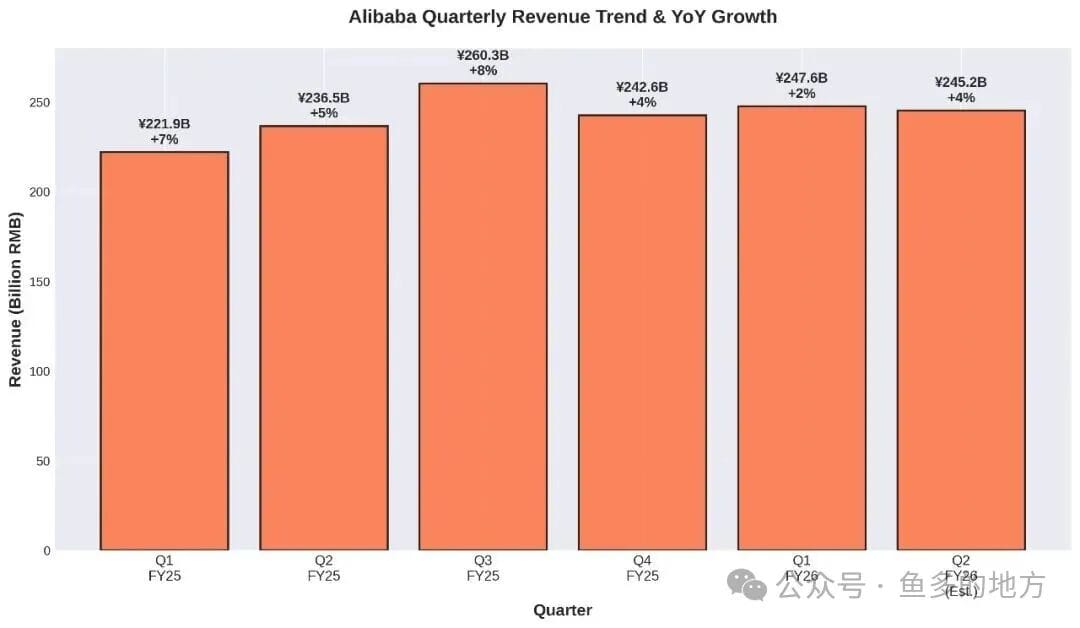
Alibaba Group is set to release its fiscal second-quarter earnings on Nov. 25, with investor attention pivoting from traditional e-commerce metrics to the company’s aggressive expansion in artificial intelligence and cloud computing. While headline profit is expected to contract due to heavy infrastructure spending, the market is looking for validation that the tech giant's strategic transition is delivering tangible growth.
Analysts surveyed by Bloomberg forecast revenue of RMB 245.16 billion (US$33.8 billion) for the quarter ending September 2025, representing a 4% year-on-year increase. This marks a slight acceleration from the 2% growth recorded in the previous quarter, signaling stability in the top line. However, the focal point remains the cloud division, where growth is anticipated to outpace the broader business significantly as AI demand surges.
Profitability faces near-term headwinds as the company executes its capital-intensive pivot. Bloomberg consensus estimates predict adjusted net income will fall 63% to RMB 13.47 billion (US 1.86 billion), with earnings per share projected to drop 90%. This decline reflects a dual investment strategy: peaked spending in the instant retail sector and a massive, sustained capital expenditure cycle dedicated to cloud and AI infrastructure.
The earnings release serves as a critical test for Alibaba’s year-to-date stock rally of 79%, which has significantly outperformed the S&P 500. Investors are awaiting confirmation that the "E-commerce + Cloud + AI" multi-engine strategy is gaining traction, particularly whether the cloud unit can sustain a growth trajectory that rivals global peers.
AI Momentum and Cloud resurgence
The Cloud Intelligence Group is expected to be the standout performer in the upcoming report. JPMorgan forecasts cloud revenue growth to accelerate to 30%, while Guosen Securities estimates revenue will reach RMB 38.5 billion (US$5.3 billion). This follows a 26% increase in the previous quarter, suggesting the unit is rapidly entering a high-growth phase driven by the proliferation of AI applications.
Alibaba’s proprietary Qwen large language models have spurred distinct ecosystem growth, with over 90,000 derivative models now hosted on Hugging Face. This activity is converting directly into demand for computing power. Guosen Securities notes that Alibaba Cloud currently holds a 35.8% share of China's AI cloud market, maintaining a lead over competitors such as Huawei and Tencent.
Management has committed to investing RMB 380 billion (US$52.4 billion) in AI and cloud infrastructure over the next three years—a figure exceeding the total investment of the past decade. If the projected 30% growth is realized, Alibaba’s cloud expansion would rank globally competitive, comparable to growth rates seen at Alphabet Inc.’s Google Cloud and Microsoft's Azure.
E-Commerce Resilience and Profit Margins
While cloud offers high growth potential, the Taobao and Tmall Group remains the company's financial bedrock, expected to contribute RMB 115.5 billion (US$15.9 billion) or 47.1% of total revenue. Customer management revenue (CMR), a key indicator of merchant advertising sentiment, is projected by JPMorgan to grow by more than 10%, indicating resilience despite intense competition from rivals like PDD and Douyin.
Profit margins, however, are under pressure from strategic spending. The sharp decline in projected net income is attributed to the peak investment period for the instant retail business, which Guosen Securities suggests hit its high point in the second quarter. Additionally, the aggressive scaling of global digital commerce is expected to drive revenue growth of 28.5% for the International Digital Commerce Group (AIDC), according to Haitong International, further prioritizing market share over immediate profitability.
Valuation and Market Sentiment
Investor sentiment has warmed significantly in 2025, with Alibaba’s stock rising from 89.50 to 160 year-to-date. At approximately 20 times adjusted earnings, analysts view the valuation as reasonable relative to historical averages and peers.
Wall Street remains largely bullish heading into the print. Of 32 analysts covering the stock, the average price target stands at 198.43, implying potential upside of roughly 240 for the U.S.-listed shares, citing the potential for the cloud business to become a second primary growth curve within two to three years.
Key Metrics to Watch
The market’s reaction will likely hinge on specific forward-looking indicators rather than the headline earnings miss. Key areas of focus include:
- Cloud & AI Velocity: Whether cloud revenue growth hits or exceeds the 30% mark, and the specific contribution of AI-related products, which have seen triple-digit growth for eight consecutive quarters.
- Investment Guidance: Management’s commentary on the path to AI monetization and whether the heavy capex cycle is yielding clear returns.
- Margin Recovery Trends: Trends in adjusted EBITA, particularly whether losses in instant retail are narrowing as projected for the third quarter.
- Core Commerce Health: Any deceleration in CMR growth below 10% could reignite concerns over market share erosion in the domestic e-commerce sector.