
Alibaba Unveils Qwen3.5 AI Model With Native Multimodal Capabilities and Enhanced Agent Functions
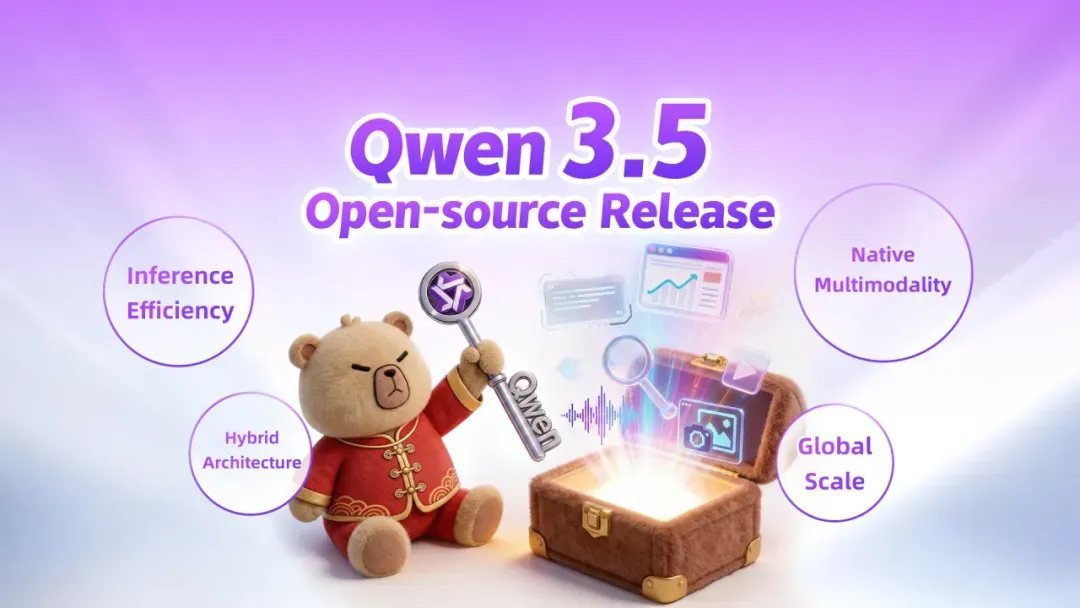
Alibaba has launched Qwen3.5, a new generation of large language models featuring breakthrough architecture that activates only 17 billion parameters from a total of 397 billion, delivering performance comparable to trillion-parameter models while significantly reducing deployment costs and boosting inference efficiency up to 19-fold. The open-source release of Qwen3.5-Plus marks a strategic shift toward native multimodal intelligence and autonomous agent capabilities, positioning the model as a foundational tool for enterprise applications and developer ecosystems.
The model introduces a hybrid architecture combining linear attention mechanisms with sparse mixture-of-experts (MoE) design, achieving what Alibaba describes as superior performance with 40% fewer parameters than its predecessor Qwen3-Max. Deployment memory requirements have dropped 60%, while API pricing stands at just 0.8 yuan per million tokens ($0.11), making advanced AI capabilities more accessible to businesses and developers globally.
Qwen3.5 represents a generational leap from text-only models to native multimodal training, pre-trained on mixed vision and text tokens rather than pure text. The model supports 201 languages and dialects, expanded from 119 in Qwen3, and features a 250,000-token vocabulary that improves encoding efficiency for smaller languages by up to 60%. The Qwen app and desktop platforms have integrated Qwen3.5-Plus, while developers can access the model through ModelScope, HuggingFace, or directly via Alibaba Cloud's Bailian API services.
Architectural Innovation Drives Efficiency Gains
Qwen3.5's performance improvements stem from fundamental innovations to the Transformer architecture. The development team incorporated gating technology research that won Best Paper at the 2025 NeurIPS conference, integrating these advances into a hybrid architecture that combines linear attention with sparse MoE models. This design enables the Qwen3.5-397B-A17B variant to activate merely 17 billion parameters from its 397 billion total, achieving performance parity with Qwen3-Max while dramatically enhancing inference efficiency.
In standard 32K context scenarios, Qwen3.5 delivers 8.6 times higher inference throughput compared to its predecessor. For ultra-long 256K context applications, maximum throughput increases reach 19-fold, substantially reducing operational costs for enterprises processing large-scale workloads. The model maintains competitive performance across reasoning, coding, and agent benchmarks, scoring 87.8 on MMLU-Pro cognitive assessments—surpassing certain configurations of competing models—and achieving 88.4 on the doctoral-level GPQA evaluation.
Training stability optimizations and multi-token prediction techniques further enhance model efficiency. Alibaba's AI infrastructure enabled native multimodal training with throughput approaching 100% of pure text model training when processing mixed text, image, and video data. Through strategic application of FP8 and FP32 precision, activation memory decreased approximately 50% while training speed improved over 10%, even as training scaled to tens of trillions of tokens.
Native Multimodal Capabilities Transform Visual Understanding
Unlike previous Qwen language models, Qwen3.5 achieves native multimodal integration by pre-training on mixed visual and text tokens rather than bolting vision capabilities onto a text-only foundation. This architectural choice enables more natural understanding of relationships between images, videos, and text, with substantial increases in Chinese, English, multilingual, STEM, and reasoning training data.
The model demonstrates marked improvements across visual benchmarks, including multimodal reasoning (MathVision), general visual question answering (RealWorldQA), text recognition and document understanding (CC_OCR), spatial intelligence (RefCOCO-avg), and video comprehension (MLVU). In spatial positioning and image-based reasoning tasks, Qwen3.5 outperforms the specialized Qwen3-VL model, delivering more precise and detailed analysis.
Video understanding capabilities extend to processing up to two hours of content within the model's 1 million token context window, suitable for long-form video analysis and summarization. The native fusion of visual understanding with coding abilities enables practical applications such as converting hand-drawn interface sketches into functional frontend code or identifying and fixing UI issues from screenshots alone, transforming visual programming into a production-ready tool for developers and designers.
Agent Architecture Scales to Million-Level Deployments
Qwen3.5 advances from agent frameworks to practical agent applications through enhanced visual capabilities and infrastructure improvements. The model autonomously operates mobile devices and computers to complete routine tasks, supporting mainstream applications on mobile platforms and handling complex multi-step operations on desktop systems, including cross-application data organization and automated workflow execution.
Alibaba's development team constructed a scalable asynchronous reinforcement learning framework that achieves 3-to-5-fold end-to-end acceleration and extends plugin-based agent support to million-scale deployments. This infrastructure emphasizes training environment difficulty and generalizability rather than optimization for narrow query categories or specific metrics. Performance improvements scale with RL environment expansion across benchmarks including BFCL-V4, VITA-Bench, DeepPlanning, Tool-Decathlon, and MCP-Mark.
The AI shopping agent launched in the Qwen app on January 15 demonstrated real-world commercial viability by processing 120 million orders over six days during the Spring Festival period, marking the first large-scale implementation of consumer-grade AI task execution. The significantly enhanced agent capabilities in Qwen3.5 expand possibilities for autonomous task completion across work and personal life scenarios, moving beyond single-task assistance toward persistent, context-aware support systems.
Global Open-Source Leadership and Developer Adoption
Since launching its open-source initiative in 2023, Alibaba has released over 400 Qwen models spanning all sizes and modalities, accumulating more than 1 billion global downloads. Monthly download volumes exceed the combined totals of DeepSeek, Meta, OpenAI, Zhipu, Kimi, and MiniMax, establishing Qwen as the world's leading open-source model ecosystem. Developers have created over 200,000 derivative models based on Qwen, reflecting its status as the most developer-friendly open-source large language model.
The expanded 201-language support and 250,000-token vocabulary address diverse international developer and enterprise requirements, with encoding efficiency improvements of approximately 10-60% for most languages. Additional Qwen3.5 series models of varying sizes and capabilities will be released progressively, with a more powerful flagship Qwen3.5-Max model scheduled for future launch.
Alibaba Cloud's Bailian platform enables developers to access Qwen3.5-Plus through OpenAI-compatible APIs, with parameters for enabling reasoning mode, internet search, and code interpreter functions. The model integrates seamlessly with third-party development tools including Qwen Code, Claude Code, Cline, OpenClaw, and OpenCode, providing streamlined coding experiences. The decoupled training-inference architecture, combined with FP8 optimization, speculative sampling, and multi-round rollout locking, enhances system throughput and training-inference consistency while supporting stable, seamless multi-turn environment interactions for native agent workflows.